
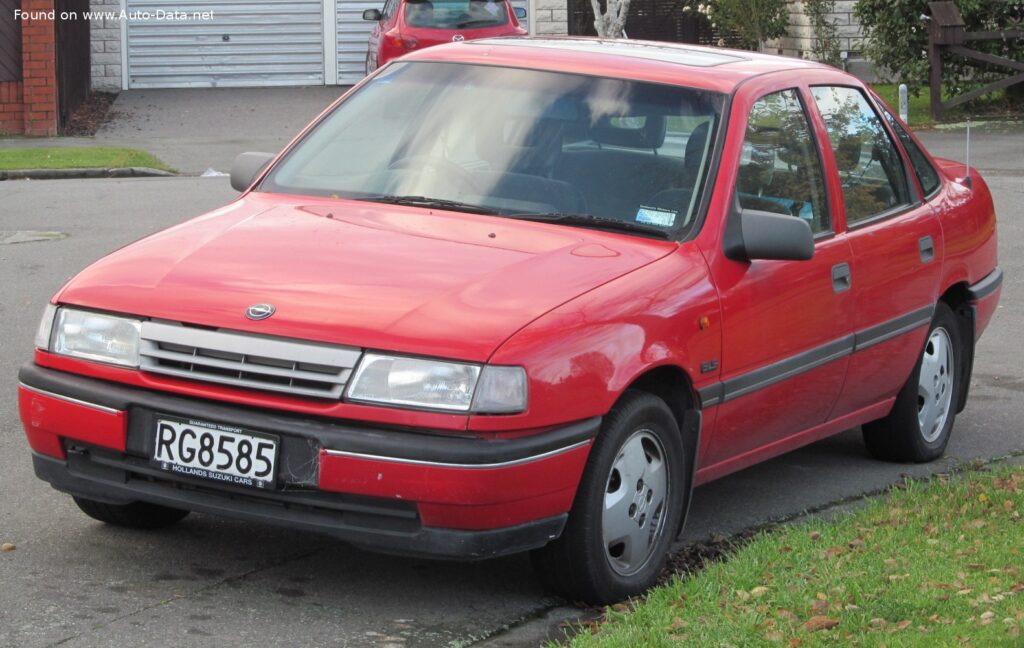
The Opel Vectra A, launched in 1988, represented a pivotal moment for the German manufacturer in the highly competitive European mid-size family car market. Replacing the long-serving Ascona, the Vectra A (sold as the Vauxhall Cavalier in the United Kingdom) introduced a new design language emphasizing aerodynamics, enhanced safety features, and updated powertrains. The 2.0i (115 Hp) Automatic variant, produced from 1988 to 1989, proved popular with buyers seeking a balance of reliable performance, comfort, and the ease of an automatic transmission. While never officially offered for sale in the United States, the Vectra A’s design and technological advancements reflected broader trends in global automotive engineering, providing a window into the European automotive landscape of the late 1980s.
The Opel Vectra A 2.0i: A European Family Sedan
The Vectra A was more than just a replacement for the Ascona; it was a deliberate step towards modernizing Opel’s image and appealing to a more discerning customer base. The car’s design, penned under the direction of Hideo Komuro, formerly of Nissan, was a significant departure from the boxier aesthetics of its predecessor. This focus on aerodynamics wasn’t merely cosmetic; it contributed to improved fuel efficiency and reduced wind noise. The Vectra A’s success in Europe solidified Opel’s position as a major player in the family car segment, competing directly with models from Ford, Volkswagen, and Renault. It established a foundation for future Vectra generations, which would continue to evolve and refine the formula of practicality, comfort, and performance.
Engine & Performance: The 20NE Powertrain
The heart of the Opel Vectra A 2.0i Automatic is a 2.0-liter (1998 cm3 or 121.93 cubic inches) naturally aspirated inline-four cylinder engine, internally designated as the 20NE. This engine was mounted transversely in the front of the vehicle, driving the front wheels – a configuration increasingly common in family cars of the era for its efficiency and packaging benefits. The engine employed a single overhead camshaft (SOHC) valvetrain with two valves per cylinder, a design known for its simplicity, durability, and relatively low manufacturing cost. Fuel delivery was managed by a multi-port fuel injection system, a significant upgrade over older carburetor designs, resulting in improved fuel atomization, more precise fuel metering, and enhanced engine responsiveness.
The 20NE engine produced 115 horsepower (Hp) at 5200 revolutions per minute (rpm), equating to approximately 57.6 Hp per liter. Peak torque output was 170 Newton-meters (Nm), or 125.39 lb.-ft., available at 2600 rpm. This relatively low peak torque rpm contributed to good drivability in everyday traffic conditions, particularly when coupled with the automatic transmission. The engine’s oil capacity was 4 liters (4.23 US quarts), and the cooling system required 7 liters (7.4 US quarts) of coolant, indicating a robust thermal management system designed for sustained operation. The engine’s design prioritized reliability and ease of maintenance, reflecting Opel’s commitment to providing a practical and dependable vehicle.
Driving Dynamics and Transmission
Power from the 2.0i engine was transferred to the front wheels through a 4-speed automatic transmission. While modern automatic transmissions offer a greater number of gears for improved fuel economy and performance, a 4-speed unit was considered standard for a mid-range family car in 1988, providing a smooth and convenient driving experience. Acceleration from 0 to 60 mph was estimated at 11.4 seconds (0-62 mph in 12 seconds), with a top speed of 130.49 mph (210 km/h). These figures were competitive within the segment, offering adequate performance for highway cruising and overtaking maneuvers.
Fuel economy was a key consideration for European buyers, and the Vectra A 2.0i Automatic delivered respectable figures. Combined fuel consumption was rated at 31.4 US mpg (7.5 l/100 km). City driving yielded approximately 21.8 US mpg (10.8 l/100 km), while highway driving improved to 39.2 US mpg (6 l/100 km). These numbers were commendable for a 2.0-liter sedan equipped with an automatic transmission in the late 1980s, demonstrating Opel’s focus on engine efficiency. The vehicle’s weight-to-power ratio was 9.8, indicating a reasonable balance between performance and efficiency.
Design & Features: A Modern Family Car
The Opel Vectra A’s exterior design was a significant departure from the more angular styling of the Ascona. The car featured a sleek, aerodynamic profile with a sloping hood, integrated headlights, and a relatively low drag coefficient. This design not only improved fuel efficiency but also gave the Vectra A a more modern and sophisticated appearance. The body was available in several configurations, including a four-door sedan and a five-door hatchback (the Caravan estate/wagon was also available).
Inside, the Vectra A offered a comfortable and practical cabin. The interior design was functional and focused on providing a pleasant driving experience. Features included comfortable seating, a well-laid-out dashboard, and ample storage space. Safety features, while not as comprehensive as those found in modern vehicles, were improved compared to the Ascona. These included a reinforced safety cage, side impact protection, and available anti-lock braking system (ABS) on higher trim levels. The Vectra A represented a significant step forward in terms of both design and features, solidifying its position as a competitive offering in the European mid-size family car segment.
Technical Specifications
| Engine Type | 2.0-liter Inline-Four (20NE) |
| Displacement | 1998 cm3 (121.93 cu in) |
| Horsepower | 115 Hp @ 5200 rpm |
| Torque | 170 Nm (125.39 lb-ft) @ 2600 rpm |
| Compression Ratio | 9.2:1 |
| Fuel System | Multi-Port Fuel Injection |
| Transmission | 4-Speed Automatic |
| Drivetrain | Front-Wheel Drive |
| 0-60 mph | 11.4 seconds (estimated) |
| Top Speed | 130.49 mph (210 km/h) |
| Combined Fuel Economy | 31.4 US mpg (7.5 l/100 km) |
| Urban Fuel Economy | 21.8 US mpg (10.8 l/100 km) |
| Extra-Urban Fuel Economy | 39.2 US mpg (6 l/100 km) |
| Oil Capacity | 4 liters (4.23 US quarts) |
| Coolant Capacity | 7 liters (7.4 US quarts) |
| Weight-to-Power Ratio | 9.8 |
