
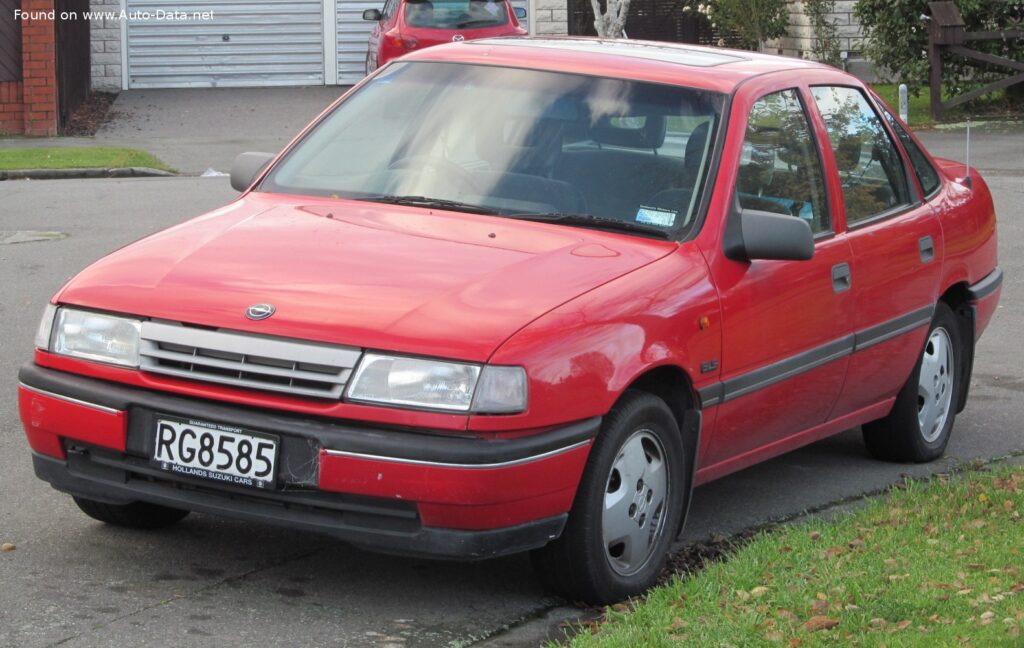
The Opel Vectra A 2.0i 16V CAT (150 Hp) represents a significant step forward for Opel in the mid-size family car segment. Produced between 1990 and 1992, the Vectra A was designed to replace the aging Ascona and Manta models, offering a more modern and refined driving experience. While not officially sold in the United States, the Vectra A was a popular choice in Europe, known for its blend of practicality, performance, and relatively advanced technology for its time. It served as a key model in Opel’s lineup, establishing a foundation for subsequent Vectra generations and solidifying the brand’s presence in the competitive European market.
Opel Vectra A: A Detailed Overview
The Vectra A marked a departure from Opel’s traditionally boxy designs, adopting a more aerodynamic and contemporary aesthetic. It was available in several body styles, including a four-door sedan (the focus of this article), a five-door hatchback, and a station wagon (estate) variant. The 2.0i 16V CAT model, equipped with a 2.0-liter inline-four engine, was positioned as a performance-oriented option within the Vectra A range, appealing to drivers seeking a balance between fuel efficiency and spirited driving.
Engine & Performance
At the heart of the Vectra A 2.0i 16V CAT lies the C20XE engine, a 1998 cc (121.93 cu. in.) naturally aspirated inline-four cylinder powerplant. This engine, a hallmark of Opel engineering in the early 1990s, produced 150 horsepower at 6000 rpm and 196 Nm (144.56 lb.-ft.) of torque at 4600 rpm. The engine featured multi-port fuel injection and a double overhead camshaft (DOHC) valvetrain, contributing to its responsive performance and relatively high power output for its displacement – boasting 75.1 horsepower per liter.
Power is delivered to the front wheels via a five-speed manual transmission. This configuration allowed for a 0-60 mph (0-96 km/h) acceleration time of approximately 8.1 seconds, and a 0-62 mph (0-100 km/h) time of 8.5 seconds. The car achieved a maximum speed of 217 km/h (134.84 mph). Fuel consumption was rated at 7.2 liters per 100 kilometers (32.7 US mpg, 39.2 UK mpg), a respectable figure for a vehicle of this performance class in the early 1990s.
Design & Features
The Opel Vectra A 2.0i 16V CAT is a four-door sedan designed to comfortably accommodate five passengers. Its body dimensions are 4432 mm (174.49 in) in length, 1706 mm (67.17 in) in width, and 1400 mm (55.12 in) in height, with a wheelbase of 2600 mm (102.36 in). The car’s drag coefficient of 0.29 was considered relatively aerodynamic for its era, contributing to improved fuel efficiency and stability at higher speeds.
While safety features were less comprehensive than those found in modern vehicles, the Vectra A incorporated essential safety elements for the early 1990s, including a robust chassis construction and available anti-lock braking system (ABS) on some trims. Interior features focused on providing a comfortable and practical environment for both driver and passengers. The trunk offered a generous 530 liters (18.72 cu. ft.) of space, expandable to 840 liters (29.66 cu. ft.) with the rear seats folded down. The fuel tank capacity is 61 liters (16.11 US gal, 13.42 UK gal). The car’s design prioritized functionality and durability, reflecting the needs of European families and commuters.
Technical Specifications
| Brand | Opel |
| Model | Vectra |
| Generation | Vectra A |
| Type (Engine) | 2.0i 16V CAT (150 Hp) |
| Start of production | 1990 |
| End of production | 1992 |
| Powertrain Architecture | Internal Combustion engine |
| Body type | Sedan |
| Seats | 5 |
| Doors | 4 |
| Fuel consumption (combined) | 7.2 l/100 km |
| Fuel consumption (US mpg) | 32.7 US mpg |
| Fuel consumption (UK mpg) | 39.2 UK mpg |
| Fuel consumption (km/l) | 13.9 km/l |
| Fuel Type | Petrol (Gasoline) |
| Acceleration 0 – 100 km/h | 8.5 sec |
| Acceleration 0 – 62 mph | 8.5 sec |
| Acceleration 0 – 60 mph | 8.1 sec |
| Maximum speed | 217 km/h (134.84 mph) |
| Power | 150 Hp @ 6000 rpm |
| Power per litre | 75.1 Hp/l |
| Torque | 196 Nm @ 4600 rpm (144.56 lb.-ft. @ 4600 rpm) |
| Engine layout | Front, Transverse |
| Engine Model/Code | C20XE |
| Engine displacement | 1998 cm3 (121.93 cu. in.) |
| Number of cylinders | 4 |
| Engine configuration | Inline |
| Cylinder Bore | 86 mm (3.39 in.) |
| Piston Stroke | 86 mm (3.39 in.) |
| Compression ratio | 10.5:1 |
| Number of valves per cylinder | 4 |
| Fuel injection system | Multi-port manifold injection |
| Engine aspiration | Naturally aspirated engine |
| Valvetrain | DOHC |
| Engine oil capacity | 4.5 l (4.76 US qt | 3.96 UK qt) |
| Coolant | 7.2 l (7.61 US qt | 6.34 UK qt) |
| Max. weight | 1805 kg (3979.34 lbs.) |
| Trunk (boot) space – minimum | 530 l (18.72 cu. ft.) |
| Trunk (boot) space – maximum | 840 l (29.66 cu. ft.) |
| Fuel tank capacity | 61 l (16.11 US gal | 13.42 UK gal) |
| Length | 4432 mm (174.49 in.) |
| Width | 1706 mm (67.17 in.) |
| Height | 1400 mm (55.12 in.) |
| Wheelbase | 2600 mm (102.36 in.) |
| Front track | 1420 mm (55.91 in.) |
| Rear (Back) track | 1423 mm (56.02 in.) |
| Drag coefficient (Cd) | 0.29 |
| Drivetrain Architecture | ICE drives front wheels |
| Drive wheel | Front wheel drive |
| Number of gears and type of gearbox | 5 gears, manual transmission |
| Tires size | 195/60 R15 |
| Wheel rims size | 15 |
The Opel Vectra A 2.0i 16V CAT, while not a performance icon, represented a well-rounded and capable family car for its time. Its combination of a responsive engine, practical design, and reasonable fuel economy made it a popular choice among European drivers, and a significant step forward for Opel in the competitive mid-size segment.
