
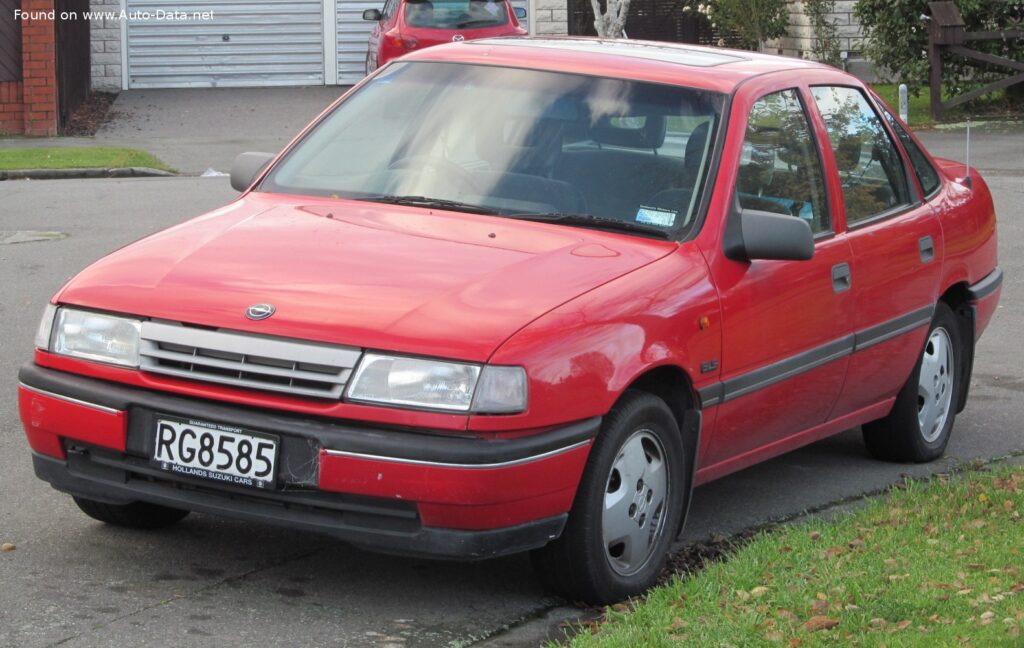
The Opel Vectra A 2.0i CAT (115 Hp) 4×4, produced between 1988 and 1992, represents a significant step forward for Opel in the mid-size family car segment. Replacing the aging Ascona and Manta models, the Vectra A aimed to offer a more modern, spacious, and technologically advanced package. While not officially sold in the United States, the Vectra was a popular choice in Europe, competing with vehicles like the Ford Mondeo, Volkswagen Passat, and Peugeot 405. The “CAT” designation refers to the catalytic converter, indicating an effort to meet increasingly stringent European emissions standards. The 4×4 variant, though less common, provided enhanced traction and stability, particularly appealing in regions with inclement weather.
Opel Vectra A: A European Family Sedan
The Vectra A marked a departure from Opel’s traditionally conservative styling. It featured a more aerodynamic and contemporary design, reflecting the influence of evolving automotive trends. The sedan body style was the most prevalent, offering a practical and comfortable option for families. The 2.0i CAT model, equipped with a 2.0-liter inline-four engine, provided a balance of performance and fuel efficiency. The inclusion of a four-wheel-drive system in this variant was relatively unusual for the time, setting it apart from many competitors and catering to drivers seeking all-weather capability.
Engine & Performance
The heart of the Vectra A 2.0i CAT 4×4 is its C20NE inline-four cylinder engine, displacing 1,998 cubic centimeters (121.93 cubic inches). This naturally aspirated engine produces 115 horsepower at 5,400 rpm and 170 Nm (125.39 lb.-ft.) of torque at 2,600 rpm. While not a high-performance engine by modern standards, it provided adequate power for comfortable cruising and everyday driving. The engine utilizes multi-port fuel injection and an overhead camshaft (OHC) valvetrain, contributing to its relatively smooth operation and reasonable fuel economy. The five-speed manual transmission allows for driver engagement and efficient power delivery. Acceleration from 0 to 100 km/h (0-62 mph) takes approximately 10.5 seconds, with a top speed of 198 km/h (123.03 mph). Fuel consumption is rated at 8.6 liters per 100 kilometers (27.4 US mpg), a respectable figure for a vehicle of its size and era.
Design & Features
The Opel Vectra A sedan is a four-door, five-seater vehicle characterized by its relatively boxy, yet aerodynamic, silhouette. The design prioritized practicality and interior space. The 4×4 variant features a more robust suspension system to accommodate the added weight and complexity of the all-wheel-drive drivetrain. Interior features, while not lavish, were focused on comfort and functionality. The dashboard layout was straightforward and easy to use, with clear instrumentation. Safety features for the time included seatbelts and a reinforced passenger safety cell. The trunk offered a generous 530 liters (18.72 cubic feet) of space, expandable to 840 liters (29.66 cubic feet) with the rear seats folded down. The Vectra A represented a significant improvement in interior space and comfort compared to its predecessors, making it a practical choice for families.
Technical Specifications
| Brand | Opel |
| Model | Vectra |
| Generation | Vectra A |
| Type (Engine) | 2.0i CAT (115 Hp) 4×4 |
| Start of production | 1988 |
| End of production | 1992 |
| Powertrain Architecture | Internal Combustion engine |
| Body type | Sedan |
| Seats | 5 |
| Doors | 4 |
| Fuel consumption (combined) | 8.6 l/100 km |
| Fuel consumption (US mpg) | 27.4 US mpg |
| Fuel consumption (UK mpg) | 32.8 UK mpg |
| Fuel consumption (km/l) | 11.6 km/l |
| Fuel Type | Petrol (Gasoline) |
| Acceleration 0 – 100 km/h | 10.5 sec |
| Acceleration 0 – 62 mph | 10.5 sec |
| Acceleration 0 – 60 mph | 10 sec |
| Maximum speed | 198 km/h |
| Maximum speed (mph) | 123.03 mph |
| Power | 115 Hp @ 5400 rpm |
| Power per litre | 57.6 Hp/l |
| Torque | 170 Nm @ 2600 rpm |
| Torque (lb.-ft.) | 125.39 lb.-ft. @ 2600 rpm |
| Engine layout | Front, Transverse |
| Engine Model/Code | C20NE |
| Engine displacement | 1998 cm3 |
| Engine displacement (cu. in.) | 121.93 cu. in. |
| Number of cylinders | 4 |
| Engine configuration | Inline |
| Cylinder Bore | 86 mm |
| Cylinder Bore (in.) | 3.39 in. |
| Piston Stroke | 86 mm |
| Piston Stroke (in.) | 3.39 in. |
| Compression ratio | 9.2:1 |
| Number of valves per cylinder | 2 |
| Fuel injection system | Multi-port manifold injection |
| Engine aspiration | Naturally aspirated engine |
| Valvetrain | OHC |
| Engine oil capacity | 4 l |
| Engine oil capacity (US qt) | 4.23 US qt |
| Engine oil capacity (UK qt) | 3.52 UK qt |
| Coolant | 7.2 l |
| Coolant (US qt) | 7.61 US qt |
| Coolant (UK qt) | 6.34 UK qt |
| Trunk (boot) space – minimum | 530 l |
| Trunk (boot) space – minimum (cu. ft.) | 18.72 cu. ft. |
| Trunk (boot) space – maximum | 840 l |
| Trunk (boot) space – maximum (cu. ft.) | 29.66 cu. ft. |
| Fuel tank capacity | 61 l |
| Fuel tank capacity (US gal) | 16.11 US gal |
| Fuel tank capacity (UK gal) | 13.42 UK gal |
| Length | 4432 mm |
| Length (in.) | 174.49 in. |
| Width | 1706 mm |
| Width (in.) | 67.17 in. |
| Height | 1400 mm |
| Height (in.) | 55.12 in. |
| Wheelbase | 2600 mm |
| Wheelbase (in.) | 102.36 in. |
| Front track | 1420 mm |
| Front track (in.) | 55.91 in. |
| Rear (Back) track | 1423 mm |
| Rear (Back) track (in.) | 56.02 in. |
| Drag coefficient (Cd) | 0.29 |
| Drive wheel | All wheel drive (4×4) |
| Number of gears | 5 |
| Type of gearbox | manual transmission |
The Opel Vectra A 2.0i CAT 4×4, while not a performance icon, represents a well-rounded and practical family car of its era. Its combination of a reasonably efficient engine, comfortable interior, and all-wheel-drive capability made it a popular choice for drivers in Europe seeking a reliable and versatile vehicle.
