
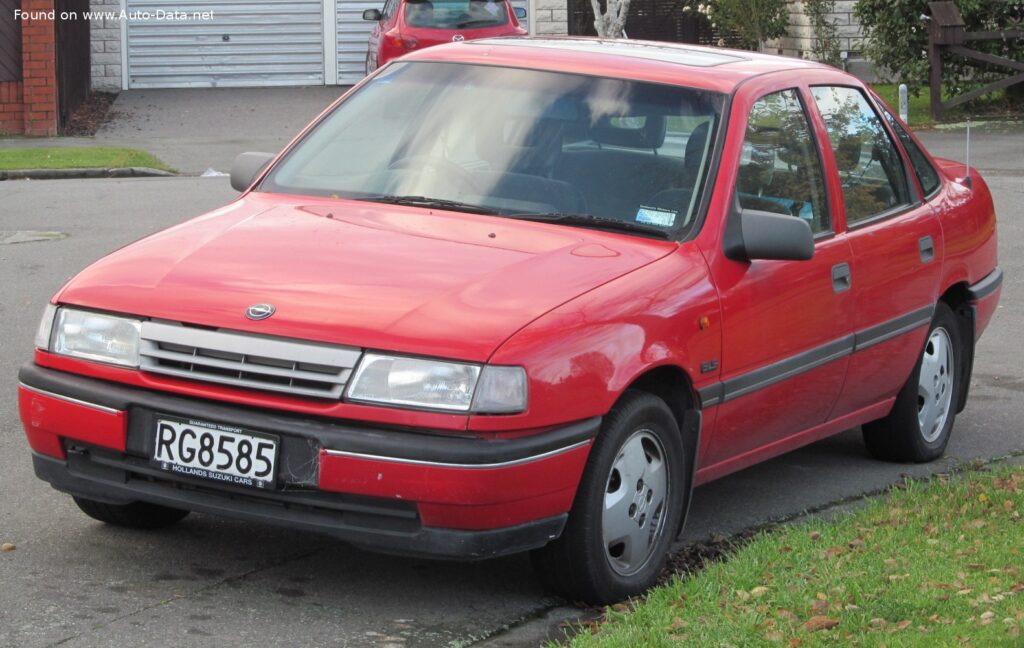
The Opel Vectra A 2.0i CAT (115 Hp) Automatic, produced between 1988 and 1992, represents a significant step forward for Opel in the mid-size family car segment. Replacing the aging Ascona and Manta models, the Vectra A aimed to offer a more modern, spacious, and technologically advanced package. While not officially sold in the United States, the Vectra was a popular choice in Europe, competing with vehicles like the Ford Mondeo, Volkswagen Passat, and Peugeot 405. This model, specifically the 2.0i CAT with automatic transmission, offered a balance of performance and convenience for buyers seeking a comfortable and reliable family sedan.
Opel Vectra A: A European Family Sedan
The Vectra A marked a departure from Opel’s previous designs, embracing a more aerodynamic and contemporary aesthetic. It was available in several body styles, including a four-door sedan (the focus of this article), a five-door hatchback, and a station wagon (estate). The “CAT” designation in the model name refers to the catalytic converter, indicating an effort to meet increasingly stringent European emissions standards. The automatic transmission option provided a more relaxed driving experience, appealing to a broader range of customers.
Engine & Performance
The heart of the Vectra A 2.0i CAT is its 1,998 cc (121.93 cu. in.) inline-four cylinder engine. This naturally aspirated engine, designated C20NE, produces 115 horsepower at 5,200 rpm and 170 Nm (125.39 lb.-ft.) of torque at 2,600 rpm. The engine utilizes multi-port fuel injection and an overhead camshaft (OHC) valvetrain, contributing to its relatively smooth operation and reasonable fuel efficiency for the era. Paired with a four-speed automatic transmission, the Vectra A 2.0i CAT achieves a 0-100 km/h (0-62 mph) acceleration time of 12 seconds and a top speed of 193 km/h (119.92 mph). While not a performance car, the powertrain provides adequate power for everyday driving and comfortable highway cruising. The weight-to-power ratio of 9.9 kg/Hp and a weight-to-torque ratio of 6.7 kg/Nm demonstrate a reasonable balance for a family sedan of its time. Fuel economy is rated at 7.5 l/100 km (31.4 US mpg) combined, and 10.5 l/100 km (22.4 US mpg) in urban conditions.
Design & Features
The Opel Vectra A sedan is a four-door, five-seater vehicle characterized by its relatively boxy, yet aerodynamic, silhouette. The design prioritized interior space and practicality. Key features included ventilated front disc brakes and disc brakes in the rear, providing adequate stopping power. The inclusion of an Anti-lock Braking System (ABS) was a notable safety feature for the time, enhancing braking performance and stability, particularly in adverse conditions. The steering system utilizes a hydraulic power steering rack and pinion, offering a responsive and comfortable driving experience. The interior was designed with practicality in mind, offering comfortable seating and a spacious trunk with a capacity ranging from 530 to 840 liters (18.72 to 29.66 cu. ft.) depending on the rear seat configuration. The vehicle rides on 195/60 R15 tires mounted on 15-inch wheel rims. The drag coefficient of 0.29 was considered respectable for a sedan of this era, contributing to improved fuel efficiency and reduced wind noise.
Technical Specifications
| Brand | Opel |
| Model | Vectra |
| Generation | Vectra A |
| Type (Engine) | 2.0i CAT (115 Hp) Automatic |
| Start of production | 1988 |
| End of production | 1992 |
| Powertrain Architecture | Internal Combustion engine |
| Body type | Sedan |
| Seats | 5 |
| Doors | 4 |
| Fuel consumption (urban) | 10.5 l/100 km (22.4 US mpg) |
| Fuel consumption (combined) | 7.5 l/100 km (31.4 US mpg) |
| Fuel Type | Petrol (Gasoline) |
| Acceleration 0 – 100 km/h | 12 sec |
| Acceleration 0 – 62 mph | 12 sec |
| Acceleration 0 – 60 mph | 11.4 sec |
| Maximum speed | 193 km/h (119.92 mph) |
| Weight-to-power ratio | 9.9 kg/Hp |
| Weight-to-torque ratio | 6.7 kg/Nm |
| Power | 115 Hp @ 5200 rpm |
| Torque | 170 Nm @ 2600 rpm (125.39 lb.-ft. @ 2600 rpm) |
| Engine layout | Front, Transverse |
| Engine Model/Code | C20NE |
| Engine displacement | 1998 cm3 (121.93 cu. in.) |
| Number of cylinders | 4 |
| Engine configuration | Inline |
| Cylinder Bore | 86 mm (3.39 in.) |
| Piston Stroke | 86 mm (3.39 in.) |
| Compression ratio | 10.8:1 |
| Number of valves per cylinder | 2 |
| Fuel injection system | Multi-port manifold injection |
| Engine aspiration | Naturally aspirated engine |
| Valvetrain | OHC |
| Engine oil capacity | 4 l (4.23 US qt | 3.52 UK qt) |
| Coolant capacity | 7 l (7.4 US qt | 6.16 UK qt) |
| Kerb Weight | 1144 kg (2522.09 lbs.) |
| Max. weight | 1670 kg (3681.72 lbs.) |
| Max load | 526 kg (1159.63 lbs.) |
| Trunk (boot) space – minimum | 530 l (18.72 cu. ft.) |
| Trunk (boot) space – maximum | 840 l (29.66 cu. ft.) |
| Fuel tank capacity | 61 l (16.11 US gal | 13.42 UK gal) |
| Length | 4432 mm (174.49 in.) |
| Width | 1706 mm (67.17 in.) |
| Height | 1400 mm (55.12 in.) |
| Wheelbase | 2600 mm (102.36 in.) |
| Front track | 1426 mm (56.14 in.) |
| Rear track | 1432 mm (56.38 in.) |
| Drag coefficient (Cd) | 0.29 |
| Drivetrain Architecture | ICE, Front wheel drive |
| Drive wheel | Front wheel drive |
| Number of gears | 4 |
| Gearbox type | Automatic transmission |
| Front suspension | Wishbone |
| Rear suspension | Coil spring |
| Front brakes | Ventilated discs |
| Rear brakes | Disc |
| Assisting systems | ABS (Anti-lock braking system) |
| Steering type | Steering rack and pinion |
| Power steering | Hydraulic Steering |
| Tires size | 195/60 R15 |
| Wheel rims size | 15 |
The Opel Vectra A 2.0i CAT Automatic, while not a groundbreaking vehicle in terms of innovation, represented a solid and reliable offering in the European mid-size car market. Its combination of practicality, comfort, and reasonable performance made it a popular choice for families and commuters alike. It laid the foundation for subsequent Vectra generations, which would continue to evolve and refine Opel’s presence in this competitive segment.
