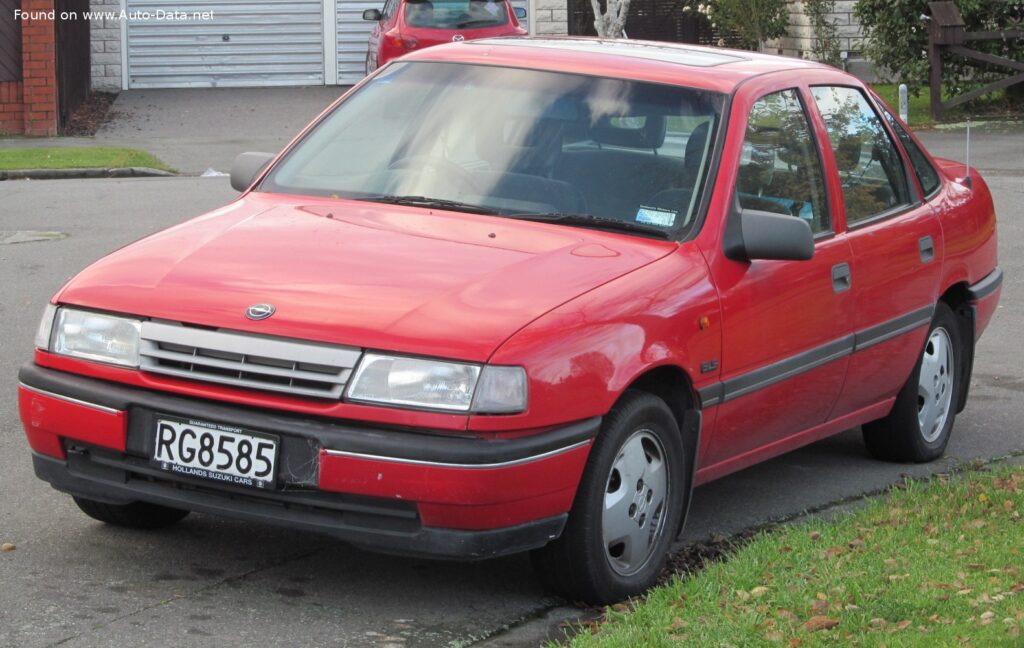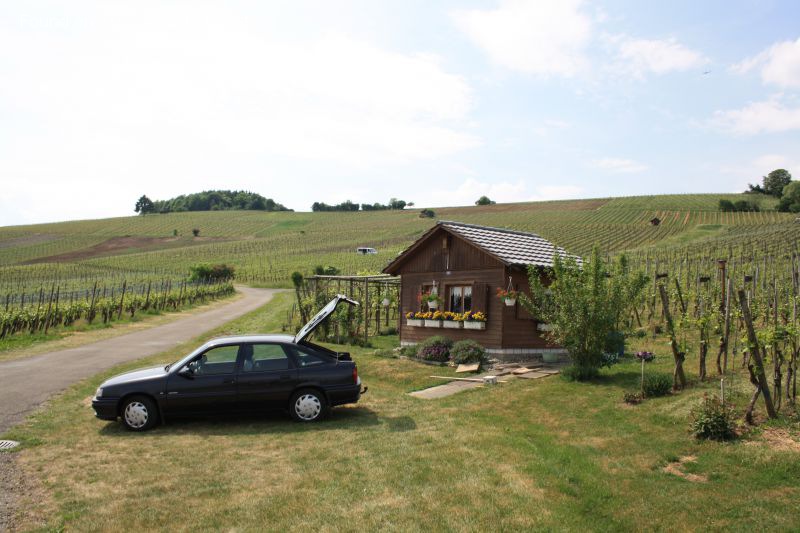
The Opel Vectra A CC (facelift 1992) 2.0i 16V 4×4 represents a significant evolution in Opel’s mid-size offerings. Introduced in August 1992 and produced until February 1994, this variant of the Vectra A, a compact/family car, aimed to provide a blend of performance, practicality, and all-weather capability. While the Vectra nameplate had existed previously, the ‘A’ generation marked a substantial redesign, and the facelifted version refined the aesthetics and mechanicals. The 2.0i 16V 4×4 model, with its 150 horsepower engine and all-wheel drive system, was positioned as a more premium and capable option within the Vectra range, primarily targeted at the European market.
Opel Vectra A CC (facelift 1992) 2.0i 16V 4×4: An Overview
The Vectra A was Opel’s replacement for the Ascona and Manta models, aiming to consolidate their offerings into a single, more modern package. The “CC” designation stands for “Coupé Cabriolet,” although it’s a hatchback – a marketing term used by Opel at the time to emphasize the sleek, rounded roofline. The 1992 facelift brought revised styling, including a new front grille, headlights, and interior updates. The 2.0i 16V 4×4 was a relatively rare and upscale trim level, offering a more engaging driving experience than the base models. It wasn’t officially sold in the United States, but it was a popular choice in Europe for drivers seeking a practical yet sporty vehicle.
Engine & Performance
The heart of the Vectra A CC 2.0i 16V 4×4 is the C20XE engine, a 2.0-liter (1998 cm3 or 121.93 cu. in.) inline-four cylinder powerplant. This engine, a product of Opel’s engineering prowess, features a dual overhead camshaft (DOHC) valvetrain with four valves per cylinder, and multi-port fuel injection. It produces 150 horsepower (Hp) at 6000 rpm and 196 Newton-meters (144.56 lb.-ft.) of torque at 4600 rpm. This translates to a power-to-weight ratio of 8.1 kg/Hp and a torque-to-weight ratio of 6.2 kg/Nm. The engine’s output provides brisk acceleration, with a 0-100 km/h (0-62 mph) time of 9.5 seconds and a top speed of 208 km/h (129.25 mph). The all-wheel drive system, while adding weight, enhances traction and stability, particularly in adverse weather conditions. The five-speed manual transmission allows for driver engagement and efficient power delivery.
Design & Features
The Vectra A CC is a five-door hatchback, offering a practical and versatile body style. Its rounded design, characteristic of early 1990s automotive aesthetics, aimed for aerodynamic efficiency. The facelifted model featured subtle but noticeable styling changes that modernized its appearance. Inside, the Vectra A offered seating for five passengers and a reasonably spacious interior for its class. The 4×4 model often included upgraded interior trim and features compared to the base versions. While safety features were less comprehensive than modern vehicles, the Vectra A did incorporate an Anti-lock Braking System (ABS) as an important safety feature. Hydraulic power steering was standard, providing ease of maneuverability. Trunk space is commendable, ranging from 460 liters (16.24 cu. ft.) with the rear seats up to 1290 liters (45.56 cu. ft.) with the seats folded down, making it a practical choice for families and those needing to transport larger items.
Technical Specifications
| Brand | Opel |
| Model | Vectra |
| Generation | Vectra A CC (facelift 1992) |
| Type (Engine) | 2.0i 16V (150 Hp) 4×4 |
| Start of production | August, 1992 |
| End of production | February, 1994 |
| Powertrain Architecture | Internal Combustion engine |
| Body type | Hatchback |
| Seats | 5 |
| Doors | 5 |
| Fuel consumption (combined) | 8.3 l/100 km |
| Fuel consumption (US mpg) | 28.3 US mpg |
| Fuel consumption (UK mpg) | 34 UK mpg |
| Fuel consumption (km/l) | 12 km/l |
| Fuel Type | Petrol (Gasoline) |
| Acceleration 0 – 100 km/h | 9.5 sec |
| Acceleration 0 – 62 mph | 9.5 sec |
| Acceleration 0 – 60 mph | 9 sec |
| Maximum speed | 208 km/h |
| Maximum speed (mph) | 129.25 mph |
| Weight-to-power ratio | 8.1 kg/Hp |
| Weight-to-torque ratio | 6.2 kg/Nm |
| Power | 150 Hp @ 6000 rpm |
| Power per litre | 75.1 Hp/l |
| Torque | 196 Nm @ 4600 rpm |
| Torque (lb.-ft.) | 144.56 lb.-ft. @ 4600 rpm |
| Engine layout | Front, Transverse |
| Engine Model/Code | C20XE |
| Engine displacement | 1998 cm3 |
| Engine displacement (cu. in.) | 121.93 cu. in. |
| Number of cylinders | 4 |
| Engine configuration | Inline |
| Cylinder Bore | 86 mm |
| Cylinder Bore (in.) | 3.39 in. |
| Piston Stroke | 86 mm |
| Piston Stroke (in.) | 3.39 in. |
| Compression ratio | 10.5:1 |
| Number of valves per cylinder | 4 |
| Fuel injection system | Multi-port manifold injection |
| Engine aspiration | Naturally aspirated engine |
| Valvetrain | DOHC |
| Engine oil capacity | 4.5 l |
| Engine oil capacity (US qt) | 4.76 US qt |
| Engine oil capacity (UK qt) | 3.96 UK qt |
| Coolant | 7.2 l |
| Coolant (US qt) | 7.61 US qt |
| Coolant (UK qt) | 6.34 UK qt |
| Kerb Weight | 1215 kg |
| Kerb Weight (lbs.) | 2678.62 lbs. |
| Max. weight | 1720 kg |
| Max. weight (lbs.) | 3791.95 lbs. |
| Max load | 505 kg |
| Max load (lbs.) | 1113.33 lbs. |
| Trunk (boot) space – minimum | 460 l |
| Trunk (boot) space – minimum (cu. ft.) | 16.24 cu. ft. |
| Trunk (boot) space – maximum | 1290 l |
| Trunk (boot) space – maximum (cu. ft.) | 45.56 cu. ft. |
| Fuel tank capacity | 61 l |
| Fuel tank capacity (US gal) | 16.11 US gal |
| Fuel tank capacity (UK gal) | 13.42 UK gal |
| Length | 4352 mm |
| Length (in.) | 171.34 in. |
| Width | 1706 mm |
| Width (in.) | 67.17 in. |
| Height | 1400 mm |
| Height (in.) | 55.12 in. |
| Wheelbase | 2600 mm |
| Wheelbase (in.) | 102.36 in. |
| Front track | 1420 mm |
| Front track (in.) | 55.91 in. |
| Rear (Back) track | 1423 mm |
| Rear (Back) track (in.) | 56.02 in. |
| Drive wheel | All wheel drive (4×4) |
| Number of gears and type of gearbox | 5 gears, manual transmission |
| Front suspension | Coil spring |
| Rear suspension | Coil spring |
| Front brakes | Ventilated discs |
| Rear brakes | Disc |
| Assisting systems | ABS (Anti-lock braking system) |
| Power steering | Hydraulic Steering |
| Tires size | 195/60 R15 |
| Wheel rims size | 15 |