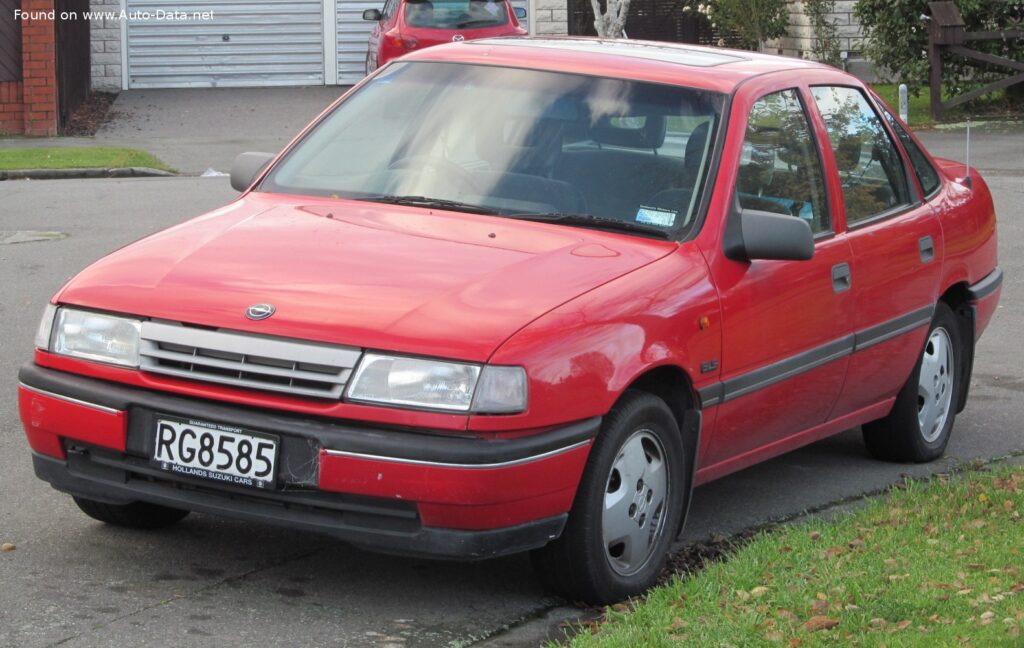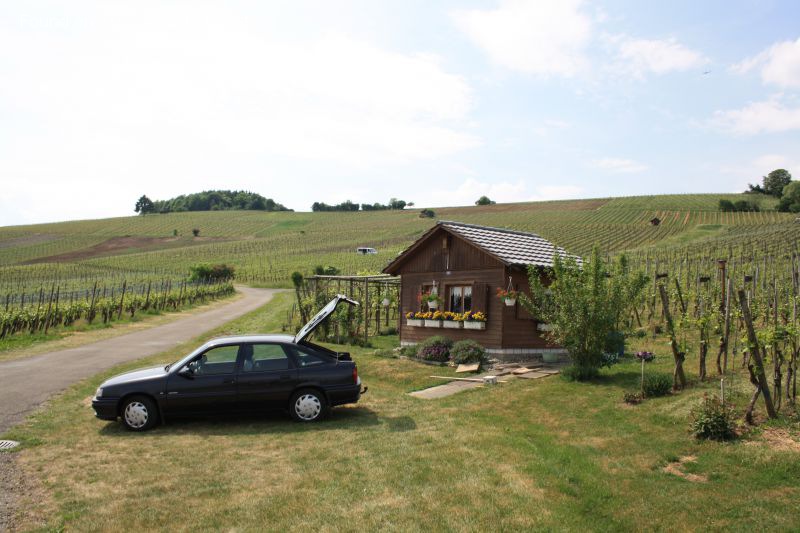
The Opel Vectra A CC (facelift 1992) 2.0i 16V Turbo 4×4 represents a significant evolution in Opel’s mid-size offerings. Produced from August 1993 to July 1994, this variant of the Vectra A, known internally as the “Caravan” (CC denoting the Combi or station wagon body style, though this specific model is a hatchback), aimed to blend practicality with performance. While the Vectra nameplate was well-established in Europe, it wasn’t officially sold in the United States. The Vectra A, and particularly this turbocharged, all-wheel-drive version, served as a competitor to models like the Ford Mondeo, Volkswagen Passat, and Peugeot 405 in the European market, offering a more dynamic driving experience than many of its rivals.
Opel Vectra A CC (Facelift 1992): A Performance-Oriented Family Car
The facelifted Vectra A, introduced in 1992, brought subtle but important styling updates and mechanical refinements. The 2.0i 16V Turbo 4×4 was a flagship model, showcasing Opel’s engineering capabilities. It targeted buyers who desired a spacious, comfortable family car but weren’t willing to compromise on performance. The all-wheel-drive system provided enhanced traction and stability, particularly valuable in varying weather conditions common across Europe. This model occupied a niche position, appealing to those seeking a more engaging drive than the standard Vectra variants.
Engine & Performance
At the heart of the Vectra A CC 2.0i 16V Turbo 4×4 lies the C20LET engine, a 2.0-liter inline-four cylinder powerplant. This engine is notable for its use of a turbocharger and a 16-valve double overhead camshaft (DOHC) configuration. It produced a respectable 204 horsepower at 5600 rpm and 188 Nm (138.66 lb.-ft.) of torque at 3200 rpm. The turbocharger significantly boosted power output, giving the Vectra a surprisingly quick acceleration time. The engine’s power-to-liter ratio stood at an impressive 102.1 hp/liter. Acceleration from 0 to 100 km/h (0-62 mph) took 6.8 seconds, while 0-60 mph was achieved in approximately 6.5 seconds. The car boasted a top speed of 240 km/h (149.13 mph). The five-speed manual transmission allowed for precise control, and the all-wheel-drive system ensured efficient power delivery to all four wheels. The weight-to-power ratio of 6.1 kg/Hp and weight-to-torque ratio of 6.6 kg/Nm further highlight the car’s performance credentials.
Design & Features
The Vectra A CC (facelift 1992) 2.0i 16V Turbo 4×4 is a five-door hatchback, offering a practical and versatile body style. Its design, while typical of early 1990s European cars, was relatively streamlined and functional. The facelift brought minor cosmetic changes, including revised front and rear fascias, and updated interior trim. Inside, the Vectra offered seating for five passengers and a generous amount of cargo space. The trunk capacity ranged from 460 liters (16.24 cu. ft.) with the rear seats up to 1290 liters (45.56 cu. ft.) with the seats folded down. Safety features for the time included an Anti-lock Braking System (ABS) and hydraulic power steering. While not as comprehensive as modern safety systems, ABS was a significant advancement in braking technology. The car’s curb weight of 1245 kg (2744.76 lbs) and a maximum weight of 1755 kg (3869.11 lbs) contributed to its handling characteristics. The 195/60 R15 tires mounted on 15-inch wheel rims provided a balance between grip and ride comfort.
Technical Specifications
| Brand | Opel |
| Model | Vectra |
| Generation | Vectra A CC (facelift 1992) |
| Type (Engine) | 2.0i 16V Turbo (204 Hp) 4×4 |
| Start of production | August, 1993 |
| End of production | July, 1994 |
| Powertrain Architecture | Internal Combustion engine |
| Body type | Hatchback |
| Seats | 5 |
| Doors | 5 |
| Fuel consumption (combined) | 8.4 l/100 km (28 US mpg, 33.6 UK mpg, 11.9 km/l) |
| Fuel Type | Petrol (Gasoline) |
| Acceleration 0 – 100 km/h | 6.8 sec |
| Acceleration 0 – 62 mph | 6.8 sec |
| Acceleration 0 – 60 mph | 6.5 sec |
| Maximum speed | 240 km/h (149.13 mph) |
| Weight-to-power ratio | 6.1 kg/Hp |
| Weight-to-torque ratio | 6.6 kg/Nm |
| Power | 204 Hp @ 5600 rpm |
| Power per litre | 102.1 Hp/l |
| Torque | 188 Nm @ 3200 rpm (138.66 lb.-ft. @ 3200 rpm) |
| Engine layout | Front, Transverse |
| Engine Model/Code | C20LET |
| Engine displacement | 1998 cm3 (121.93 cu. in.) |
| Number of cylinders | 4 |
| Engine configuration | Inline |
| Piston Stroke | 86 mm (3.39 in.) |
| Compression ratio | 10.8:1 |
| Number of valves per cylinder | 4 |
| Fuel injection system | Multi-port manifold injection |
| Engine aspiration | Turbocharger |
| Valvetrain | DOHC |
| Engine oil capacity | 4.5 l (4.76 US qt | 3.96 UK qt) |
| Coolant | 7.2 l (7.61 US qt | 6.34 UK qt) |
| Kerb Weight | 1245 kg (2744.76 lbs.) |
| Max. weight | 1755 kg (3869.11 lbs.) |
| Max load | 510 kg (1124.36 lbs.) |
| Trunk (boot) space – minimum | 460 l (16.24 cu. ft.) |
| Trunk (boot) space – maximum | 1290 l (45.56 cu. ft.) |
| Fuel tank capacity | 61 l (16.11 US gal | 13.42 UK gal) |
| Length | 4352 mm (171.34 in.) |
| Width | 1706 mm (67.17 in.) |
| Height | 1400 mm (55.12 in.) |
| Wheelbase | 2600 mm (102.36 in.) |
| Front track | 1426 mm (56.14 in.) |
| Rear (Back) track | 1432 mm (56.38 in.) |
| Drive wheel | All wheel drive (4×4) |
| Number of gears and type of gearbox | 5 gears, manual transmission |
| Front suspension | Wishbone |
| Rear suspension | Coil spring |
| Front brakes | Ventilated discs |
| Rear brakes | Disc |
| Assisting systems | ABS (Anti-lock braking system), Hydraulic Steering |
| Tires size | 195/60 R15 |
| Wheel rims size | 15 |
The Opel Vectra A CC 2.0i 16V Turbo 4×4, while not a household name in the United States, represents a compelling example of 1990s European automotive engineering. It successfully combined practicality, performance, and all-weather capability, making it a desirable choice for drivers seeking a versatile and engaging family car.