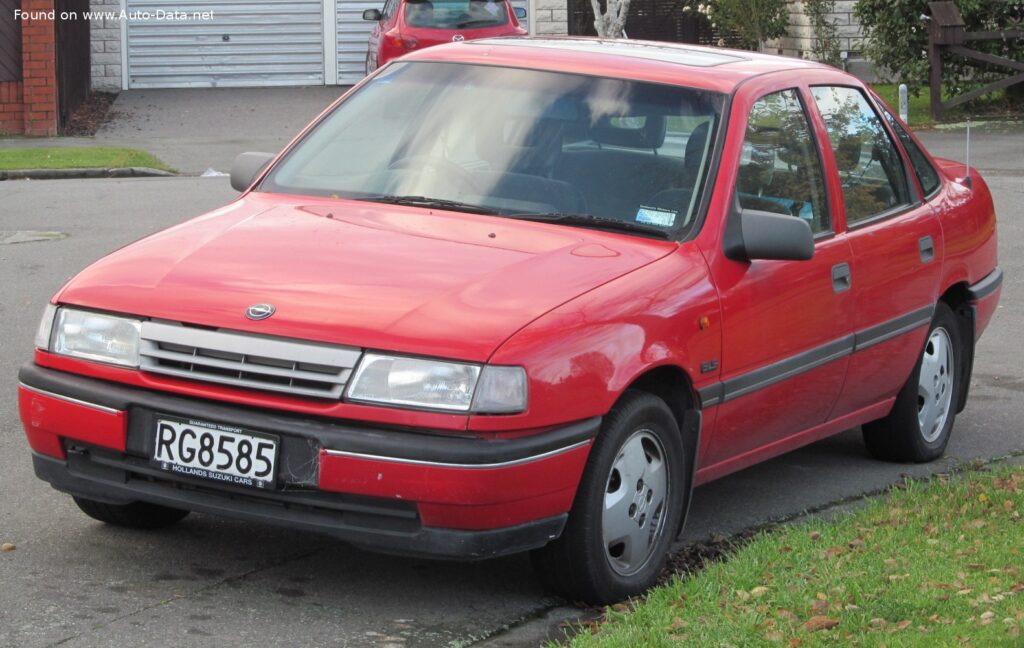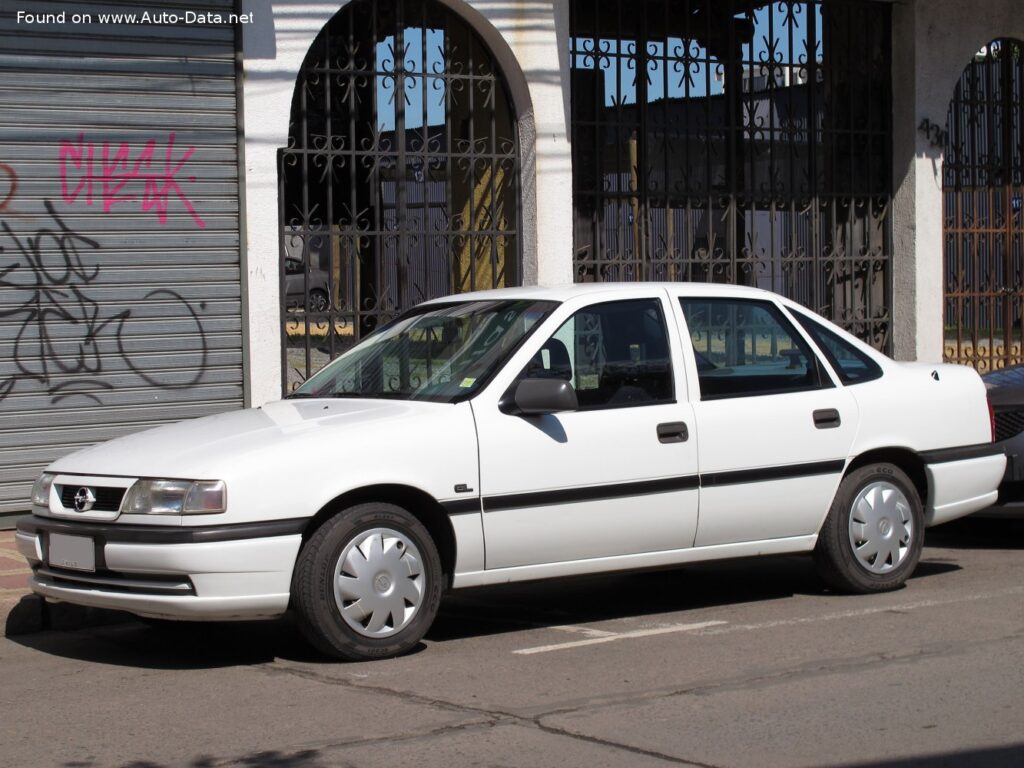
The Opel Vectra A (facelift 1992) 2.0i Turbo 4×4 represents a significant evolution in Opel’s mid-size offerings. Introduced in August 1993 and produced until July 1994, this variant of the Vectra A aimed to deliver a blend of performance and all-weather capability. While the Vectra nameplate was well-established in Europe, it wasn’t officially sold in the United States. The Vectra A, and specifically this turbocharged, all-wheel-drive version, served as a competitor to models like the Ford Mondeo, Volkswagen Passat, and BMW 3 Series in the European market, offering a more affordable alternative with a focus on practicality and driving dynamics.
Opel Vectra A (facelift 1992) 2.0i Turbo 4×4: An Overview
The Vectra A, launched in 1988, was Opel’s replacement for the Ascona and Manta models. The 1992 facelift brought updated styling and mechanical improvements, enhancing the car’s appeal. The 2.0i Turbo 4×4 was a flagship model, distinguished by its potent engine and all-wheel-drive system. This combination was relatively uncommon for the time, positioning the Vectra as a sporty and capable family sedan. The car’s design reflected the early 1990s aesthetic, prioritizing aerodynamic efficiency and a clean, functional appearance.
Engine & Performance
The heart of the Vectra A 2.0i Turbo 4×4 is the C20LET, a 2.0-liter inline-four cylinder engine equipped with a turbocharger and intercooler. This configuration allowed the engine to produce 204 horsepower at 6000 rpm and 280 Nm (206.52 lb.-ft.) of torque at 3000 rpm. The turbocharging system significantly boosted power output compared to naturally aspirated engines of similar displacement, resulting in brisk acceleration. The engine features multi-port fuel injection and a double overhead camshaft (DOHC) valvetrain, contributing to its efficiency and responsiveness.
Power is delivered to all four wheels via a five-speed manual transmission and a sophisticated all-wheel-drive system. This drivetrain configuration provides enhanced traction, particularly in adverse weather conditions. Performance figures are impressive for its era, with a 0-100 km/h (0-62 mph) acceleration time of 6.8 seconds and a 0-60 mph time of 6.5 seconds. The car boasts a top speed of 240 km/h (149.13 mph). The weight-to-power ratio of 6.1 kg/Hp and weight-to-torque ratio of 4.4 kg/Nm further highlight the car’s performance capabilities.
Design & Features
The Opel Vectra A (facelift 1992) 2.0i Turbo 4×4 is a four-door sedan with a practical and understated design. Its body measures 4432 mm (174.49 in) in length, 1706 mm (67.17 in) in width, and 1400 mm (55.12 in) in height. The car’s drag coefficient of 0.29 indicates a focus on aerodynamic efficiency. The interior offers seating for five passengers and provides a comfortable and functional environment.
While not laden with luxury features, the Vectra A 2.0i Turbo 4×4 included essential amenities for its time. A key safety feature was the inclusion of ABS (Anti-lock braking system), which was becoming increasingly common in the early 1990s. The car also features hydraulic power steering for ease of maneuverability. The trunk offers a generous amount of space, ranging from 530 liters (18.72 cu. ft.) with the rear seats up to 840 liters (29.66 cu. ft.) with the seats folded down. The fuel tank capacity is 60 liters (15.85 US gal).
Technical Specifications
| Brand | Opel |
| Model | Vectra |
| Generation | Vectra A (facelift 1992) |
| Type (Engine) | 2.0i Turbo (204 Hp) 4×4 |
| Start of production | August, 1993 |
| End of production | July, 1994 |
| Powertrain Architecture | Internal Combustion engine |
| Body type | Sedan |
| Seats | 5 |
| Doors | 4 |
| Fuel consumption (economy) – combined | 8.8 l/100 km |
| Fuel consumption (economy) – combined (US mpg) | 26.7 US mpg |
| Fuel consumption (economy) – combined (UK mpg) | 32.1 UK mpg |
| Fuel consumption (economy) – combined (km/l) | 11.4 km/l |
| Fuel Type | Petrol (Gasoline) |
| Acceleration 0 – 100 km/h | 6.8 sec |
| Acceleration 0 – 62 mph | 6.8 sec |
| Acceleration 0 – 60 mph | 6.5 sec |
| Maximum speed | 240 km/h |
| Maximum speed (mph) | 149.13 mph |
| Weight-to-power ratio | 6.1 kg/Hp |
| Weight-to-torque ratio | 4.4 kg/Nm |
| Power | 204 Hp @ 6000 rpm |
| Power per litre | 102.1 Hp/l |
| Torque | 280 Nm @ 3000 rpm |
| Torque (lb.-ft.) | 206.52 lb.-ft. @ 3000 rpm |
| Engine layout | Front, Transverse |
| Engine Model/Code | C20LET |
| Engine displacement | 1998 cm3 |
| Engine displacement (cu. in.) | 121.93 cu. in. |
| Number of cylinders | 4 |
| Engine configuration | Inline |
| Cylinder Bore | 86 mm |
| Cylinder Bore (in.) | 3.39 in. |
| Piston Stroke | 86 mm |
| Piston Stroke (in.) | 3.39 in. |
| Compression ratio | 9:1 |
| Number of valves per cylinder | 4 |
| Fuel injection system | Multi-port manifold injection |
| Engine aspiration | Turbocharger, Intercooler |
| Valvetrain | DOHC |
| Engine oil capacity | 4.5 l |
| Engine oil capacity (US qt) | 4.76 US qt |
| Engine oil capacity (UK qt) | 3.96 UK qt |
| Coolant | 7.2 l |
| Coolant (US qt) | 7.61 US qt |
| Coolant (UK qt) | 6.34 UK qt |
| Kerb Weight | 1245 kg |
| Kerb Weight (lbs.) | 2744.76 lbs. |
| Max. weight | 1765 kg |
| Max. weight (lbs.) | 3891.16 lbs. |
| Max load | 520 kg |
| Max load (lbs.) | 1146.4 lbs. |
| Trunk (boot) space – minimum | 530 l |
| Trunk (boot) space – minimum (cu. ft.) | 18.72 cu. ft. |
| Trunk (boot) space – maximum | 840 l |
| Trunk (boot) space – maximum (cu. ft.) | 29.66 cu. ft. |
| Fuel tank capacity | 60 l |
| Fuel tank capacity (US gal) | 15.85 US gal |
| Fuel tank capacity (UK gal) | 13.2 UK gal |
| Length | 4432 mm |
| Length (in.) | 174.49 in. |
| Width | 1706 mm |
| Width (in.) | 67.17 in. |
| Height | 1400 mm |
| Height (in.) | 55.12 in. |
| Wheelbase | 2600 mm |
| Wheelbase (in.) | 102.36 in. |
| Front track | 1420 mm |
| Front track (in.) | 55.91 in. |
| Rear (Back) track | 1423 mm |
| Rear (Back) track (in.) | 56.02 in. |
| Drag coefficient (Cd) | 0.29 |
| Drive wheel | All wheel drive (4×4) |
| Number of gears and type of gearbox | 5 gears, manual transmission |
| Assisting systems | ABS (Anti-lock braking system) |
| Steering type | Steering rack and pinion |
| Power steering | Hydraulic Steering |
| Tires size | 195/60 R15 |
| Wheel rims size | 15 |