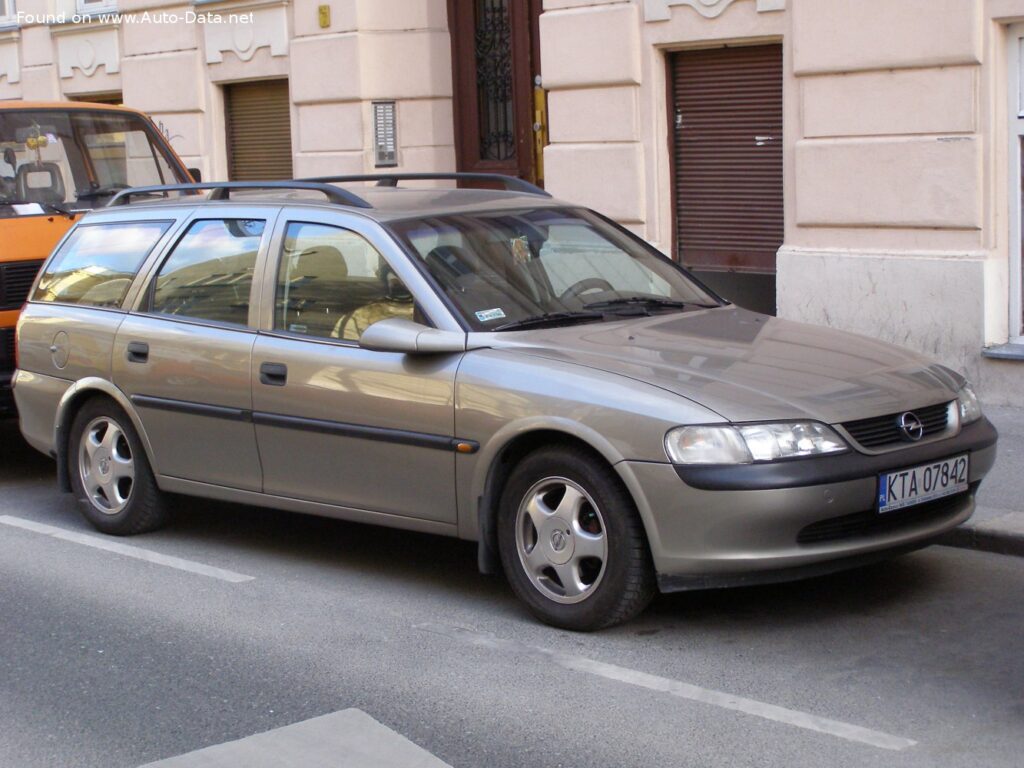
The Opel Vectra B Caravan 1.8i 16V Automatic, produced between 1996 and 1998, represents a significant iteration in Opel’s mid-size family car lineage. As a station wagon (estate) variant of the Vectra B, it catered to European buyers seeking a practical and spacious vehicle. While not officially sold in the United States, the Vectra B was a popular choice in Europe, competing with models like the Ford Mondeo and Volkswagen Passat. This version, equipped with a 1.8-liter 16-valve engine and an automatic transmission, offered a balance of performance and convenience for everyday driving.
Opel Vectra B Caravan: A Detailed Overview
The Vectra B, launched in 1995, was a substantial upgrade over its predecessor, the Vectra A. It featured a more modern design, improved interior space, and enhanced safety features. The Caravan body style, specifically, emphasized practicality with its large cargo area, making it ideal for families and those requiring ample space for luggage or equipment. The 1.8i 16V engine was a common choice within the Vectra B range, providing adequate power for most driving situations, and the availability of an automatic transmission broadened its appeal to a wider range of drivers.
Engine & Performance
The heart of the Vectra B Caravan 1.8i 16V is an inline four-cylinder, 1.8-liter (1796 cm3 or 109.6 cu. in.) gasoline engine. Designated the X18XE, this engine produces 115 horsepower (Hp) at 5400 rpm and 170 Newton-meters (125.39 lb.-ft.) of torque at 3400 rpm. The engine utilizes multi-port fuel injection and a double overhead camshaft (DOHC) valvetrain with four valves per cylinder, contributing to its relatively efficient operation. Paired with a four-speed automatic transmission, the vehicle achieves a 0 to 100 km/h (0 to 62 mph) acceleration time of 13.5 seconds, and a 0 to 60 mph time of 12.8 seconds. Its maximum speed is rated at 190 km/h (118.06 mph). The power-to-weight ratio stands at 11.4 kg/Hp, and the torque-to-weight ratio is 7.7 kg/Nm. Fuel economy figures are 8.6 l/100 km (27.4 US mpg, 32.8 UK mpg) on a combined cycle, with 12 l/100 km (19.6 US mpg, 23.5 UK mpg) in urban conditions and 6.6 l/100 km (35.6 US mpg, 42.8 UK mpg) on the extra-urban cycle. CO2 emissions are rated at 221 g/km.
Design & Features
The Opel Vectra B Caravan is a five-door station wagon with seating for five passengers. Its design reflects the styling trends of the mid-1990s, characterized by smooth lines and a relatively understated aesthetic. The Caravan body style significantly expands the vehicle’s practicality, offering a minimum trunk (boot) space of 460 liters (16.24 cu. ft.) and a maximum capacity of 1490 liters (52.62 cu. ft.) with the rear seats folded down. The vehicle’s dimensions are: length 4490 mm (176.77 in.), width 1707 mm (67.2 in.), height 1490 mm (58.66 in.), and wheelbase 2637 mm (103.82 in.). The kerb weight is 1310 kg (2888.06 lbs.), with a maximum permissible weight of 1905 kg (4199.81 lbs.).
Safety features for the era included an Anti-lock Braking System (ABS) as standard equipment. The steering system is a hydraulic power-assisted rack and pinion setup. The suspension utilizes coil springs on both the front and rear axles. The vehicle rides on 195/65 R15 tires mounted on 5.5J x 15 inch wheel rims. Interior features, while not extensively documented, would have typically included basic amenities such as power windows, central locking, and a radio/cassette player, reflecting the standards of the mid-1990s automotive market.
Technical Specifications
| Brand | Opel |
| Model | Vectra |
| Generation | Vectra B Caravan |
| Type (Engine) | 1.8i 16V (115 Hp) Automatic |
| Start of production | October, 1996 |
| End of production | November, 1998 |
| Powertrain Architecture | Internal Combustion engine |
| Body type | Station wagon (estate) |
| Seats | 5 |
| Doors | 5 |
| Fuel consumption (urban) | 12 l/100 km (19.6 US mpg, 23.5 UK mpg) |
| Fuel consumption (extra urban) | 6.6 l/100 km (35.6 US mpg, 42.8 UK mpg) |
| Fuel consumption (combined) | 8.6 l/100 km (27.4 US mpg, 32.8 UK mpg) |
| CO2 emissions | 221 g/km |
| Fuel Type | Petrol (Gasoline) |
| Acceleration 0 – 100 km/h | 13.5 sec |
| Acceleration 0 – 62 mph | 13.5 sec |
| Acceleration 0 – 60 mph | 12.8 sec |
| Maximum speed | 190 km/h (118.06 mph) |
| Weight-to-power ratio | 11.4 kg/Hp |
| Weight-to-torque ratio | 7.7 kg/Nm |
| Power | 115 Hp @ 5400 rpm |
| Torque | 170 Nm @ 3400 rpm (125.39 lb.-ft. @ 3400 rpm) |
| Engine layout | Front, Transverse |
| Engine Model/Code | X18XE |
| Engine displacement | 1796 cm3 (109.6 cu. in.) |
| Number of cylinders | 4 |
| Engine configuration | Inline |
| Cylinder Bore | 80.5 mm (3.17 in.) |
| Piston Stroke | 88.2 mm (3.47 in.) |
| Compression ratio | 10:1 |
| Number of valves per cylinder | 4 |
| Fuel injection system | Multi-port manifold injection |
| Engine aspiration | Naturally aspirated |
| Engine oil capacity | 4.25 l (4.49 US qt | 3.74 UK qt) |
| Coolant capacity | 7.1 l (7.5 US qt | 6.25 UK qt) |
| Kerb Weight | 1310 kg (2888.06 lbs.) |
| Max. weight | 1905 kg (4199.81 lbs.) |
| Max load | 595 kg (1311.75 lbs.) |
| Trunk (boot) space – minimum | 460 l (16.24 cu. ft.) |
| Trunk (boot) space – maximum | 1490 l (52.62 cu. ft.) |
| Fuel tank capacity | 60 l (15.85 US gal | 13.2 UK gal) |
| Length | 4490 mm (176.77 in.) |
| Width | 1707 mm (67.2 in.) |
| Width including mirrors | 1941 mm (76.42 in.) |
| Height | 1490 mm (58.66 in.) |
| Wheelbase | 2637 mm (103.82 in.) |
| Front track | 1484 mm (58.43 in.) |
| Rear track | 1473 mm (57.99 in.) |
| Ride height (ground clearance) | 160 mm (6.3 in.) |
| Drag coefficient (Cd) | 0.32 |
| Drive wheel | Front wheel drive |
| Number of gears | 4 |
| Gearbox type | automatic transmission |