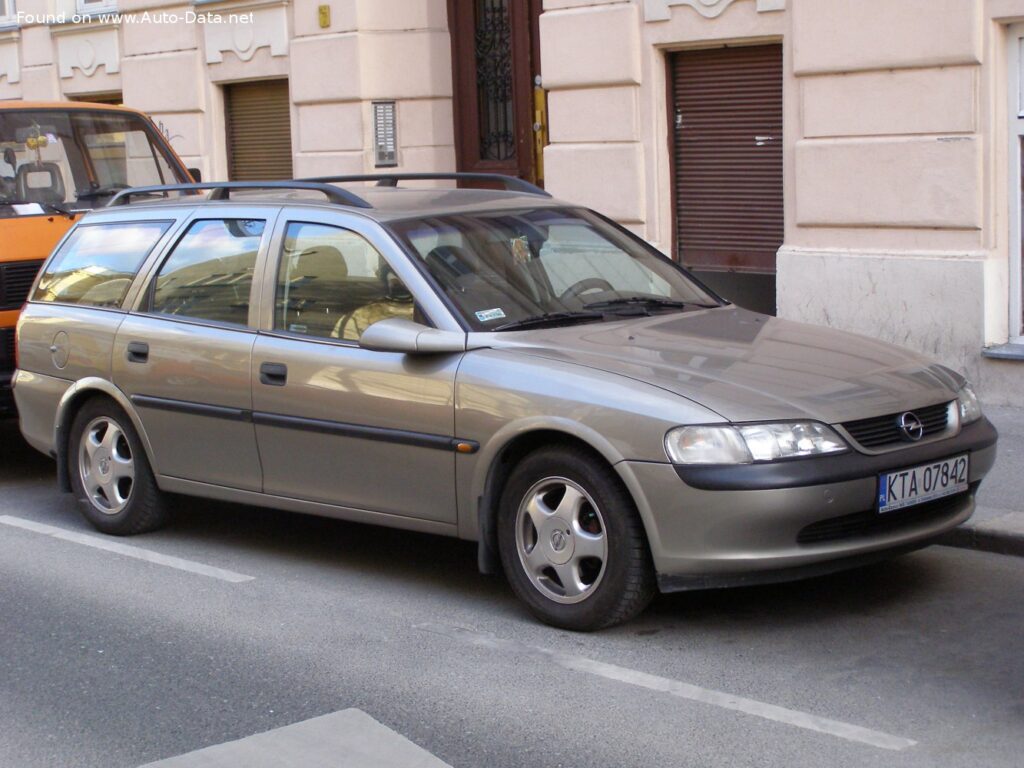
The Opel Vectra B Caravan 2.0 DI 16V was a station wagon (estate) produced between 1996 and 1998, representing a significant evolution in Opel’s mid-size offerings. Part of the B generation of the Vectra, which ran from 1995 to 2002, the Caravan body style provided a practical and spacious alternative to the saloon (sedan) version. While not officially sold in the United States, the Vectra was a popular choice in Europe as a family vehicle, competing with models like the Ford Mondeo Estate and Volkswagen Passat Variant. The 2.0 DI 16V variant, equipped with a direct injection diesel engine, focused on fuel efficiency and reasonable performance for its time.
Opel Vectra B Caravan: A Detailed Overview
The Vectra B represented a substantial leap forward for Opel in terms of design, technology, and build quality. It moved away from the more angular styling of the previous generation and adopted a smoother, more aerodynamic profile. The Caravan, specifically, offered increased cargo capacity and versatility, making it a popular choice for families and those requiring a vehicle capable of carrying larger loads. The 2.0 DI 16V engine was a key component of the model range, offering a balance between economy and usability.
Engine & Performance
The heart of the Vectra B Caravan 2.0 DI 16V is its 1995 cc inline-four cylinder diesel engine, designated X20DTL. This engine utilizes direct injection technology, a relatively advanced feature for the mid-1990s, to improve fuel efficiency and reduce emissions. Producing 82 horsepower (Hp) at 4300 rpm and 185 Newton-meters (136.45 lb.-ft.) of torque at 1800 rpm, the engine provides adequate, though not particularly brisk, performance. Acceleration from 0 to 100 km/h (0-62 mph) takes approximately 17 seconds, while reaching 0 to 60 mph requires 16.2 seconds. The top speed is rated at 170 km/h (105.63 mph). The engine’s turbocharger contributes to its torque output, providing improved responsiveness compared to naturally aspirated diesel engines of the era. Fuel economy is a strong point, with combined cycle consumption rated at 6.4 liters per 100 kilometers (36.8 US mpg or 44.1 UK mpg). The engine features an overhead camshaft (OHC) valvetrain and a compression ratio of 18.5:1.
Design & Features
The Opel Vectra B Caravan is a five-door station wagon with seating for five passengers. Its design emphasizes practicality and space. The Caravan body style offers a significantly larger cargo area compared to the saloon version, with a minimum capacity of 460 liters (16.24 cu. ft.) expanding to 1490 liters (52.62 cu. ft.) with the rear seats folded down. The vehicle’s dimensions are 4490 mm (176.77 in.) in length, 1707 mm (67.2 in.) in width, and 1490 mm (58.66 in.) in height. Standard features for the time included hydraulic power steering, disc brakes on all wheels, and an Anti-lock Braking System (ABS) for enhanced safety. The interior, while functional, was typically equipped with cloth upholstery and basic trim levels. The focus was on providing a comfortable and practical environment for everyday use. The drag coefficient of 0.32 was respectable for a vehicle of its type and era, contributing to improved fuel efficiency.
Technical Specifications
| Brand | Opel |
| Model | Vectra |
| Generation | Vectra B Caravan |
| Type (Engine) | 2.0 DI 16V (82 Hp) |
| Start of production | September, 1996 |
| End of production | November, 1998 |
| Powertrain Architecture | Internal Combustion engine |
| Body type | Station wagon (estate) |
| Seats | 5 |
| Doors | 5 |
| Fuel consumption (urban) | 8.4 l/100 km (28 US mpg, 33.6 UK mpg, 11.9 km/l) |
| Fuel consumption (extra urban) | 5.3 l/100 km (44.4 US mpg, 53.3 UK mpg, 18.9 km/l) |
| Fuel consumption (combined) | 6.4 l/100 km (36.8 US mpg, 44.1 UK mpg, 15.6 km/l) |
| CO2 emissions | 170 g/km |
| Fuel Type | Diesel |
| Acceleration 0 – 100 km/h | 17 sec |
| Acceleration 0 – 62 mph | 17 sec |
| Acceleration 0 – 60 mph | 16.2 sec |
| Maximum speed | 170 km/h (105.63 mph) |
| Weight-to-power ratio | 17 kg/Hp, 59 Hp/tonne |
| Weight-to-torque ratio | 7.5 kg/Nm, 133.1 Nm/tonne |
| Power | 82 Hp @ 4300 rpm |
| Power per litre | 41.1 Hp/l |
| Torque | 185 Nm @ 1800 rpm (136.45 lb.-ft. @ 1800 rpm) |
| Engine layout | Front, Transverse |
| Engine Model/Code | X20DTL |
| Engine displacement | 1995 cm3 (121.74 cu. in.) |
| Number of cylinders | 4 |
| Engine configuration | Inline |
| Cylinder Bore | 84 mm (3.31 in.) |
| Piston Stroke | 90 mm (3.54 in.) |
| Compression ratio | 18.5:1 |
| Number of valves per cylinder | 4 |
| Fuel injection system | Diesel Commonrail |
| Engine aspiration | Turbocharger |
| Valvetrain | OHC |
| Engine oil capacity | 5.5 l (5.81 US qt | 4.84 UK qt) |
| Coolant | 7.4 l (7.82 US qt | 6.51 UK qt) |
| Kerb Weight | 1390 kg (3064.43 lbs.) |
| Max. weight | 1985 kg (4376.18 lbs.) |
| Max load | 595 kg (1311.75 lbs.) |
| Trunk (boot) space – minimum | 460 l (16.24 cu. ft.) |
| Trunk (boot) space – maximum | 1490 l (52.62 cu. ft.) |
| Fuel tank capacity | 60 l (15.85 US gal | 13.2 UK gal) |
| Length | 4490 mm (176.77 in.) |
| Width | 1707 mm (67.2 in.) |
| Width including mirrors | 1841 mm (72.48 in.) |
| Height | 1490 mm (58.66 in.) |
| Wheelbase | 2637 mm (103.82 in.) |
| Front track | 1484 mm (58.43 in.) |
| Rear (Back) track | 1473 mm (57.99 in.) |
| Ride height (ground clearance) | 160 mm (6.3 in.) |
| Drag coefficient (Cd) | 0.32 |
| Drivetrain Architecture | ICE, Front wheel drive |
| Drive wheel | Front wheel drive |
| Number of gears and type of gearbox | 5 gears, manual transmission |
| Front suspension | Coil spring |
| Rear suspension | Coil spring |
| Front brakes | Disc |
| Rear brakes | Disc |
| Assisting systems | ABS (Anti-lock braking system) |
| Steering type | Steering rack and pinion |
| Power steering | Hydraulic Steering |
| Tires size | 195/65 R15 |
| Wheel rims size | 5.5J x 15 |