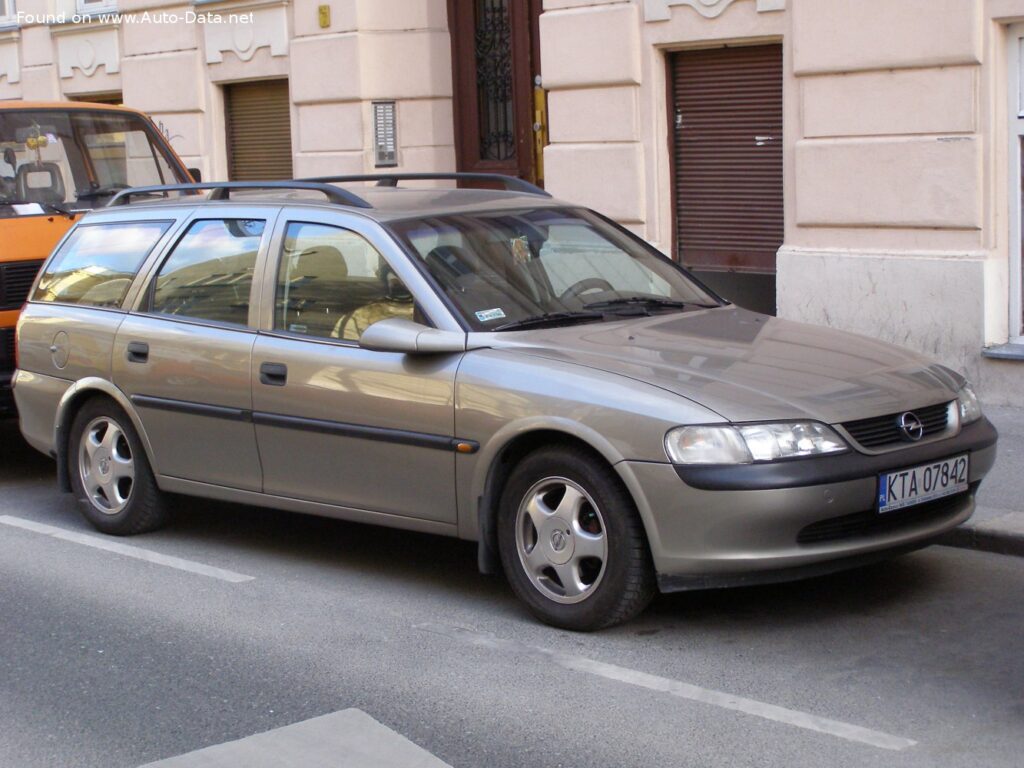
The Opel Vectra B Caravan 2.5 i500 V6 24V represents a significant iteration in Opel’s mid-size family car lineage. Produced between December 1997 and November 1998, this variant of the Vectra B, a station wagon (estate) body style, was primarily aimed at the European market. It offered a blend of practicality, performance, and relative luxury within its segment. While not officially sold in the United States, understanding its specifications and position within the European automotive landscape provides insight into the engineering and design philosophies of the late 1990s. The Vectra B series, as a whole, aimed to modernize Opel’s offerings and compete with established rivals like the Ford Mondeo and Volkswagen Passat.
Opel Vectra B Caravan: A Detailed Overview
The Vectra B Caravan distinguished itself with its spacious interior, generous cargo capacity, and a range of engine options. The 2.5 i500 V6 24V model, specifically, was positioned as a higher-performance variant, appealing to drivers seeking a more engaging driving experience. The “Caravan” designation signifies the station wagon body style, emphasizing its practicality for families and those requiring ample cargo space. This model year represented a refinement of the B-series, incorporating improvements in build quality and features compared to its predecessor.
Engine & Performance
At the heart of the Vectra B Caravan 2.5 i500 V6 24V lies a naturally aspirated 2.5-liter V6 engine, designated the X25XEI. This engine produces 195 horsepower at 6,500 rpm and 240 Newton-meters (177.01 lb.-ft.) of torque at 3,500 rpm. The engine’s configuration – a V6 with 24 valves and multi-port fuel injection – contributes to its smooth power delivery and relatively high specific output of 78.1 horsepower per liter. Power is delivered to the front wheels via a 5-speed manual transmission. This configuration allows for a 0-62 mph (0-100 km/h) acceleration time of 8.2 seconds and a top speed of 226 km/h (140.43 mph). The weight-to-power ratio of 7.5 kg/Hp and a weight-to-torque ratio of 6.1 kg/Nm indicate a reasonably responsive and balanced driving experience for its time. The engine requires 4.5 liters (4.76 US quarts) of oil and 7.7 liters (8.14 US quarts) of coolant for optimal operation.
Design & Features
The Vectra B Caravan boasts a functional yet aesthetically pleasing design typical of late-1990s European station wagons. Its five-door configuration provides easy access for passengers and cargo. The vehicle’s dimensions – 4,490 mm (176.77 in) in length, 1,707 mm (67.2 in) in width, and 1,490 mm (58.66 in) in height – provide a substantial presence on the road. The drag coefficient of 0.32 is respectable for a vehicle of this type and era, contributing to reasonable aerodynamic efficiency. Inside, the Vectra B Caravan offers seating for five passengers and a versatile cargo area. The trunk space ranges from a minimum of 460 liters (16.24 cu. ft.) to a maximum of 1,490 liters (52.62 cu. ft.) with the rear seats folded down. Safety features, while not as comprehensive as modern standards, included ventilated front disc brakes and disc brakes on the rear, along with hydraulic power steering. The vehicle rides on coil springs at both the front and rear, providing a comfortable ride. Standard tire size is 215/45 R17 on 17-inch wheel rims.
Technical Specifications
| Brand | Opel |
| Model | Vectra |
| Generation | Vectra B Caravan |
| Type (Engine) | 2.5 i500 V6 24V (195 Hp) |
| Start of production | December, 1997 |
| End of production | November, 1998 |
| Powertrain Architecture | Internal Combustion engine |
| Body type | Station wagon (estate) |
| Seats | 5 |
| Doors | 5 |
| CO2 emissions | 248 g/km |
| Fuel Type | Petrol (Gasoline) |
| Acceleration 0 – 100 km/h | 8.2 sec |
| Acceleration 0 – 62 mph | 8.2 sec |
| Acceleration 0 – 60 mph | 7.8 sec |
| Maximum speed | 226 km/h / 140.43 mph |
| Weight-to-power ratio | 7.5 kg/Hp, 132.8 Hp/tonne |
| Weight-to-torque ratio | 6.1 kg/Nm, 163.5 Nm/tonne |
| Power | 195 Hp @ 6500 rpm |
| Power per litre | 78.1 Hp/l |
| Torque | 240 Nm @ 3500 rpm / 177.01 lb.-ft. @ 3500 rpm |
| Engine layout | Front, Transverse |
| Engine Model/Code | X25XEI |
| Engine displacement | 2498 cm3 / 152.44 cu. in. |
| Number of cylinders | 6 |
| Engine configuration | V-engine |
| Cylinder Bore | 81.6 mm / 3.21 in. |
| Piston Stroke | 79.6 mm / 3.13 in. |
| Compression ratio | 10.8:1 |
| Number of valves per cylinder | 4 |
| Fuel injection system | Multi-port manifold injection |
| Engine aspiration | Naturally aspirated engine |
| Engine oil capacity | 4.5 l / 4.76 US qt | 3.96 UK qt |
| Coolant | 7.7 l / 8.14 US qt | 6.78 UK qt |
| Kerb Weight | 1468 kg / 3236.39 lbs |
| Max. weight | 1995 kg / 4398.22 lbs |
| Max load | 527 kg / 1161.84 lbs |
| Trunk (boot) space – minimum | 460 l / 16.24 cu. ft. |
| Trunk (boot) space – maximum | 1490 l / 52.62 cu. ft. |
| Fuel tank capacity | 60 l / 15.85 US gal | 13.2 UK gal |
| Permitted trailer load with brakes (12%) | 1500 kg / 3306.93 lbs |
| Permitted trailer load without brakes | 715 kg / 1576.31 lbs |
| Length | 4490 mm / 176.77 in |
| Width | 1707 mm / 67.2 in |
| Width including mirrors | 1841 mm / 72.48 in |
| Height | 1490 mm / 58.66 in |
| Wheelbase | 2637 mm / 103.82 in |
| Front track | 1484 mm / 58.43 in |
| Rear (Back) track | 1473 mm / 57.99 in |
| Ride height (ground clearance) | 140 mm / 5.51 in |
| Drag coefficient (Cd) | 0.32 |
| Drivetrain Architecture | The Internal combustion engine (ICE) drives the front wheels of the vehicle. |
| Drive wheel | Front wheel drive |
| Number of gears and type of gearbox | 5 gears, manual transmission |
| Front suspension | Coil spring |
| Rear suspension | Coil spring |
| Front brakes | Ventilated discs |
| Rear brakes | Disc |
| Steering type | Steering rack and pinion |
| Power steering | Hydraulic Steering |
| Tires size | 215/45 R17 |
| Wheel rims size | 17 |