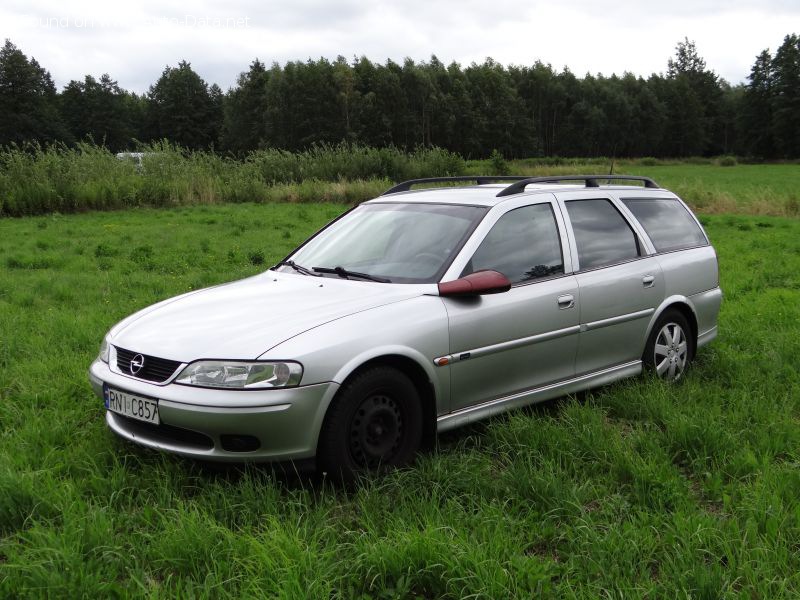
The Opel Vectra B Caravan (facelift 1999) 2.5i V6 represents a refined iteration of Opel’s mid-size offering, positioned as a practical and relatively upscale station wagon (estate) for the European market. Introduced in 2000 and continuing through 2002, this variant combined a comfortable ride with a potent V6 engine, appealing to families and drivers seeking both space and performance. While not officially sold in the United States, the Vectra B Caravan provides a compelling example of European automotive engineering of the period, emphasizing practicality, safety, and a more engaging driving experience than many of its contemporaries.
Opel Vectra B Caravan: A Detailed Overview
The Vectra B, launched in 1995, was a significant step forward for Opel, replacing the aging Vectra A. The Caravan body style, essentially the station wagon version, offered increased cargo capacity and versatility. The 1999 facelift brought revised styling, improved interior materials, and updated engine options, including the 2.5i V6 detailed here. The Vectra competed with vehicles like the Ford Mondeo, Volkswagen Passat, and Peugeot 406, aiming to provide a well-rounded package with a focus on comfort and practicality.
Engine & Performance
The heart of the Vectra B Caravan 2.5i V6 is its 2.5-liter, naturally aspirated V6 engine, designated Y26SE. This engine produces 170 horsepower at 5800 rpm and 230 Nm (169.64 lb.-ft.) of torque at 3200 rpm. The engine’s configuration – a 60-degree V-angle – contributes to its smooth operation and relatively compact size. Power is delivered to the front wheels via a 5-speed manual transmission. This powertrain configuration allows for a 0-60 mph (0-96 km/h) acceleration time of approximately 8.6 seconds and a top speed of 222 km/h (137.94 mph). The engine’s power-to-weight ratio of 8.2 kg/Hp and torque-to-weight ratio of 6.1 kg/Nm contribute to a responsive driving experience. Fuel economy is rated at 14.3 l/100 km (16.4 US mpg) in urban conditions and 7.5 l/100 km (31.4 US mpg) on the open road.
Design & Features
The Vectra B Caravan is a five-door station wagon with seating for five passengers. Its design reflects the styling trends of the late 1990s and early 2000s, characterized by smooth lines and a relatively understated aesthetic. The facelifted model features revised headlights, a new grille, and updated bumpers. Inside, the cabin prioritizes practicality and comfort. The key feature is, of course, the expansive cargo area. With the rear seats up, the trunk offers 460 liters (16.24 cu. ft.) of space, expanding to a substantial 1490 liters (52.62 cu. ft.) with the rear seats folded down. Safety features for the time included ABS (Anti-lock Braking System) and front disc brakes, along with rear disc brakes. Hydraulic power steering provides ease of maneuverability. The vehicle rides on coil springs at both the front and rear, offering a comfortable ride quality. Standard tire size is 205/55 R16, mounted on 7J x 16 inch wheel rims.
Technical Specifications
| Brand | Opel |
| Model | Vectra |
| Generation | Vectra B Caravan (facelift 1999) |
| Type (Engine) | 2.5i V6 (170 Hp) |
| Start of production | July, 2000 |
| End of production | January, 2002 |
| Powertrain Architecture | Internal Combustion engine |
| Body type | Station wagon (estate) |
| Seats | 5 |
| Doors | 5 |
| Fuel consumption (urban) | 14.3 l/100 km (16.4 US mpg, 19.8 UK mpg, 7 km/l) |
| Fuel consumption (extra urban) | 7.5 l/100 km (31.4 US mpg, 37.7 UK mpg, 13.3 km/l) |
| Fuel Type | Petrol (Gasoline) |
| Acceleration 0 – 100 km/h | 9 sec |
| Acceleration 0 – 62 mph | 9 sec |
| Acceleration 0 – 60 mph | 8.6 sec |
| Maximum speed | 222 km/h (137.94 mph) |
| Weight-to-power ratio | 8.2 kg/Hp |
| Weight-to-torque ratio | 6.1 kg/Nm |
| Power | 170 Hp @ 5800 rpm |
| Power per litre | 68.1 Hp/l |
| Torque | 230 Nm @ 3200 rpm (169.64 lb.-ft. @ 3200 rpm) |
| Engine layout | Front, Transverse |
| Engine Model/Code | Y26SE |
| Engine displacement | 2498 cm3 (152.44 cu. in.) |
| Number of cylinders | 6 |
| Engine configuration | V-engine |
| Cylinder Bore | 81.6 mm (3.21 in.) |
| Piston Stroke | 79.6 mm (3.13 in.) |
| Compression ratio | 10:1 |
| Number of valves per cylinder | 4 |
| Fuel injection system | Multi-port manifold injection |
| Engine aspiration | Naturally aspirated engine |
| Valvetrain | DOHC |
| Engine oil capacity | 4.75 l (5.02 US qt | 4.18 UK qt) |
| Coolant | 7.7 l (8.14 US qt | 6.78 UK qt) |
| Kerb Weight | 1397 kg (3079.86 lbs.) |
| Max. weight | 1965 kg (4332.08 lbs.) |
| Max load | 568 kg (1252.23 lbs.) |
| Trunk (boot) space – minimum | 460 l (16.24 cu. ft.) |
| Trunk (boot) space – maximum | 1490 l (52.62 cu. ft.) |
| Fuel tank capacity | 60 l (15.85 US gal | 13.2 UK gal) |
| Length | 4490 mm (176.77 in.) |
| Width | 1707 mm (67.2 in.) |
| Width including mirrors | 1841 mm (72.48 in.) |
| Height | 1490 mm (58.66 in.) |
| Wheelbase | 2637 mm (103.82 in.) |
| Front track | 1484 mm (58.43 in.) |
| Rear (Back) track | 1473 mm (57.99 in.) |
| Ride height (ground clearance) | 160 mm (6.3 in.) |
| Drag coefficient (Cd) | 0.32 |
| Drivetrain Architecture | ICE drives front wheels |
| Drive wheel | Front wheel drive |
| Number of gears and type of gearbox | 5 gears, manual transmission |
| Front suspension | Coil spring |
| Rear suspension | Coil spring |
| Front brakes | Disc |
| Rear brakes | Disc |
| Assisting systems | ABS |
| Steering type | Steering rack and pinion |
| Power steering | Hydraulic |
| Tires size | 205/55 R16 |
| Wheel rims size | 7J x 16 |
The Opel Vectra B Caravan 2.5i V6, while not a performance car in the purest sense, offered a compelling blend of practicality, comfort, and respectable performance for its time. It remains a representative example of European automotive design and engineering from the early 2000s.