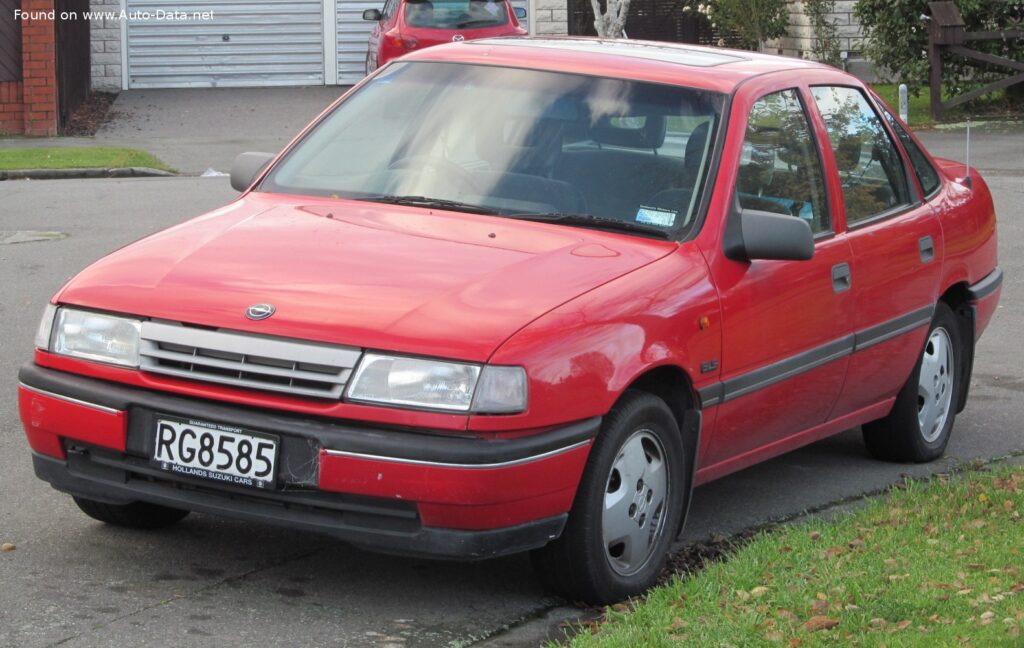
The Opel Vectra B CC (facelift 1999) 1.6i 16V represents a mid-cycle refresh of the second-generation Vectra, a large family car produced by the German manufacturer Opel. While not officially sold in the United States, the Vectra was a significant model in Europe, competing with vehicles like the Ford Mondeo, Volkswagen Passat, and Peugeot 406. The “CC” designation stands for “Comfort and Chassis,” indicating a focus on ride quality and handling. This particular variant, powered by a 1.6-liter 16-valve engine producing 101 horsepower, was aimed at buyers seeking a balance of affordability and practicality within the D-segment.
Opel Vectra B CC: A Refinement of a Popular European Sedan
The Vectra B, launched in 1995, was a crucial model for Opel, representing a move upmarket in terms of design and technology. The 1999 facelift brought revised styling, improved safety features, and updated engine options. The 1.6i 16V model occupied a key position in the lineup, offering a more economical alternative to the larger-displacement engines while still providing adequate performance for everyday driving. The Vectra’s success stemmed from its spacious interior, comfortable ride, and relatively affordable price point, making it a popular choice for families and company car fleets across Europe.
Engine & Performance
The heart of the 1999 Opel Vectra B CC 1.6i 16V is the X16XEL engine, a 1.6-liter inline-four cylinder gasoline engine. This naturally aspirated engine delivers 101 horsepower at 6000 rpm and 150 Nm (110.63 lb.-ft.) of torque at 3600 rpm. While not a performance-oriented engine, it provides sufficient power for typical commuting and highway driving. The engine features multi-port fuel injection and a double overhead camshaft (DOHC) valvetrain, contributing to its relatively efficient operation. Acceleration from 0 to 100 km/h (0-62 mph) takes 12.5 seconds, and it achieves a maximum speed of 193 km/h (119.92 mph). The engine’s power-to-weight ratio is 12 kg/Hp, and the torque-to-weight ratio is 8.1 kg/Nm. The engine is paired with a five-speed manual transmission, driving the front wheels.
Design & Features
The Vectra B CC is a five-door hatchback, offering a practical and versatile body style. The facelifted model features subtle styling updates, including a revised front grille, headlights, and bumpers. The interior is designed with practicality in mind, offering comfortable seating for five passengers and a generous amount of legroom and headroom. The trunk offers a minimum capacity of 480 liters (16.95 cu. ft.), expanding to 790 liters (27.9 cu. ft.) with the rear seats folded down. Safety features for this era included ABS (Anti-lock Braking System) as standard equipment. The vehicle’s suspension utilizes coil springs on both the front and rear axles, providing a comfortable ride. Power steering, utilizing a hydraulic system, is also standard. The vehicle rides on 15-inch wheel rims with 195/65 R15 tires.
Technical Specifications
| Brand | Opel |
| Model | Vectra |
| Generation | Vectra B CC (facelift 1999) |
| Type (Engine) | 1.6i 16V (101 Hp) |
| Start of production | January, 1999 |
| End of production | January, 2000 |
| Powertrain Architecture | Internal Combustion engine |
| Body type | Hatchback |
| Seats | 5 |
| Doors | 5 |
| Fuel consumption (urban) | 10.1 l/100 km (23.3 US mpg / 28 UK mpg / 9.9 km/l) |
| Fuel consumption (extra urban) | 5.8 l/100 km (40.6 US mpg / 48.7 UK mpg / 17.2 km/l) |
| Fuel consumption (combined) | 7.4 l/100 km (31.8 US mpg / 38.2 UK mpg / 13.5 km/l) |
| CO2 emissions | 178 g/km |
| Fuel Type | Petrol (Gasoline) |
| Acceleration 0 – 100 km/h | 12.5 sec |
| Acceleration 0 – 62 mph | 12.5 sec |
| Acceleration 0 – 60 mph | 11.9 sec |
| Maximum speed | 193 km/h (119.92 mph) |
| Emission standard | Euro 2 |
| Weight-to-power ratio | 12 kg/Hp |
| Weight-to-torque ratio | 8.1 kg/Nm |
| Power | 101 Hp @ 6000 rpm |
| Power per litre | 63.2 Hp/l |
| Torque | 150 Nm @ 3600 rpm (110.63 lb.-ft. @ 3600 rpm) |
| Engine layout | Front, Transverse |
| Engine Model/Code | X16XEL |
| Engine displacement | 1598 cm3 (97.52 cu. in.) |
| Number of cylinders | 4 |
| Engine configuration | Inline |
| Cylinder Bore | 79 mm (3.11 in.) |
| Piston Stroke | 81.5 mm (3.21 in.) |
| Compression ratio | 10.5:1 |
| Number of valves per cylinder | 4 |
| Fuel injection system | Multi-port manifold injection |
| Engine aspiration | Naturally aspirated engine |
| Valvetrain | DOHC |
| Engine oil capacity | 3.25 l (3.43 US qt | 2.86 UK qt) |
| Coolant | 6.7 l (7.08 US qt | 5.9 UK qt) |
| Kerb Weight | 1215 kg (2678.62 lbs.) |
| Max. weight | 1745 kg (3847.07 lbs.) |
| Max load | 530 kg (1168.45 lbs.) |
| Trunk (boot) space – minimum | 480 l (16.95 cu. ft.) |
| Trunk (boot) space – maximum | 790 l (27.9 cu. ft.) |
| Fuel tank capacity | 60 l (15.85 US gal | 13.2 UK gal) |
| Length | 4495 mm (176.97 in.) |
| Width | 1707 mm (67.2 in.) |
| Width including mirrors | 1841 mm (72.48 in.) |
| Height | 1425 mm (56.1 in.) |
| Wheelbase | 2637 mm (103.82 in.) |
| Front track | 1484 mm (58.43 in.) |
| Rear (Back) track | 1487 mm (58.54 in.) |
| Drivetrain Architecture | The Internal combustion engine (ICE) drives the front wheels of the vehicle. |
| Drive wheel | Front wheel drive |
| Number of gears and type of gearbox | 5 gears, manual transmission |
| Front suspension | Coil spring |
| Rear suspension | Coil spring |
| Front brakes | Ventilated discs |
| Rear brakes | Disc |
| Assisting systems | ABS (Anti-lock braking system) |
| Steering type | Steering rack and pinion |
| Power steering | Hydraulic Steering |
| Tires size | 195/65 R15 |
| Wheel rims size | 15 |
The Opel Vectra B CC 1.6i 16V, while not a groundbreaking vehicle, represented a solid and reliable option in the European D-segment. Its combination of practicality, affordability, and reasonable performance made it a popular choice for a wide range of buyers. Although never sold in the US market, it exemplifies the engineering and design principles that characterized Opel during this period.