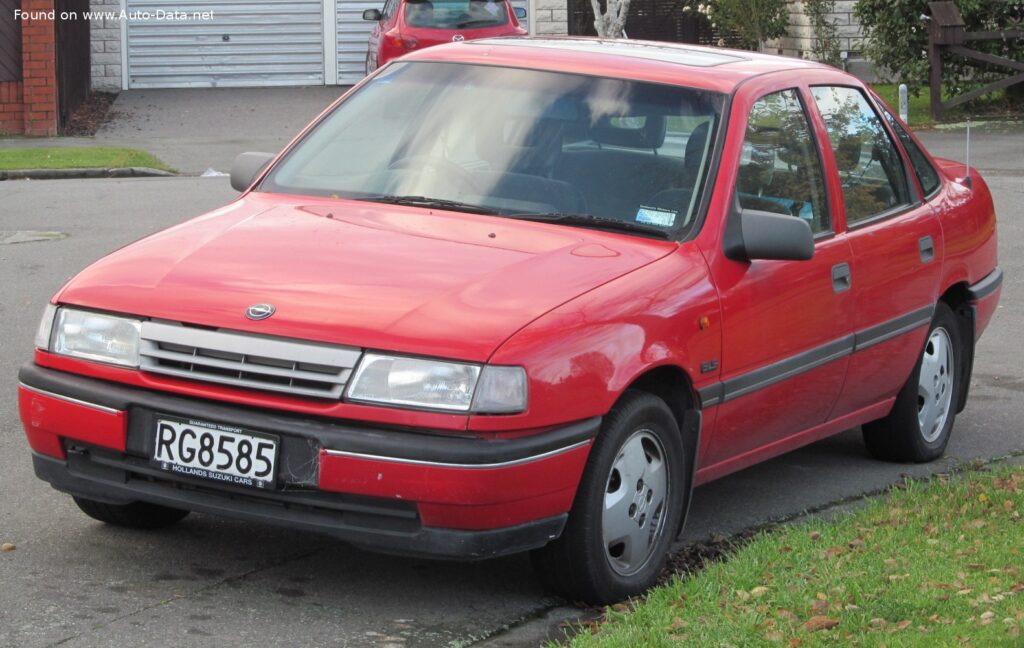
The Opel Vectra B CC (facelift, 1999) 1.6i represents a mid-cycle refresh of the second-generation Vectra, a compact/mid-size car engineered by the German automaker Opel. Introduced in 1995, the Vectra B aimed to modernize Opel’s offerings and compete with established rivals like the Ford Mondeo and Volkswagen Passat. While not officially sold in the United States, the Vectra was a significant model in Europe, known for its practicality, comfortable ride, and relatively affordable price point. The “CC” designation stands for “Coupe Comfort,” referring to the hatchback body style, which was popular in European markets. This particular variant, the 1.6i with 75 horsepower, was positioned as an entry-level option, prioritizing fuel economy and accessibility over outright performance.
Opel Vectra B CC (Facelift 1999) 1.6i: An Overview
The 1999 facelift brought subtle but important changes to the Vectra B, including revised front and rear styling, updated interior trim, and improvements to the engine range. The 1.6i engine, while not a powerhouse, provided adequate performance for everyday driving. This model year represents a key point in the Vectra B’s lifecycle, balancing affordability with a more contemporary design. The Vectra line would continue until 2002, when it was replaced by the Vectra C.
Engine & Performance
The Opel Vectra B CC 1.6i is powered by a 1.6-liter inline four-cylinder gasoline engine, designated the X16SZR. This engine produces 75 horsepower at 5200 rpm and 120 Nm (88.51 lb.-ft.) of torque at 2200 rpm. The engine utilizes a multi-port fuel injection system and a single overhead camshaft (OHC) valvetrain with two valves per cylinder. While not particularly powerful by modern standards, the 1.6i engine was designed for efficiency and reliability. Power is delivered to the front wheels via a five-speed manual transmission. Acceleration from 0 to 100 km/h (0-62 mph) takes 15.5 seconds, and 0 to 60 mph is achieved in approximately 14.7 seconds. The vehicle has a maximum speed of 175 km/h (108.74 mph). The engine’s power-to-weight ratio is 15.8 kg/Hp, and its torque-to-weight ratio is 9.9 kg/Nm. Fuel economy is rated at 10.5 l/100 km (22.4 US mpg) in urban driving, 5.8 l/100 km (40.6 US mpg) on the extra-urban cycle, and 6.7 l/100 km (35.1 US mpg) combined. CO2 emissions are 180 g/km, meeting Euro 2 emission standards.
Design & Features
The Vectra B CC is a five-door hatchback, offering a practical and versatile body style. Its design, updated with the 1999 facelift, features a more rounded and aerodynamic appearance compared to its predecessor. The interior provides seating for five passengers and offers a reasonable amount of space for both passengers and cargo. The trunk (boot) space ranges from 480 liters (16.95 cu. ft.) with the rear seats up to 790 liters (27.9 cu. ft.) with the rear seats folded down. Safety features for the time included an Anti-lock Braking System (ABS). The vehicle utilizes a hydraulic power steering system and coil spring suspension on both the front and rear axles. Ventilated disc brakes are used on the front wheels, while drum brakes are fitted to the rear. The standard tire size is 175/70 R14, mounted on 14-inch wheel rims. The overall dimensions of the vehicle are: length 4495 mm (176.97 in.), width 1707 mm (67.2 in.), and height 1425 mm (56.1 in.).
Technical Specifications
| Brand | Opel |
| Model | Vectra |
| Generation | Vectra B CC (facelift 1999) |
| Type (Engine) | 1.6i (75 Hp) |
| Start of production | January, 1999 |
| End of production | 2000 |
| Powertrain Architecture | Internal Combustion engine |
| Body type | Hatchback |
| Seats | 5 |
| Doors | 5 |
| Fuel consumption (urban) | 10.5 l/100 km (22.4 US mpg) |
| Fuel consumption (extra urban) | 5.8 l/100 km (40.6 US mpg) |
| Fuel consumption (combined) | 6.7 l/100 km (35.1 US mpg) |
| CO2 emissions | 180 g/km |
| Fuel Type | Petrol (Gasoline) |
| Acceleration 0 – 100 km/h | 15.5 sec |
| Acceleration 0 – 62 mph | 15.5 sec |
| Acceleration 0 – 60 mph | 14.7 sec |
| Maximum speed | 175 km/h (108.74 mph) |
| Emission standard | Euro 2 |
| Weight-to-power ratio | 15.8 kg/Hp |
| Weight-to-torque ratio | 9.9 kg/Nm |
| Power | 75 Hp @ 5200 rpm |
| Torque | 120 Nm @ 2200 rpm (88.51 lb.-ft. @ 2200 rpm) |
| Engine layout | Front, Transverse |
| Engine Model/Code | X16SZR |
| Engine displacement | 1598 cm3 (97.52 cu. in.) |
| Number of cylinders | 4 |
| Engine configuration | Inline |
| Cylinder Bore | 79 mm (3.11 in.) |
| Piston Stroke | 81.5 mm (3.21 in.) |
| Compression ratio | 9.6:1 |
| Number of valves per cylinder | 2 |
| Fuel injection system | Multi-port manifold injection |
| Engine aspiration | Naturally aspirated |
| Valvetrain | OHC |
| Engine oil capacity | 3.25 l (3.43 US qt | 2.86 UK qt) |
| Coolant capacity | 6.4 l (6.76 US qt | 5.63 UK qt) |
| Kerb Weight | 1185 kg (2612.48 lbs.) |
| Max. weight | 1715 kg (3780.93 lbs.) |
| Max load | 530 kg (1168.45 lbs.) |
| Trunk (boot) space – minimum | 480 l (16.95 cu. ft.) |
| Trunk (boot) space – maximum | 790 l (27.9 cu. ft.) |
| Fuel tank capacity | 60 l (15.85 US gal | 13.2 UK gal) |
| Length | 4495 mm (176.97 in.) |
| Width | 1707 mm (67.2 in.) |
| Width including mirrors | 1841 mm (72.48 in.) |
| Height | 1425 mm (56.1 in.) |
| Wheelbase | 2637 mm (103.82 in.) |
| Front track | 1484 mm (58.43 in.) |
| Rear track | 1487 mm (58.54 in.) |
| Drivetrain | Front wheel drive |
| Number of gears | 5 gears, manual transmission |
The Opel Vectra B CC 1.6i, while not a performance icon, represents a practical and reliable choice for European drivers in the late 1990s and early 2000s. Its blend of affordability, fuel efficiency, and hatchback versatility made it a popular option in its segment.