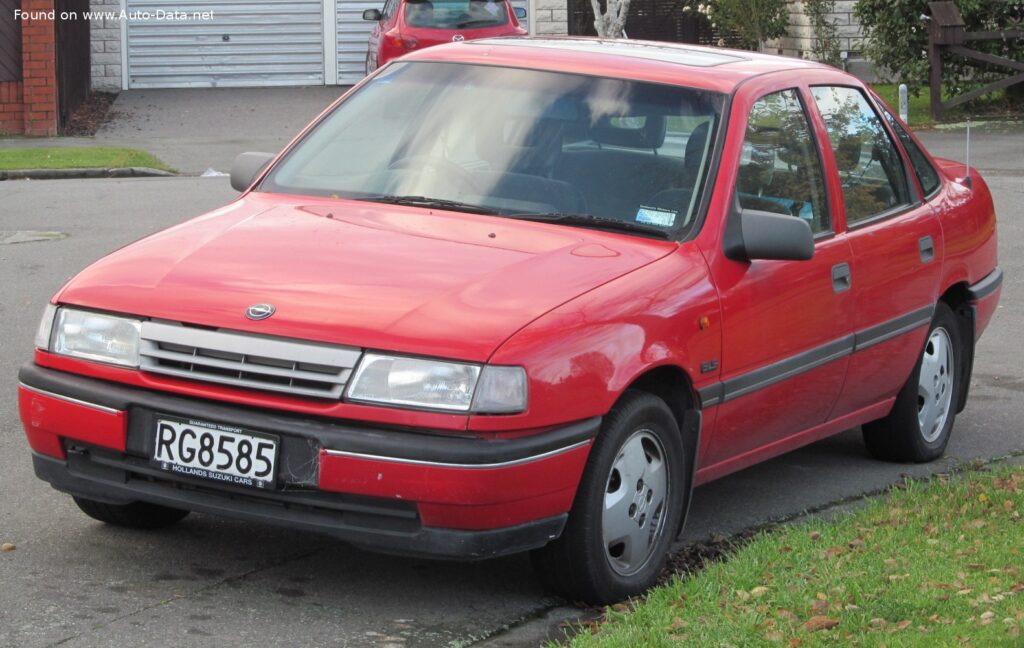
The Opel Vectra B CC (facelift 1999) 2.0 DI 16V represents a mid-cycle refresh of the second-generation Vectra, a large family car engineered by the German automaker Opel. While not officially sold in the United States, the Vectra was a significant model in Europe, competing with vehicles like the Ford Mondeo, Volkswagen Passat, and Peugeot 406. The “CC” designation stands for “Comfort and Communication,” highlighting the model’s focus on providing a well-equipped and comfortable driving experience. This particular variant, powered by a 2.0-liter direct injection diesel engine, aimed to balance fuel efficiency with acceptable performance for the European market.
Opel Vectra B CC: A European Family Sedan
The Vectra B, launched in 1995, was a crucial model for Opel, representing a move upmarket in terms of design, technology, and build quality. The facelifted version in 1999 brought subtle styling changes, improved interior materials, and updated engine options. The 2.0 DI 16V model was positioned as a practical choice for drivers prioritizing fuel economy and low running costs, particularly those covering long distances. It offered a blend of comfort, space, and efficiency, making it a popular choice for families and company car fleets across Europe.
Engine & Performance
The heart of the Vectra B CC 2.0 DI 16V is a 1,995 cc (121.74 cu. in.) inline-four cylinder diesel engine. This engine utilizes direct injection technology, signified by the “DI” in its name, and is equipped with a turbocharger and 16 valves (hence “16V”). It produces 82 horsepower (Hp) at 4,300 rpm and 185 Newton-meters (136.45 lb.-ft.) of torque between 1,800 and 2,500 rpm. While not a performance-oriented engine, the turbocharger helps to deliver usable torque at lower engine speeds, aiding in everyday driving situations. The engine is transversely mounted at the front of the vehicle. Power is delivered to the front wheels via a five-speed manual transmission. Acceleration from 0 to 100 km/h (0-62 mph) takes 15.5 seconds, and it achieves a maximum speed of 178 km/h (110.6 mph). The engine’s compression ratio of 18.5:1 is typical for a direct injection diesel, contributing to its efficiency. Fuel economy figures are respectable for its time, achieving approximately 41.3 US mpg (49.6 UK mpg) on a combined cycle.
Design & Features
The Vectra B CC is a five-door hatchback, offering a practical and versatile body style. The hatchback configuration provides easy access to the cargo area and allows for greater flexibility in carrying luggage and other items. The vehicle seats five passengers comfortably. The 1999 facelift brought minor cosmetic updates, including revised front and rear bumpers, updated headlights, and a redesigned grille. Inside, the cabin focused on providing a comfortable and functional environment. Features included power steering, ABS (Anti-lock Braking System), and a relatively spacious interior. Safety features, while not as comprehensive as modern vehicles, were improving during this period, with ABS being a key addition. The trunk offers a minimum of 480 liters (16.95 cu. ft.) of space, expanding to 790 liters (27.9 cu. ft.) with the rear seats folded down. The vehicle rides on coil springs at both the front and rear, providing a comfortable ride quality. Ventilated disc brakes are used at the front, while drum brakes are fitted at the rear.
Technical Specifications
| Brand | Opel |
| Model | Vectra |
| Generation | Vectra B CC (facelift 1999) |
| Type (Engine) | 2.0 DI 16V (82 Hp) |
| Start of production | January, 1999 |
| End of production | February, 2000 |
| Powertrain Architecture | Internal Combustion engine |
| Body type | Hatchback |
| Seats | 5 |
| Doors | 5 |
| Fuel consumption (urban) | 7.7 l/100 km (30.5 US mpg, 36.7 UK mpg, 13 km/l) |
| Fuel consumption (extra urban) | 4.6 l/100 km (51.1 US mpg, 61.4 UK mpg, 21.7 km/l) |
| Fuel consumption (combined) | 5.7 l/100 km (41.3 US mpg, 49.6 UK mpg, 17.5 km/l) |
| Fuel Type | Diesel |
| Acceleration 0 – 100 km/h | 15.5 sec |
| Acceleration 0 – 62 mph | 15.5 sec |
| Acceleration 0 – 60 mph | 14.7 sec |
| Maximum speed | 178 km/h (110.6 mph) |
| Weight-to-power ratio | 16.3 kg/Hp |
| Weight-to-torque ratio | 7.2 kg/Nm |
| Power | 82 Hp @ 4300 rpm |
| Torque | 185 Nm @ 1800-2500 rpm (136.45 lb.-ft. @ 1800-2500 rpm) |
| Engine layout | Front, Transverse |
| Engine Model/Code | X20DTL |
| Engine displacement | 1995 cm3 (121.74 cu. in.) |
| Number of cylinders | 4 |
| Engine configuration | Inline |
| Cylinder Bore | 84 mm (3.31 in.) |
| Piston Stroke | 90 mm (3.54 in.) |
| Compression ratio | 18.5:1 |
| Number of valves per cylinder | 4 |
| Fuel injection system | Diesel Commonrail |
| Engine aspiration | Turbocharger |
| Valvetrain | OHC |
| Engine oil capacity | 5.5 l (5.81 US qt | 4.84 UK qt) |
| Coolant | 7.4 l (7.82 US qt | 6.51 UK qt) |
| Kerb Weight | 1335 kg (2943.17 lbs.) |
| Max. weight | 1870 kg (4122.64 lbs.) |
| Max load | 535 kg (1179.47 lbs.) |
| Trunk (boot) space – minimum | 480 l (16.95 cu. ft.) |
| Trunk (boot) space – maximum | 790 l (27.9 cu. ft.) |
| Fuel tank capacity | 60 l (15.85 US gal | 13.2 UK gal) |
| Length | 4495 mm (176.97 in.) |
| Width | 1707 mm (67.2 in.) |
| Width including mirrors | 1841 mm (72.48 in.) |
| Height | 1425 mm (56.1 in.) |
| Wheelbase | 2637 mm (103.82 in.) |
| Front track | 1484 mm (58.43 in.) |
| Rear (Back) track | 1487 mm (58.54 in.) |
| Drive wheel | Front wheel drive |
| Number of gears and type of gearbox | 5 gears, manual transmission |
| Front suspension | Coil spring |
| Rear suspension | Coil spring |
| Front brakes | Ventilated discs |
| Rear brakes | Drum |
| Assisting systems | ABS (Anti-lock braking system) |
| Steering type | Steering rack and pinion |
| Power steering | Hydraulic Steering |
| Tires size | 195/65 R15 |
| Wheel rims size | 15 |
The Opel Vectra B CC 2.0 DI 16V, while not a groundbreaking vehicle, represented a solid and practical choice for European buyers seeking a comfortable, fuel-efficient, and reasonably spacious family car. Its blend of features and affordability contributed to its success in a competitive market segment.