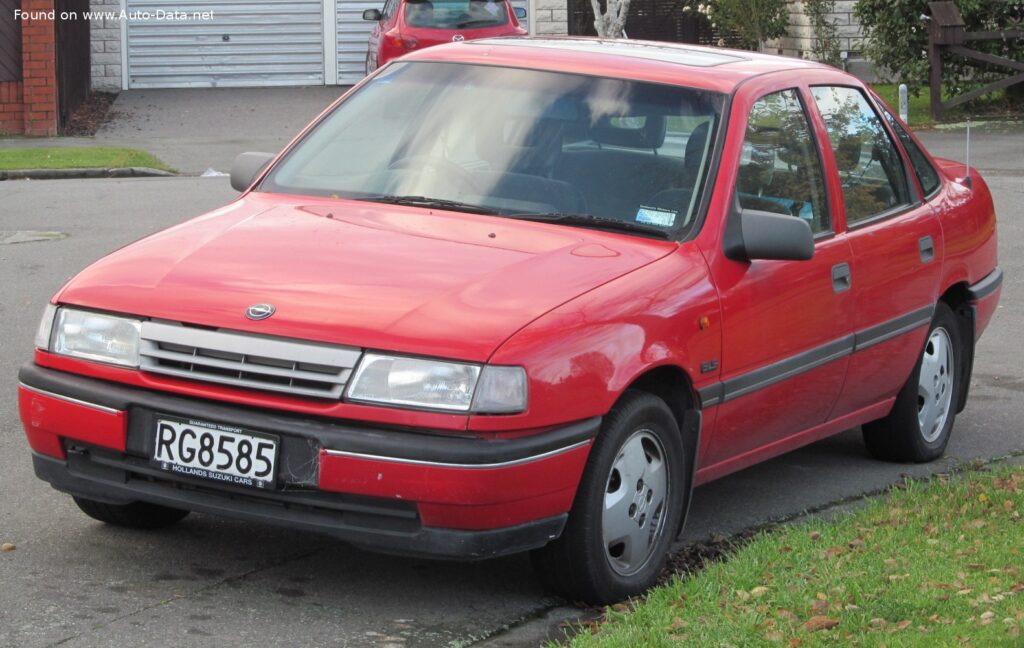
The Opel Vectra B CC (facelift 1999) 2.2 16V represents a significant iteration of Opel’s mid-size offering, produced from 2000 to 2002. Positioned as a competitor to vehicles like the Ford Mondeo and Volkswagen Passat in the European market, the Vectra B aimed to provide a blend of practicality, comfort, and performance. The “CC” designation stands for “Comfort Coupe,” referring to the hatchback body style which was popular in Europe. While not officially sold in the United States, understanding the Vectra B provides insight into the engineering and design trends of European automakers during the late 1990s and early 2000s.
Opel Vectra B CC: An Overview
The Vectra B, launched in 1995, was a crucial model for Opel, representing a move upmarket in terms of design and technology. The 1999 facelift brought revised styling, improved safety features, and updated engine options. The 2.2 16V variant, producing 147 horsepower, was a popular choice, offering a balance between fuel economy and performance for everyday driving. The Vectra B’s success was largely confined to the European market, where its practicality and relatively affordable price point resonated with buyers. It served as a key model in establishing Opel’s presence in the competitive D-segment.
Engine & Performance
The heart of the Vectra B CC 2.2 16V is its 2.2-liter inline four-cylinder engine, designated the Z22SE. This naturally aspirated engine delivers 147 horsepower at 5800 rpm and 203 Nm (149.73 lb.-ft.) of torque at 4000 rpm. The engine utilizes multi-port fuel injection and a double overhead camshaft (DOHC) valvetrain, contributing to its relatively efficient operation and responsive power delivery. Paired with a 5-speed manual transmission, the Vectra B CC 2.2 16V achieves a 0-100 km/h (0-62 mph) acceleration time of 9.5 seconds and a maximum speed of 218 km/h (135.46 mph). The weight-to-power ratio of 8.8 kg/Hp and weight-to-torque ratio of 6.4 kg/Nm indicate a reasonably efficient powertrain for its time. Fuel consumption is rated at 8.4 liters per 100 kilometers (28 US mpg), making it a practical choice for daily commuting.
Design & Features
The Vectra B CC is a five-door hatchback, offering a versatile combination of passenger space and cargo capacity. Its design, updated with the 1999 facelift, features a more streamlined front end and revised taillights. Inside, the Vectra B CC prioritizes comfort and functionality. The interior offers seating for five passengers and a trunk volume ranging from 480 liters (16.95 cu. ft.) with the rear seats up to 1423 liters (50.25 cu. ft.) with the rear seats folded down. Safety features, while not as advanced as modern vehicles, included ABS (Anti-lock Braking System) as standard equipment. Hydraulic power steering provides ease of maneuverability. The vehicle’s dimensions – 4495 mm (176.97 in.) in length, 1707 mm (67.2 in.) in width, and 1425 mm (56.1 in.) in height – position it squarely within the mid-size segment. The front suspension utilizes coil springs, while the rear also employs a coil spring setup, providing a comfortable ride quality.
Technical Specifications
| Brand | Opel |
| Model | Vectra |
| Generation | Vectra B CC (facelift 1999) |
| Type (Engine) | 2.2 16V (147 Hp) |
| Start of production | July, 2000 |
| End of production | January, 2002 |
| Powertrain Architecture | Internal Combustion engine |
| Body type | Hatchback |
| Seats | 5 |
| Doors | 5 |
| Fuel consumption (combined) | 8.4 l/100 km |
| Fuel consumption (US mpg) | 28 US mpg |
| Fuel consumption (UK mpg) | 33.6 UK mpg |
| Fuel consumption (km/l) | 11.9 km/l |
| Fuel Type | Petrol (Gasoline) |
| Acceleration 0 – 100 km/h | 9.5 sec |
| Acceleration 0 – 62 mph | 9.5 sec |
| Acceleration 0 – 60 mph | 9 sec |
| Maximum speed | 218 km/h |
| Maximum speed (mph) | 135.46 mph |
| Weight-to-power ratio | 8.8 kg/Hp |
| Weight-to-torque ratio | 6.4 kg/Nm |
| Power | 147 Hp @ 5800 rpm |
| Power per litre | 66.9 Hp/l |
| Torque | 203 Nm @ 4000 rpm |
| Torque (lb.-ft.) | 149.73 lb.-ft. @ 4000 rpm |
| Engine layout | Front, Transverse |
| Engine Model/Code | Z22SE |
| Engine displacement | 2198 cm3 |
| Engine displacement (cu. in.) | 134.13 cu. in. |
| Number of cylinders | 4 |
| Engine configuration | Inline |
| Cylinder Bore | 86 mm |
| Cylinder Bore (in.) | 3.39 in. |
| Piston Stroke | 94.6 mm |
| Piston Stroke (in.) | 3.72 in. |
| Compression ratio | 10:1 |
| Number of valves per cylinder | 4 |
| Fuel injection system | Multi-port manifold injection |
| Engine aspiration | Naturally aspirated engine |
| Valvetrain | DOHC |
| Engine oil capacity | 5 l |
| Engine oil capacity (US qt) | 5.28 US qt |
| Engine oil capacity (UK qt) | 4.4 UK qt |
| Coolant | 6.9 l |
| Coolant (US qt) | 7.29 US qt |
| Coolant (UK qt) | 6.07 UK qt |
| Kerb Weight | 1290 kg |
| Kerb Weight (lbs.) | 2843.96 lbs. |
| Max. weight | 1815 kg |
| Max. weight (lbs.) | 4001.39 lbs. |
| Max load | 525 kg |
| Max load (lbs.) | 1157.43 lbs. |
| Trunk (boot) space – minimum | 480 l |
| Trunk (boot) space – minimum (cu. ft.) | 16.95 cu. ft. |
| Trunk (boot) space – maximum | 1423 l |
| Trunk (boot) space – maximum (cu. ft.) | 50.25 cu. ft. |
| Fuel tank capacity | 60 l |
| Fuel tank capacity (US gal) | 15.85 US gal |
| Fuel tank capacity (UK gal) | 13.2 UK gal |
| Length | 4495 mm |
| Length (in.) | 176.97 in. |
| Width | 1707 mm |
| Width (in.) | 67.2 in. |
| Width including mirrors | 1841 mm |
| Width including mirrors (in.) | 72.48 in. |
| Height | 1425 mm |
| Height (in.) | 56.1 in. |
| Wheelbase | 2637 mm |
| Wheelbase (in.) | 103.82 in. |
| Front track | 1484 mm |
| Front track (in.) | 58.43 in. |
| Rear (Back) track | 1487 mm |
| Rear (Back) track (in.) | 58.54 in. |
| Drivetrain Architecture | The Internal combustion engine (ICE) drives the front wheels of the vehicle. |
| Drive wheel | Front wheel drive |
| Number of gears and type of gearbox | 5 gears, manual transmission |
| Front suspension | Coil spring |
| Rear suspension | Coil spring |
| Front brakes | Ventilated discs |
| Rear brakes | Disc |
| Assisting systems | ABS (Anti-lock braking system) |
| Steering type | Steering rack and pinion |
| Power steering | Hydraulic Steering |
| Tires size | 195/65 R15 |
| Wheel rims size | 15 |