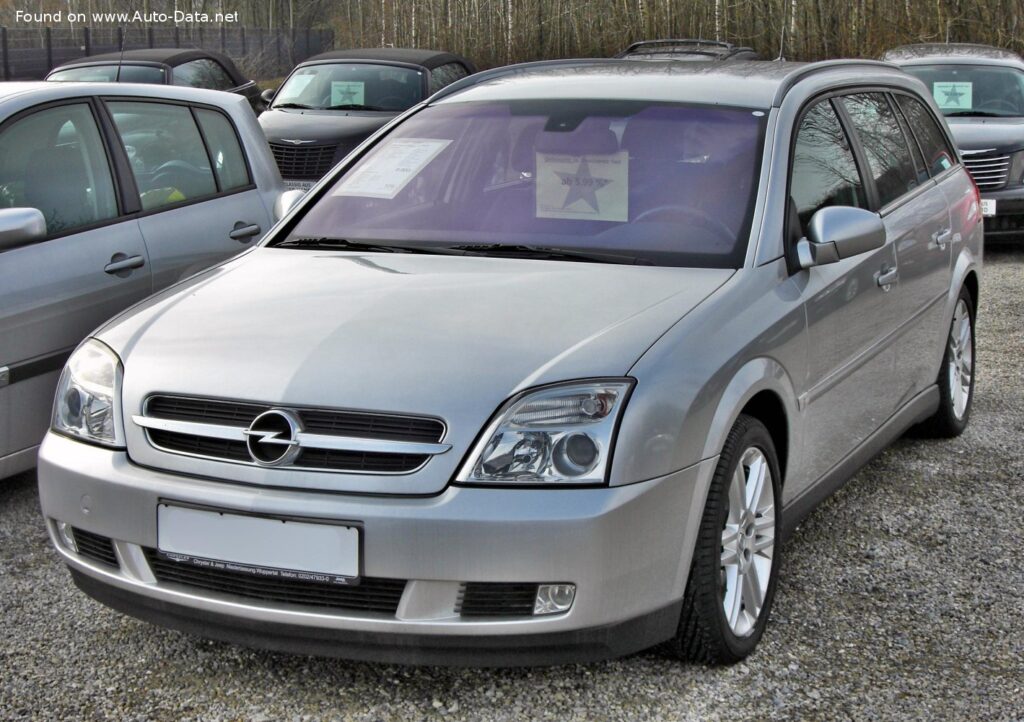
The Opel Vectra C Caravan 1.9 CDTI, produced from 2004 to 2005, represents a significant iteration in Opel’s mid-size family car lineage. As a station wagon (estate) variant of the Vectra C, it aimed to provide practicality and versatility to European buyers. While not officially sold in the United States, the Vectra C competed with models like the Ford Mondeo and Volkswagen Passat in the European market, offering a blend of comfort, space, and fuel efficiency. This particular version, equipped with a 1.9-liter CDTI diesel engine producing 120 horsepower, was designed to appeal to drivers prioritizing economy and everyday usability.
Opel Vectra C Caravan: A Detailed Overview
The Vectra C, launched in 2002, was a crucial model for Opel, representing a move towards more modern design and technology. The Caravan (estate) body style further enhanced the vehicle’s appeal by offering increased cargo capacity, making it a popular choice for families and those requiring substantial load-carrying ability. The 1.9 CDTI engine variant was a key component of Opel’s diesel lineup, offering a balance between performance and fuel economy, crucial in the European market where diesel fuel was, and remains, prevalent.
Engine & Performance
The heart of the Vectra C Caravan 1.9 CDTI is its Z19DT inline four-cylinder diesel engine. Displacing 1910 cubic centimeters (116.56 cubic inches), this engine utilizes a turbocharger with an intercooler to boost power output to 120 horsepower at 3500 rpm. More importantly for many drivers, it generates a respectable 280 Newton-meters (206.52 lb.-ft.) of torque between 2000 and 2750 rpm. This torque band provides strong pulling power for everyday driving and when carrying a load. The engine features a diesel commonrail fuel injection system, contributing to improved combustion efficiency and reduced emissions. Power is delivered to the front wheels via a six-speed manual transmission. Performance figures include a 0-100 km/h (0-62 mph) acceleration time of 12.2 seconds and a maximum speed of 195 km/h (121.17 mph). The 0-60 mph time is calculated at 11.6 seconds. The weight-to-power ratio of 13.5 kg/Hp and weight-to-torque ratio of 5.8 kg/Nm demonstrate a reasonable balance between weight and engine output.
Design & Features
The Vectra C Caravan boasts a traditional station wagon silhouette, prioritizing practicality and cargo space. Its five-door configuration provides easy access for passengers and loading. The interior is designed with family use in mind, offering seating for five occupants. Key features of the Vectra C Caravan focused on safety and convenience. Standard equipment included ABS (Anti-lock Braking System) to enhance braking performance, and a robust chassis designed for stability. The spacious interior offered a comfortable environment for long journeys. The rear seats could be folded down to significantly increase cargo capacity, ranging from a minimum of 530 liters (18.72 cubic feet) to a maximum of 1850 liters (65.33 cubic feet) with the seats folded. The exterior design, while not overtly sporty, was modern for its time, featuring a streamlined profile and integrated headlights. The vehicle’s dimensions – 4822 mm (189.84 in) in length, 1798 mm (70.79 in) in width, and 1500 mm (59.06 in) in height – positioned it squarely within the mid-size family car segment.
Technical Specifications
| Brand | Opel |
| Model | Vectra |
| Generation | Vectra C Caravan |
| Type (Engine) | 1.9 CDTI (120 Hp) |
| Start of production | January, 2004 |
| End of production | 2005 |
| Powertrain Architecture | Internal Combustion engine |
| Body type | Station wagon (estate) |
| Seats | 5 |
| Doors | 5 |
| Fuel consumption (urban) | 7.7 l/100 km (30.5 US mpg, 36.7 UK mpg, 13 km/l) |
| Fuel consumption (extra urban) | 5 l/100 km (47 US mpg, 56.5 UK mpg, 20 km/l) |
| Fuel consumption (combined) | 6 l/100 km (39.2 US mpg, 47.1 UK mpg, 16.7 km/l) |
| Fuel Type | Diesel |
| Acceleration 0 – 100 km/h | 12.2 sec |
| Acceleration 0 – 62 mph | 12.2 sec |
| Acceleration 0 – 60 mph | 11.6 sec |
| Maximum speed | 195 km/h (121.17 mph) |
| Weight-to-power ratio | 13.5 kg/Hp |
| Weight-to-torque ratio | 5.8 kg/Nm |
| Power | 120 Hp @ 3500 rpm |
| Torque | 280 Nm @ 2000-2750 rpm (206.52 lb.-ft. @ 2000-2750 rpm) |
| Engine layout | Front, Transverse |
| Engine Model/Code | Z19DT |
| Engine displacement | 1910 cm3 (116.56 cu. in.) |
| Number of cylinders | 4 |
| Engine configuration | Inline |
| Cylinder Bore | 82 mm (3.23 in.) |
| Piston Stroke | 90.4 mm (3.56 in.) |
| Compression ratio | 18:1 |
| Number of valves per cylinder | 2 |
| Fuel injection system | Diesel Commonrail |
| Engine aspiration | Turbocharger, Intercooler |
| Valvetrain | OHC |
| Engine oil capacity | 4.3 l (4.54 US qt | 3.78 UK qt) |
| Coolant | 7 l (7.4 US qt | 6.16 UK qt) |
| Kerb Weight | 1625 kg (3582.51 lbs.) |
| Max. weight | 2160 kg (4761.98 lbs.) |
| Max load | 535 kg (1179.47 lbs.) |
| Trunk (boot) space – minimum | 530 l (18.72 cu. ft.) |
| Trunk (boot) space – maximum | 1850 l (65.33 cu. ft.) |
| Fuel tank capacity | 60 l (15.85 US gal | 13.2 UK gal) |
| Length | 4822 mm (189.84 in.) |
| Width | 1798 mm (70.79 in.) |
| Height | 1500 mm (59.06 in.) |
| Wheelbase | 2830 mm (111.42 in.) |
| Front track | 1536 mm (60.47 in.) |
| Rear (Back) track | 1525 mm (60.04 in.) |
| Drivetrain Architecture | The Internal combustion engine (ICE) drives the front wheels of the vehicle. |
| Drive wheel | Front wheel drive |
| Number of gears and type of gearbox | 6 gears, manual transmission |
| Front suspension | Spring Strut |
| Rear suspension | Several levers and rods |
| Front brakes | Ventilated discs |
| Rear brakes | Disc |
| Assisting systems | ABS (Anti-lock braking system) |
| Steering type | Steering rack and pinion |
| Tires size | 195/65 R15 |
| Wheel rims size | 6.5J X 15 |
The Opel Vectra C Caravan 1.9 CDTI, while not a performance icon, offered a practical and efficient transportation solution for European families. Its combination of spaciousness, fuel economy, and reasonable performance made it a competitive offering in the mid-size segment. Although not sold in the US, understanding its specifications and role in the European market provides insight into the diverse automotive landscape and the varying priorities of different consumer bases.