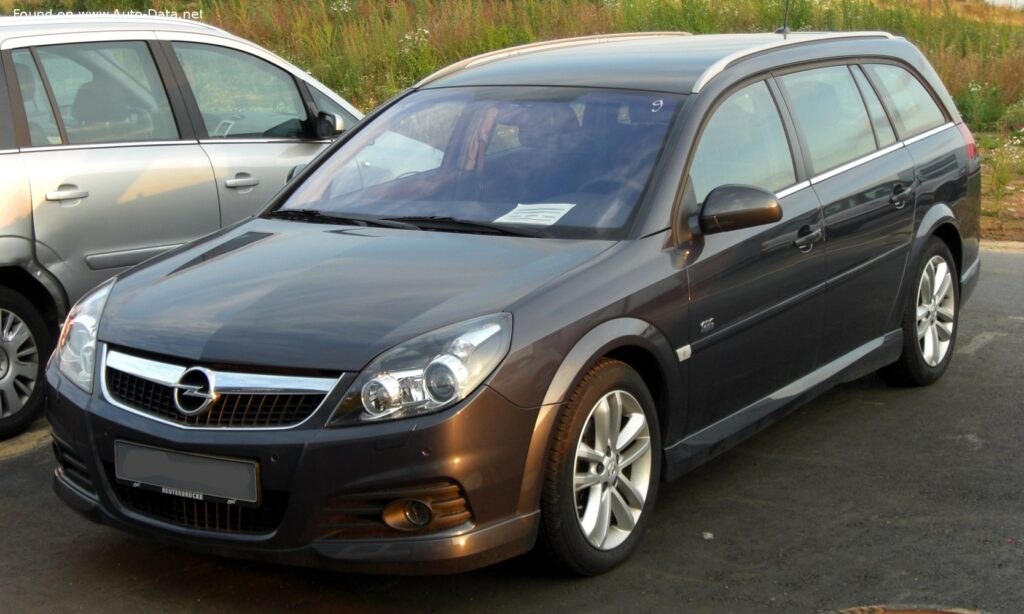
The Opel Vectra C Caravan (facelift 2005) 1.8i 16V represents a significant iteration of Opel’s mid-size family car, the Vectra. Introduced as a facelift to the C generation, which ran from 2002 to 2008, this variant focused on refining the existing platform with updated styling, improved features, and enhanced efficiency. Primarily sold in Europe, the Vectra C Caravan competed with vehicles like the Ford Mondeo Estate, Volkswagen Passat Variant, and Peugeot 407 SW, offering a practical and relatively affordable option in the station wagon segment. The facelift brought subtle but noticeable changes to the front and rear fascias, along with interior upgrades, aiming to maintain the Vectra’s appeal in a competitive market.
Opel Vectra C Caravan: A Detailed Overview
The Vectra nameplate has a long history within Opel, dating back to 1988. The C generation, and specifically the facelifted 2005 model, aimed to address criticisms of the earlier C-series cars, particularly regarding interior quality and refinement. The Caravan body style, Opel’s designation for a station wagon or estate, was a crucial part of the Vectra lineup, catering to buyers needing increased cargo capacity and versatility. While not officially sold in the United States, understanding the Vectra C Caravan provides insight into the European automotive landscape of the mid-2000s and Opel’s engineering approach to family transportation.
Engine & Performance
The 1.8i 16V engine powering the 2005 Opel Vectra C Caravan is a naturally aspirated, inline-four cylinder gasoline engine. Designated the Z18XER engine code, it produces 140 horsepower at 6,300 rpm and 175 Nm (129.07 lb.-ft.) of torque at 3,800 rpm. This engine, common in various Opel and Vauxhall models of the era, utilizes multi-port fuel injection and a double overhead camshaft (DOHC) valvetrain with four valves per cylinder. The engine’s 1796 cm³ (109.6 cu. in.) displacement provides a balance between performance and fuel economy. Acceleration from 0 to 100 km/h (0-62 mph) takes 11.2 seconds, while reaching 0 to 60 mph is achieved in approximately 10.6 seconds. The vehicle boasts a maximum speed of 209 km/h (129.87 mph). The weight-to-power ratio of 10.2 kg/Hp and a weight-to-torque ratio of 8.1 kg/Nm indicate a reasonably efficient powertrain for its time. The engine is paired with a 5-speed manual transmission, delivering power to the front wheels.
Design & Features
The Opel Vectra C Caravan is a five-door, five-seat station wagon. Its design emphasizes practicality and a relatively understated aesthetic. The facelifted model features revised headlights, a new grille, and a redesigned front bumper, giving it a more modern appearance compared to the pre-facelift versions. The Caravan body style provides a generous cargo area, with a minimum capacity of 530 liters (18.72 cu. ft.) expanding to a substantial 1850 liters (65.33 cu. ft.) with the rear seats folded down.
Inside, the 2005 Vectra C Caravan offers a functional and comfortable cabin. While not overtly luxurious, the facelift brought improvements to interior materials and build quality. Standard features typically included air conditioning, power windows, central locking, and an audio system. Safety features, increasingly important in the mid-2000s, included ABS (Anti-lock Braking System) and front airbags. The vehicle’s suspension utilizes independent coil springs on both the front and rear axles, providing a comfortable ride quality. The vehicle’s dimensions are 4839 mm (190.51 in.) in length, 1798 mm (70.79 in.) in width, and 1500 mm (59.06 in.) in height, with a wheelbase of 2830 mm (111.42 in.).
Technical Specifications
| Brand | Opel |
| Model | Vectra |
| Generation | Vectra C Caravan (facelift 2005) |
| Type (Engine) | 1.8i 16V (140 Hp) |
| Start of production | November, 2005 |
| End of production | August, 2008 |
| Powertrain Architecture | Internal Combustion engine |
| Body type | Station wagon (estate) |
| Seats | 5 |
| Doors | 5 |
| Fuel consumption (urban) | 10.4 l/100 km (22.6 US mpg / 27.2 UK mpg / 9.6 km/l) |
| Fuel consumption (extra urban) | 6.1 l/100 km (38.6 US mpg / 46.3 UK mpg / 16.4 km/l) |
| Fuel consumption (combined) | 7.7 l/100 km (30.5 US mpg / 36.7 UK mpg / 13 km/l) |
| Fuel Type | Petrol (Gasoline) |
| Acceleration 0 – 100 km/h | 11.2 sec |
| Acceleration 0 – 62 mph | 11.2 sec |
| Acceleration 0 – 60 mph | 10.6 sec |
| Maximum speed | 209 km/h (129.87 mph) |
| Weight-to-power ratio | 10.2 kg/Hp |
| Weight-to-torque ratio | 8.1 kg/Nm |
| Power | 140 Hp @ 6300 rpm |
| Power per litre | 78 Hp/l |
| Torque | 175 Nm @ 3800 rpm (129.07 lb.-ft. @ 3800 rpm) |
| Engine layout | Front, Transverse |
| Engine Model/Code | Z18XER |
| Engine displacement | 1796 cm3 (109.6 cu. in.) |
| Number of cylinders | 4 |
| Engine configuration | Inline |
| Cylinder Bore | 80.5 mm (3.17 in.) |
| Piston Stroke | 88.2 mm (3.47 in.) |
| Compression ratio | 10.5:1 |
| Number of valves per cylinder | 4 |
| Fuel injection system | Multi-port manifold injection |
| Engine aspiration | Naturally aspirated engine |
| Valvetrain | DOHC |
| Engine oil capacity | 4.5 l (4.76 US qt | 3.96 UK qt) |
| Coolant | 6.1 l (6.45 US qt | 5.37 UK qt) |
| Kerb Weight | 1425 kg (3141.59 lbs.) |
| Max. weight | 2030 kg (4475.38 lbs.) |
| Max load | 605 kg (1333.8 lbs.) |
| Trunk (boot) space – minimum | 530 l (18.72 cu. ft.) |
| Trunk (boot) space – maximum | 1850 l (65.33 cu. ft.) |
| Fuel tank capacity | 60 l (15.85 US gal | 13.2 UK gal) |
| Length | 4839 mm (190.51 in.) |
| Width | 1798 mm (70.79 in.) |
| Height | 1500 mm (59.06 in.) |
| Wheelbase | 2830 mm (111.42 in.) |
| Front track | 1536 mm (60.47 in.) |
| Rear (Back) track | 1525 mm (60.04 in.) |
| Drivetrain Architecture | Front wheel drive |
| Number of gears and type of gearbox | 5 gears, manual transmission |
| Front suspension | Independent coil spring |
| Rear suspension | Independent coil spring |
| Front brakes | Disc |
| Rear brakes | Disc |
| Assisting systems | ABS (Anti-lock braking system) |
| Tires size | 195/65 R15 |
| Wheel rims size | 15 |