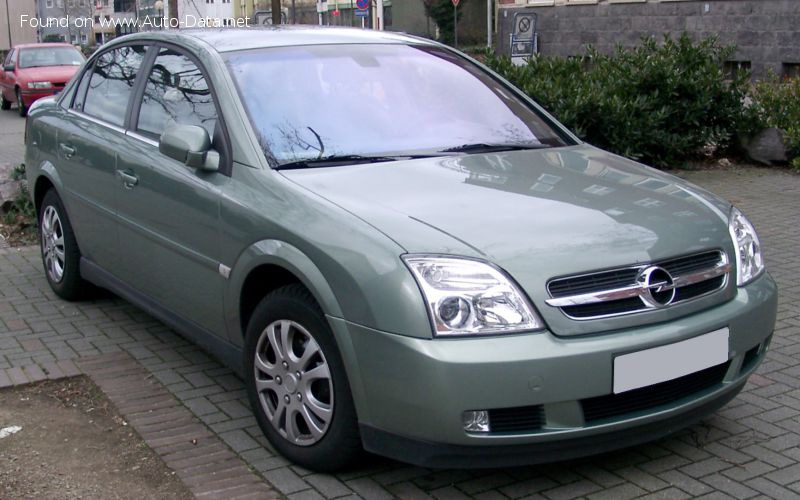
The Opel Vectra C CC 1.9 CDTI (150 Hp) represents a significant offering from Opel, a prominent European automotive manufacturer, during the mid-2000s. Positioned squarely in the competitive European D-segment, the Vectra C generation, produced from 2002 to 2008, aimed to provide a sophisticated yet practical solution for families and business users alike. The “CC” designation, often interpreted as “Compact Coupe” or “Caravan Coupe” in Opel’s nomenclature, refers to the five-door hatchback body style, blending the sleek profile of a coupe with the utility of a traditional hatchback. This particular variant, the 1.9 CDTI with 150 horsepower, was introduced in January 2004 and ceased production in 2005, carving out a niche for itself as a potent and fuel-efficient option within the Vectra lineup. It was designed to appeal to buyers prioritizing a balance of performance, economy, and everyday practicality, a common demand in the European market where diesel engines held considerable sway. While the Opel brand was not sold in the United States, its engineering and market philosophy often mirrored global trends, albeit tailored to regional preferences, making this model a prime example of European automotive design and technical prowess from its era.
Engine and Performance of the Opel Vectra C CC 1.9 CDTI (150 Hp)
At the heart of the Opel Vectra C CC 1.9 CDTI (150 Hp) lies a robust and highly efficient diesel powertrain, a hallmark of European engineering in the early 21st century. The engine, identified by the code Z19DTH, is an inline four-cylinder unit with a displacement of 1910 cubic centimeters (1.9 liters or 116.56 cubic inches). This engine was a product of a joint venture between General Motors and Fiat, a collaboration that yielded some of the most respected diesel engines of its time. It features a Double Overhead Camshaft (DOHC) valvetrain with four valves per cylinder, a configuration known for optimizing airflow and combustion efficiency. The fuel injection system is a sophisticated Commonrail Diesel setup, which allows for precise control over fuel delivery, contributing to both power output and reduced emissions.
Further enhancing its capabilities, the engine is equipped with a turbocharger and an intercooler. The turbocharger significantly boosts the engine’s power by forcing more air into the cylinders, while the intercooler cools this compressed air, making it denser and further improving combustion. This combination results in a peak power output of 150 horsepower, achieved at a relatively low 4000 revolutions per minute (rpm). More impressively for a diesel, it produces a substantial 236.02 lb.-ft. (320 Nm) of torque, available from just 2000 rpm. This broad torque band provides excellent tractability and strong acceleration from low speeds, making it ideal for both city driving and highway cruising.
The performance figures underscore the engine’s capabilities. The Opel Vectra C CC 1.9 CDTI can accelerate from 0 to 60 miles per hour in a brisk 9.3 seconds, with 0-100 km/h achieved in 9.8 seconds. Its maximum speed is an impressive 134.84 miles per hour (217 km/h), demonstrating its competence on unrestricted European autobahns. Power is delivered to the front wheels via a smooth and precise 6-speed manual transmission, offering drivers full control over the engine’s output and contributing to the vehicle’s overall efficiency. The weight-to-power ratio stands at 10.4 kg/Hp (96.5 Hp/tonne), while the weight-to-torque ratio is 4.9 kg/Nm (205.8 Nm/tonne), indicating a well-balanced power delivery for its class. Fuel economy was a major selling point for this diesel, with a combined rating of 39.9 US mpg (5.9 l/100 km), an urban rating of 30.9 US mpg (7.6 l/100 km), and an extra-urban rating of 48 US mpg (4.9 l/100 km), making it a highly economical choice for its segment.
Design and Features
The Opel Vectra C CC, a 5-door hatchback, was designed with a focus on both aesthetic appeal and practical utility. Its body type, often referred to as a liftback, offered a more dynamic profile than the traditional sedan while retaining the versatile cargo capacity typically associated with a wagon. The exterior dimensions of 180.94 inches (4596 mm) in length, 70.79 inches (1798 mm) in width (80.16 inches or 2036 mm including mirrors), and 57.48 inches (1460 mm) in height provided a substantial road presence. A generous wheelbase of 106.3 inches (2700 mm) contributed significantly to interior cabin space, especially for rear passengers, and enhanced ride stability. The design featured a relatively long front overhang of 35.63 inches (905 mm) and a rear overhang of 39.02 inches (991 mm), giving the car a balanced and mature stance.
Inside, the Vectra C CC offered seating for five occupants, emphasizing comfort and ergonomics for long journeys. The interior design of the Vectra C generation was characterized by clear lines and a functional layout, typical of German engineering, prioritizing ease of use and driver focus. While specific interior features are not detailed in the technical data, a car in this segment from 2004 would typically include amenities such as air conditioning, power windows, central locking, and a basic audio system, all designed to enhance the driving and passenger experience. The cabin environment was intended to be refined, minimizing noise and vibration, particularly important for a diesel-powered vehicle.
Practicality was a strong suit for the Vectra C CC. The hatchback configuration allowed for excellent cargo flexibility, with a minimum trunk (boot) space of 17.66 cubic feet (500 liters). When the rear seats were folded down, this expanded dramatically to an impressive 48.03 cubic feet (1360 liters), making it capable of accommodating large items or luggage for extended trips. This adaptability was a key differentiator in the European market, where versatile family vehicles are highly valued. The fuel tank capacity of 16.11 US gallons (61 liters) provided a substantial cruising range, further cementing its credentials as a capable long-distance tourer.
In terms of chassis and safety, the Vectra C CC was engineered for a confident and comfortable ride. The front suspension utilized a Spring Strut design, a common and effective setup for front-wheel-drive vehicles, offering a good balance of handling and ride comfort. The rear suspension featured a more sophisticated multi-link arrangement, which improved stability and handling dynamics, especially during cornering and over uneven surfaces. Braking performance was ensured by ventilated discs at the front and solid discs at the rear, complemented by an Anti-lock Braking System (ABS) for enhanced safety during emergency stops. The steering system was a responsive rack and pinion type, providing direct feedback to the driver. The vehicle was fitted with 215/55 R16 tires on 6.5J x 16 wheel rims, a practical size for both grip and ride quality. Overall, the Opel Vectra C CC 1.9 CDTI (150 Hp) was a well-rounded package, offering a blend of modern design, comprehensive features, and robust engineering tailored for the demands of its target market.
Technical Specifications
| Brand | Opel |
| Model | Vectra |
| Generation | Vectra C CC |
| Type (Engine) | 1.9 CDTI (150 Hp) |
| Start of production | January, 2004 year |
| End of production | 2005 year |
| Powertrain Architecture | Internal Combustion engine |
| Body type | Hatchback |
| Seats | 5 |
| Doors | 5 |
| Fuel consumption (economy) – urban | 7.6 l/100 km (30.9 US mpg) |
| Fuel consumption (economy) – extra urban | 4.9 l/100 km (48 US mpg) |
| Fuel consumption (economy) – combined | 5.9 l/100 km (39.9 US mpg) |
| Fuel Type | Diesel |
| Acceleration 0 – 60 mph | 9.3 sec |
| Acceleration 0 – 100 km/h | 9.8 sec |
| Maximum speed | 217 km/h (134.84 mph) |
| Weight-to-power ratio | 10.4 kg/Hp (96.5 Hp/tonne) |
| Weight-to-torque ratio | 4.9 kg/Nm (205.8 Nm/tonne) |
| Power | 150 Hp @ 4000 rpm. |
| Power per litre | 78.5 Hp/l |
| Torque | 320 Nm @ 2000 rpm (236.02 lb.-ft.) |
| Engine layout | Front, Transverse |
| Engine Model/Code | Z19DTH |
| Engine displacement | 1910 cm3 (1.9 l, 116.56 cu. in.) |
| Number of cylinders | 4 |
| Engine configuration | Inline |
| Cylinder Bore | 82 mm (3.23 in.) |
| Piston Stroke | 90.4 mm (3.56 in.) |
| Compression ratio | 17.5:1 |
| Number of valves per cylinder | 4 |
| Fuel injection system | Diesel Commonrail |
| Engine aspiration | Turbocharger, Intercooler |
| Valvetrain | DOHC |
| Engine oil capacity | 4.3 l (4.54 US qt) |
| Coolant | 7 l (7.4 US qt) |
| Kerb Weight | 1555 kg (3428.19 lbs.) |
| Max. weight | 2030 kg (4475.38 lbs.) |
| Max load | 475 kg (1047.2 lbs.) |
| Trunk (boot) space – minimum | 500 l (17.66 cu. ft.) |
| Trunk (boot) space – maximum | 1360 l (48.03 cu. ft.) |
| Fuel tank capacity | 61 l (16.11 US gal) |
| Length | 4596 mm (180.94 in.) |
| Width | 1798 mm (70.79 in.) |
| Width including mirrors | 2036 mm (80.16 in.) |
| Height | 1460 mm (57.48 in.) |
| Wheelbase | 2700 mm (106.3 in.) |
| Front track | 1523 mm (59.96 in.) |
| Rear (Back) track | 1513 mm (59.57 in.) |
| Front overhang | 905 mm (35.63 in.) |
| Rear overhang | 991 mm (39.02 in.) |
| Drivetrain Architecture | The Internal combustion engine (ICE) drives the front wheels of the vehicle. |
| Drive wheel | Front wheel drive |
| Number of gears and type of gearbox | 6 gears, manual transmission |
| Front suspension | Spring Strut |
| Rear suspension | Several levers and rods |
| Front brakes | Ventilated discs |
| Rear brakes | Disc |
| Assisting systems | ABS (Anti-lock braking system) |
| Steering type | Steering rack and pinion |
| Tires size | 215/55 R16 |
| Wheel rims size | 6.5J x 16 |