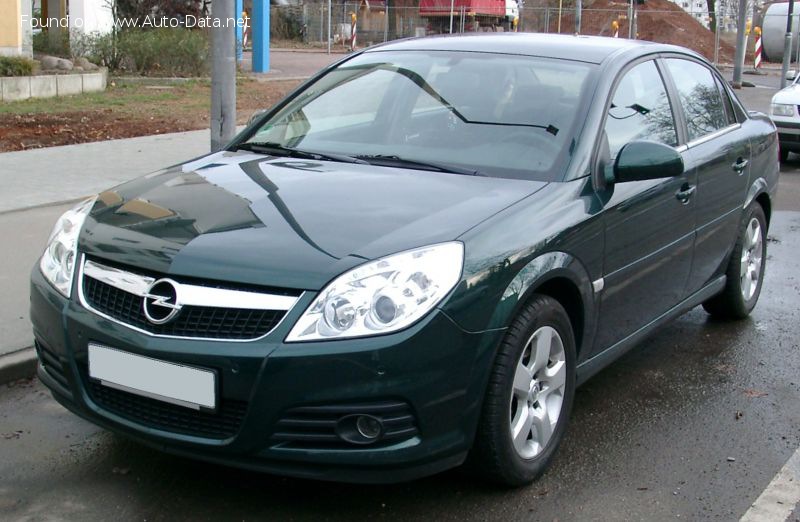
The Opel Vectra C, particularly the facelifted model introduced in 2005, represents a significant iteration of Opel’s mid-size family car, a staple in the European automotive market. Positioned within the D-segment, the Vectra C aimed to offer a blend of comfort, practicality, and dynamic performance to a broad demographic across the continent. While the Opel brand itself was not directly sold in the United States, its products, often rebadged as Vauxhalls in the UK or Saturns in North America, shared engineering lineage with General Motors’ global platforms. The 2005 facelift brought a refreshed aesthetic and enhanced technical specifications to the Vectra C, ensuring its competitiveness against rivals like the Volkswagen Passat and Ford Mondeo. This specific variant, the Opel Vectra C (facelift 2005) 2.0i 16V Turbo (175 Hp), was produced from 2005 until June 2008, embodying a period when turbocharged gasoline engines were becoming increasingly prevalent for their balance of power and efficiency.
The Opel Vectra C (facelift 2005): A Refined European Mid-Size Sedan
The Opel Vectra C, in its post-2005 facelift guise, continued to build upon the foundation of its third generation, which debuted in 2002. Opel, a German marque under the umbrella of General Motors Europe at the time, developed the Vectra C as a versatile platform, available in various body styles including a sedan, hatchback (GTS), and wagon (Caravan). The sedan variant, the focus here, was designed with a pragmatic approach, emphasizing interior space, ride comfort, and a robust build quality suitable for diverse European driving conditions, from autobahns to winding country roads. The facelift introduced subtle but effective styling revisions, including a redesigned front fascia with new headlights, grille, and bumper, giving it a more modern and assertive presence. These changes were not merely cosmetic; they aimed to keep the Vectra C visually fresh and aligned with contemporary design trends, ensuring its appeal in a highly competitive segment. The interior also received updates, focusing on improved material quality, enhanced ergonomics, and updated infotainment options, reflecting a continuous effort to refine the user experience.
Engine and Performance
At the heart of the Opel Vectra C (facelift 2005) 2.0i 16V Turbo (175 Hp) lies a sophisticated powertrain designed for spirited yet economical driving. The 2.0-liter (1998 cm3 or 121.93 cu. in.) inline-four engine, designated Z20NET, is a prime example of Opel’s engineering prowess in leveraging forced induction. This unit features a turbocharger coupled with an intercooler, a configuration that significantly boosts power output and torque across a broad RPM range. The engine produces a respectable 175 horsepower at 5500 rpm, delivering ample acceleration for daily driving and highway cruising. More importantly for real-world performance, it generates a robust 265 Nm (195.45 lb.-ft.) of torque available at a low 2500 rpm. This early torque delivery ensures responsive acceleration from a standstill and strong in-gear flexibility, minimizing the need for frequent downshifts.
The engine’s architecture includes a DOHC (Double Overhead Camshaft) valvetrain with four valves per cylinder, optimizing airflow for combustion efficiency and power delivery. The cylinder bore and piston stroke are both 86 mm (3.39 in.), indicating a square engine design, often favored for its balance of torque and high-revving capability. A compression ratio of 9.5:1 is typical for turbocharged gasoline engines, allowing for efficient combustion while mitigating the risk of pre-ignition. Fuel is delivered via a multi-port manifold injection system, a proven method for precise fuel metering. Power is channeled to the front wheels through a crisp-shifting 6-speed manual transmission, offering the driver direct control and contributing to the vehicle’s dynamic character and fuel efficiency.
Performance figures for this variant are commendable for a family sedan of its era. The Opel Vectra C 2.0i 16V Turbo accelerates from 0 to 60 mph in an estimated 8.6 seconds, with a 0-100 km/h (0-62 mph) sprint taking 9.1 seconds. Its maximum speed is an impressive 142.92 mph (230 km/h), highlighting its capability for sustained high-speed travel on European motorways. Despite its performance potential, the vehicle maintains reasonable fuel economy. The combined fuel consumption is rated at 27.4 US mpg (8.6 liters per 100 km), while extra-urban driving can yield up to 37.3 US mpg (6.3 liters per 100 km). In urban settings, consumption is naturally higher, at 18.8 US mpg (12.5 liters per 100 km). The 16.11 US gallon (61 liter) fuel tank provides a good cruising range, making it suitable for long journeys. With a curb weight of 3075.45 lbs (1395 kg), the car boasts a weight-to-power ratio of 8 kg/Hp (125.4 Hp/tonne) and a weight-to-torque ratio of 5.3 kg/Nm (190 Nm/tonne), underscoring its well-balanced performance characteristics.
Design and Features
The Opel Vectra C (facelift 2005) sedan offers a practical and understated design, prioritizing functionality and occupant comfort. Its body type is a traditional 4-door sedan, providing seating for five occupants. With an overall length of 177.6 inches (4511 mm), a width of 70.79 inches (1798 mm), and a height of 57.48 inches (1460 mm), the Vectra C occupies a significant footprint, contributing to its stable road presence and generous interior volume. The wheelbase measures 106.3 inches (2700 mm), a dimension critical for passenger legroom and ride quality, offering a smooth and composed ride even over uneven surfaces.
The vehicle’s chassis and suspension setup are engineered for a blend of comfort and predictable handling. The front suspension employs a spring strut design, a common and effective solution for MacPherson-type setups, providing direct steering response and good damping characteristics. The rear suspension features a multi-link arrangement, described as “several levers and rods,” which is crucial for maintaining tire contact with the road over varying terrain, enhancing stability, and improving ride comfort for rear passengers. Braking performance is handled by ventilated discs at the front and solid discs at the rear, a robust system for a vehicle of this size and performance. An Anti-lock Braking System (ABS) was a standard safety feature, providing enhanced control during emergency braking by preventing wheel lock-up. Steering is managed by a hydraulic rack and pinion system, offering a more tactile and connected feel to the road compared to later electric power steering systems. The car rides on 215/55 R16 tires mounted on 6.5J X 16 wheel rims, a practical size that balances grip, comfort, and replacement cost.
Practicality is a strong suit for the Vectra C sedan. The trunk (boot) space is generous, offering a minimum of 17.66 cubic feet (500 liters) with the rear seats up, expandable to a substantial 37.08 cubic feet (1050 liters) when the rear seats are folded down. This flexibility makes it highly suitable for families and individuals requiring ample cargo capacity. The maximum permissible weight for the vehicle is 4287.99 lbs (1945 kg), with a maximum payload capacity of 1212.54 lbs (550 kg), allowing for significant passenger and cargo loads. The design of the Vectra C, particularly after its 2005 facelift, solidified its position as a competent and appealing option in the highly competitive European mid-size segment, offering a compelling package of performance, practicality, and comfort.
Technical Specifications
| Brand | Opel |
| Model | Vectra |
| Generation | Vectra C (facelift 2005) |
| Type (Engine) | 2.0i 16V Turbo (175 Hp) |
| Start of production | 2005 year |
| End of production | June, 2008 year |
| Powertrain Architecture | Internal Combustion engine |
| Body type | Sedan |
| Seats | 5 |
| Doors | 4 |
| Fuel consumption (economy) – urban | 12.5 l/100 km (18.8 US mpg) |
| Fuel consumption (economy) – extra urban | 6.3 l/100 km (37.3 US mpg) |
| Fuel consumption (economy) – combined | 8.6 l/100 km (27.4 US mpg) |
| Fuel Type | Petrol (Gasoline) |
| Acceleration 0 – 60 mph | 8.6 sec |
| Acceleration 0 – 100 km/h (0 – 62 mph) | 9.1 sec |
| Maximum speed | 230 km/h (142.92 mph) |
| Weight-to-power ratio | 8 kg/Hp (125.4 Hp/tonne) |
| Weight-to-torque ratio | 5.3 kg/Nm (190 Nm/tonne) |
| Power | 175 Hp @ 5500 rpm |
| Power per liter | 87.6 Hp/l |
| Torque | 265 Nm @ 2500 rpm (195.45 lb.-ft. @ 2500 rpm) |
| Engine layout | Front, Transverse |
| Engine Model/Code | Z20NET |
| Engine displacement | 1998 cm3 (121.93 cu. in.) |
| Number of cylinders | 4 |
| Engine configuration | Inline |
| Cylinder Bore | 86 mm (3.39 in.) |
| Piston Stroke | 86 mm (3.39 in.) |
| Compression ratio | 9.5:1 |
| Number of valves per cylinder | 4 |
| Fuel injection system | Multi-port manifold injection |
| Engine aspiration | Turbocharger, Intercooler |
| Valvetrain | DOHC |
| Engine oil capacity | 6 l (6.34 US qt) |
| Coolant | 7.5 l (7.93 US qt) |
| Kerb Weight | 1395 kg (3075.45 lbs) |
| Max. weight | 1945 kg (4287.99 lbs) |
| Max load | 550 kg (1212.54 lbs) |
| Trunk (boot) space – minimum | 500 l (17.66 cu. ft.) |
| Trunk (boot) space – maximum | 1050 l (37.08 cu. ft.) |
| Fuel tank capacity | 61 l (16.11 US gal) |
| Length | 4511 mm (177.6 in.) |
| Width | 1798 mm (70.79 in.) |
| Height | 1460 mm (57.48 in.) |
| Wheelbase | 2700 mm (106.3 in.) |
| Front track | 1536 mm (60.47 in.) |
| Rear (Back) track | 1525 mm (60.04 in.) |
| Drivetrain Architecture | The Internal combustion engine (ICE) drives the front wheels of the vehicle. |
| Drive wheel | Front wheel drive |
| Number of gears and type of gearbox | 6 gears, manual transmission |
| Front suspension | Spring Strut |
| Rear suspension | Several levers and rods |
| Front brakes | Ventilated discs |
| Rear brakes | Disc |
| Assisting systems | ABS (Anti-lock braking system) |
| Steering type | Steering rack and pinion |
| Power steering | Hydraulic Steering |
| Tires size | 215/55 R16 |
| Wheel rims size | 6.5J X 16 |