
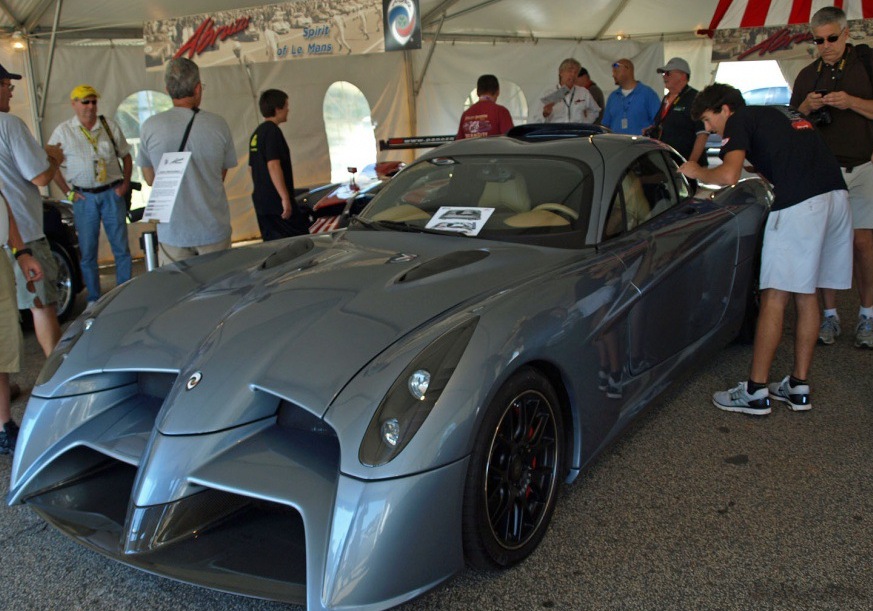
The Panoz Abruzzi Prototype, specifically the 6.2 V8 variant producing 649 horsepower, represents a brief but ambitious chapter in the history of American sports car manufacturing. Produced in extremely limited numbers during 2011, the Abruzzi was intended to be a hand-built, high-performance coupe designed to compete with European grand tourers. It was a return to Panoz’s roots of building bespoke, track-focused vehicles, harking back to the successes of the Panoz Esperante series. The Abruzzi Prototype was built around a steel tube frame chassis and featured a significant amount of carbon fiber bodywork, aiming for a lightweight and rigid platform. This particular 6.2L V8 configuration was the flagship offering, representing the pinnacle of performance for the Abruzzi line.
Technical Specifications
| Brand | Panoz |
| Model | Abruzzi |
| Generation | Abruzzi Prototype |
| Type (Engine) | 6.2 V8 (649 Hp) |
| Start of production | 2011 |
| End of production | 2011 |
| Powertrain Architecture | Internal Combustion engine |
| Body type | Coupe |
| Seats | 2 |
| Doors | 2 |
| Fuel Type | Petrol (Gasoline) |
| Acceleration 0 – 100 km/h | 3.2 sec |
| Acceleration 0 – 62 mph | 3.2 sec |
| Acceleration 0 – 60 mph | 3 sec |
| Maximum speed | 330 km/h (205.05 mph) |
| Weight-to-power ratio | 2.2 kg/Hp, 463.6 Hp/tonne |
| Weight-to-torque ratio | 1.7 kg/Nm, 582.9 Nm/tonne |
| Power | 649 Hp @ 6500 rpm |
| Power per litre | 105.3 Hp/l |
| Torque | 816 Nm @ 3800 rpm (601.85 lb.-ft. @ 3800 rpm) |
| Maximum engine speed | 6600 rpm |
| Engine displacement | 6162 cm3 (376.03 cu. in.) |
| Number of cylinders | 8 |
| Engine configuration | V-engine |
| Cylinder Bore | 103.2 mm (4.06 in.) |
| Piston Stroke | 92 mm (3.62 in.) |
| Compression ratio | 9.1:1 |
| Number of valves per cylinder | 2 |
| Fuel injection system | Multi-port manifold injection |
| Engine aspiration | Turbocharger, Intercooler |
| Kerb Weight | 1400 kg (3086.47 lbs) |
| Fuel tank capacity | 86 l (22.72 US gal | 18.92 UK gal) |
| Length | 4877 mm (192.01 in.) |
| Wheelbase | 2944 mm (115.91 in.) |
| Front track | 1610 mm (63.39 in.) |
| Rear track | 1560 mm (61.42 in.) |
| Drag coefficient (Cd) | 0.40 |
| Drivetrain Architecture | Rear wheel drive |
| Drive wheel | Rear wheel drive |
| Number of gears | 6 gears, manual transmission |
| Front brakes | Ventilated discs |
| Rear brakes | Ventilated discs |
| Assisting systems | ABS (Anti-lock braking system) |
| Tires size | 285/30 R19; 335/25 R20 |
| Wheel rims size | 19; 20 |
Powertrain & Engine Architecture
The heart of the Abruzzi Prototype 6.2 V8 is a naturally aspirated, 6.2-liter (6162 cc) V8 engine. While the engine’s origins are debated, it is widely believed to be based on a modified Chevrolet LS-series small-block V8, extensively reworked by Panoz engineers. The engine features a 9.1:1 compression ratio, a multi-port fuel injection system, and a robust valvetrain designed to handle high RPMs. The addition of a turbocharger and intercooler significantly boosted power output to 649 horsepower at 6500 rpm and 816 Nm (601.85 lb-ft) of torque at 3800 rpm. This engine was mated to a six-speed manual transmission, delivering power exclusively to the rear wheels. The transmission was chosen for its direct connection and driver engagement, aligning with the car’s performance-focused ethos.
Driving Characteristics
The Abruzzi Prototype 6.2 V8 offered exhilarating performance. The combination of a powerful V8 engine and a relatively lightweight chassis (1400 kg or 3086.47 lbs) resulted in a 0-60 mph time of approximately 3 seconds and a top speed of 205 mph. The manual transmission provided precise control, allowing drivers to fully exploit the engine’s power band. While the car was designed for track use, it was also surprisingly compliant for road driving, offering a firm but not overly harsh ride. The rear-wheel-drive configuration and limited production numbers meant that the Abruzzi demanded a skilled driver to fully appreciate its capabilities.
Equipment & Trim Levels
Given its limited production run and bespoke nature, the Abruzzi Prototype wasn’t offered with extensive trim levels. The focus was on performance and minimizing weight. Standard features included a minimalist interior with racing-style seats, a leather-wrapped steering wheel, and a basic instrument cluster. Air conditioning and a premium audio system were available as optional extras. The interior was functional and driver-focused, eschewing luxury in favor of a raw, connected driving experience. The exterior featured extensive carbon fiber bodywork, contributing to both weight reduction and aerodynamic efficiency.
Chassis & Braking
The Abruzzi Prototype utilized a steel tube frame chassis, providing a rigid and safe foundation for the vehicle. The suspension consisted of independent double wishbones at all four corners, with adjustable dampers and springs. This allowed for fine-tuning of the suspension to suit different driving conditions and driver preferences. Braking duties were handled by ventilated disc brakes at all four wheels, coupled with an ABS (Anti-lock Braking System) for enhanced safety. The car rode on 19-inch wheels at the front and 20-inch wheels at the rear, shod with high-performance tires (285/30 R19 front, 335/25 R20 rear) to maximize grip.
Market Reception & Comparison
The Panoz Abruzzi Prototype received a mixed reception from automotive critics. While the car’s performance and handling were generally praised, its limited production run and relatively high price tag (around $260,000) hindered its market appeal. Compared to other high-performance coupes of the time, such as the Porsche 911 or Chevrolet Corvette ZR1, the Abruzzi offered a more raw and visceral driving experience, but lacked the refinement and brand recognition of its competitors. Its fuel economy was also significantly lower, typical of a high-output V8 engine.
Legacy
The Panoz Abruzzi Prototype represents a unique and largely forgotten chapter in American automotive history. Its limited production run – only five were ever built – makes it a rare and collectible vehicle today. The powertrain, while based on established technology, was significantly modified by Panoz, resulting in a potent and engaging driving experience. While long-term reliability data is scarce due to the low production numbers, the underlying LS-series V8 engine is known for its durability and relatively easy maintenance. The Abruzzi Prototype serves as a testament to Panoz’s commitment to building high-performance, hand-built sports cars, even in the face of challenging market conditions. It remains a sought-after vehicle among collectors and enthusiasts who appreciate its unique character and performance potential.
