
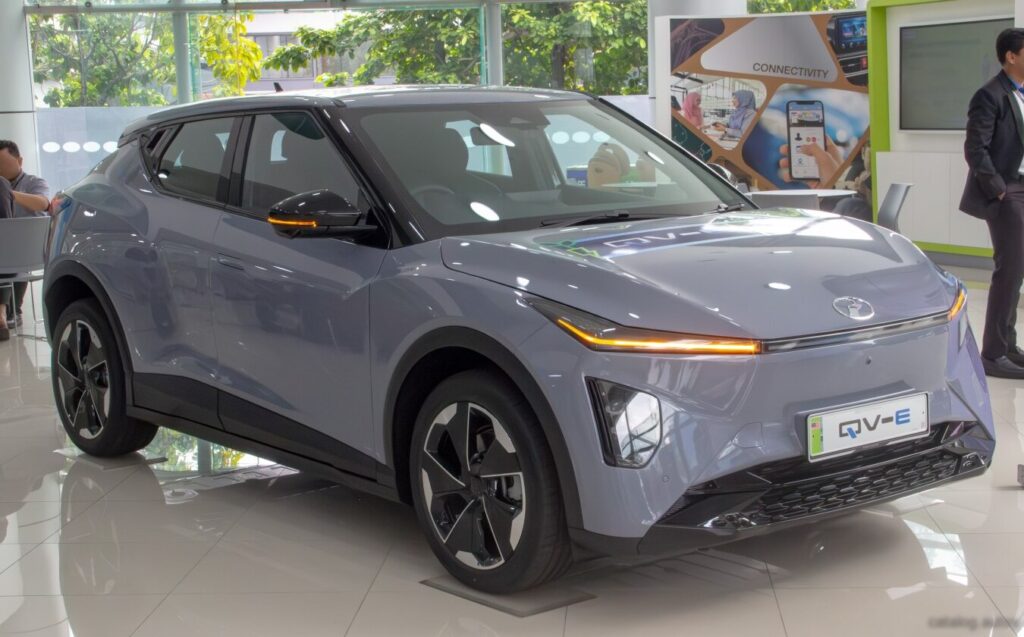
The Perodua QV-E, launched in December 2025, marks Perodua’s significant entry into the all-electric vehicle (EV) market. Positioned as a compact crossover/coupe, the QV-E aims to deliver an affordable and practical electric option, primarily targeting consumers in the Southeast Asian region. Built on a dedicated EV platform, the QV-E signifies Perodua’s commitment to future mobility. A key feature of this model is its utilization of Lithium Iron Phosphate (LiFePO4) battery technology, chosen for its cost-effectiveness and thermal stability rather than the higher energy density offered by Nickel Manganese Cobalt (NMC) batteries. This represents a substantial departure from Perodua’s historical focus on internal combustion engine vehicles.
POWERTRAIN & ENGINE ARCHITECTURE
The QV-E employs a single electric motor driving the front wheels, a common configuration in entry-level EVs designed to minimize cost and complexity. This motor generates 204 horsepower (Hp) and 285 Newton-meters (Nm) of torque, which translates to 210.21 lb.-ft. The motor is a synchronous type, recognized for its efficiency and relatively straightforward construction. Power is transmitted through a single-speed automatic transmission, standard for electric vehicles, providing seamless acceleration. The core of the QV-E is its 52.5 kWh Lithium Iron Phosphate (LiFePO4) battery pack, strategically positioned under the vehicle floor to optimize weight distribution and maximize passenger space. The battery supports fast charging capabilities, although specific charging times are dependent on the available charging infrastructure. A sophisticated battery management system (BMS) is integral to maintaining battery health, optimizing performance, and ensuring overall safety.
DRIVING CHARACTERISTICS
The QV-E delivers brisk acceleration for its class, achieving 0-100 km/h (0-62 mph) in 7.5 seconds and 0-60 mph in approximately 7.1 seconds. While not designed as a high-performance EV, the instant torque characteristic of electric motors provides responsive acceleration in typical driving scenarios. The single-speed transmission ensures a smooth and linear power delivery. Compared to potential future, higher-performance variants, the QV-E prioritizes efficiency and range over outright speed. The front-wheel-drive configuration offers adequate traction for most conditions, though some torque steer may be experienced during hard acceleration. The vehicle’s weight of 1600 kg (3527.4 lbs) influences handling, resulting in a planted feel but not exceptional agility.
EQUIPMENT & TRIM LEVELS
The QV-E is offered with a relatively comprehensive standard equipment package, aiming to provide strong value for money. Standard features include air conditioning, a touchscreen infotainment system, power windows, and essential safety systems such as ABS (Anti-lock Braking System). Interior upholstery is expected to be cloth in the base trim, with optional upgrades to leatherette available. The dashboard layout is modern and functional, designed to seamlessly integrate with the EV powertrain. Optional extras may include a larger touchscreen display, advanced driver-assistance systems (ADAS), and premium audio systems. The QV-E is configured as a five-seater, offering reasonable passenger space for a compact crossover.
CHASSIS & BRAKING
The QV-E utilizes an independent McPherson strut suspension system at the front, providing a comfortable ride and respectable handling characteristics. The rear suspension employs a torsion beam setup, a cost-effective solution commonly found in vehicles of this class. The braking system features ventilated discs at the front and solid discs at the rear, delivering adequate stopping power. Electric steering with power assistance is standard, offering light and precise steering feel. The QV-E is equipped with 215/50 R18 tires mounted on 18-inch alloy wheels, striking a balance between ride comfort and handling performance.
MARKET RECEPTION & COMPARISON
The Perodua QV-E is anticipated to compete with other entry-level EVs in the Southeast Asian market, such as the BYD Dolphin and MG ZS EV. Critics have lauded the QV-E’s affordability and practical range of 370 km (229.91 mi) WLTP or 445 km (276.51 mi) NEDC, making it a viable option for urban commuters. The choice of LiFePO4 battery technology is viewed favorably, offering enhanced safety and longevity compared to some alternative battery chemistries. However, the QV-E’s performance isn’t as robust as some competitors, and its interior may not offer the premium feel of more expensive EVs. Energy consumption, expressed as fuel economy, is a key selling point, being significantly lower than comparable gasoline-powered vehicles.
LEGACY
The QV-E represents a pivotal moment for Perodua, signifying its transition towards electric mobility. The long-term reliability of the LiFePO4 battery pack and the electric motor is expected to be good, as LiFePO4 batteries are known for their durability. As the used car market evolves, the QV-E is likely to become an attractive option for budget-conscious buyers seeking an affordable and environmentally friendly vehicle. The success of the QV-E will be crucial in shaping Perodua’s future EV strategy and its position in the rapidly changing automotive landscape. The vehicle’s relatively simple powertrain design should result in lower maintenance costs compared to traditional internal combustion engine vehicles.
TECHNICAL SPECIFICATIONS
| Brand | Perodua |
| Model | QV-E |
| Generation | QV-E |
| Type (Engine) | 52.5 kWh (204 Hp) Electric |
| Start of production | December, 2025 year |
| Powertrain Architecture | BEV (Electric Vehicle) |
| Body type | Coupe, SUV |
| Seats | 5 |
| Doors | 5 |
| Fuel Type | Electricity |
| Acceleration 0 – 100 km/h | 7.5 sec |
| Acceleration 0 – 62 mph | 7.5 sec |
| Acceleration 0 – 60 mph | 7.1 sec |
| Weight-to-power ratio | 7.8 kg/Hp |
| Weight-to-torque ratio | 5.6 kg/Nm |
| Gross battery capacity | 52.5 kWh |
| Battery technology | Lithium iron phosphate (LiFePO4) |
| Battery location | Below the floor |
| All-electric range (WLTP) | 370 km (229.91 mi) |
| All-electric range (NEDC) | 445 km (276.51 mi) |
| Electric motor power | 204 Hp |
| Electric motor Torque | 285 Nm (210.21 lb.-ft.) |
| Electric motor location | Front axle, Transverse |
| Kerb Weight | 1600 kg (3527.4 lbs.) |
| Trunk (boot) space – minimum | 320 l (11.3 cu. ft.) |
| Length | 4170 mm (164.17 in.) |
| Width | 1800 mm (70.87 in.) |
| Height | 1502 mm (59.13 in.) |
| Wheelbase | 2680 mm (105.51 in.) |
| Ride height (ground clearance) | 158 mm (6.22 in.) |
| Number of gears and type of gearbox | 1 gears, automatic transmission |
| Front suspension | Independent type McPherson |
| Rear suspension | Torsion |
| Front brakes | Ventilated discs |
| Rear brakes | Disc |
| Tires size | 215/50 R18 |
| Wheel rims size | 18 |
