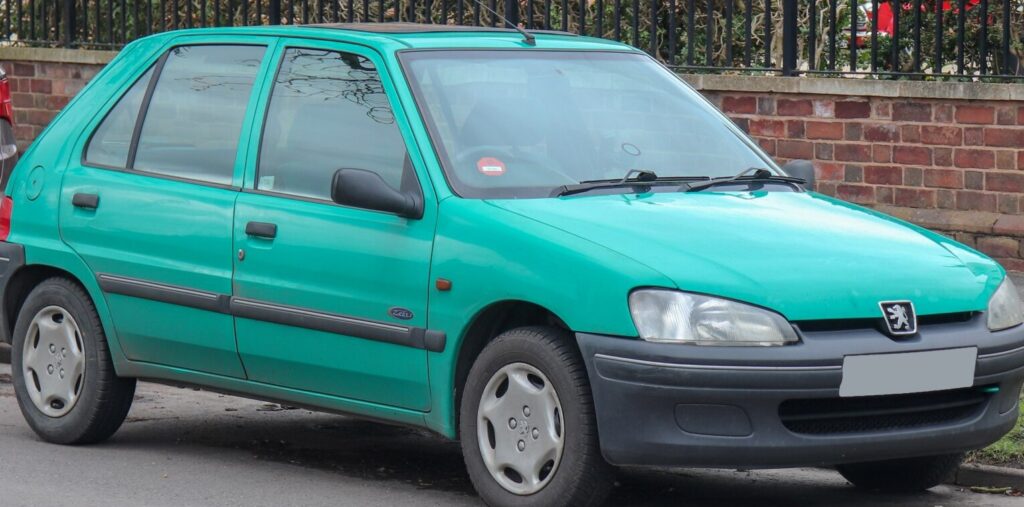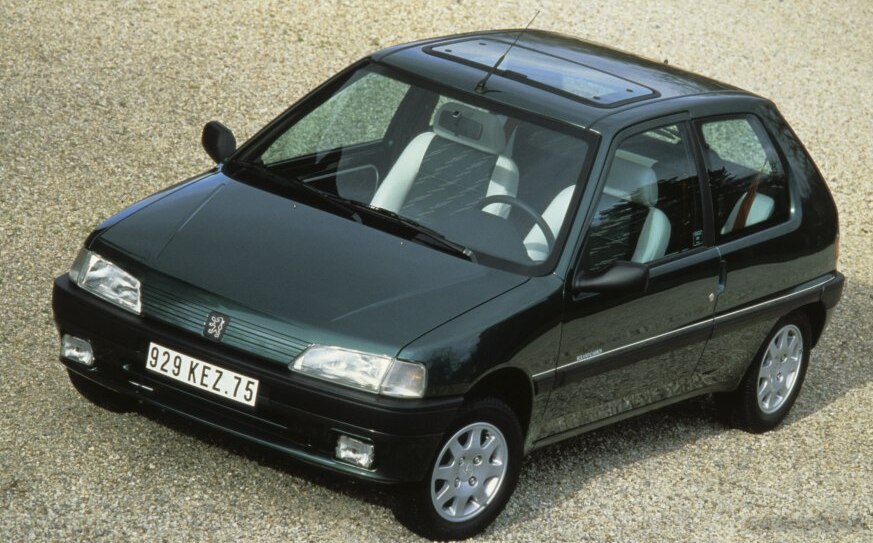
The Peugeot 106, launched in 1991, was a supermini car produced by the French manufacturer Peugeot. Representing the company’s entry into the small hatchback segment, the 106 was designed to be a modern and affordable vehicle. The first generation, known as the 106 I (1A/C), was produced from 1991 to 1996. Within this generation, the 1.1-liter (60 hp) variant occupied the entry-level position in the lineup, offering a budget-friendly option for buyers seeking basic transportation. This model was particularly popular with first-time car owners, city dwellers, and those prioritizing fuel efficiency over outright performance.
Peugeot 106 I (1A/C) 1.1: An Entry-Level Supermini
The 1.1-liter Peugeot 106 I (1A/C) was designed as the most accessible model in the range. It provided a simple, reliable, and economical means of personal transportation. While not offering the sporty appeal of higher-spec models or the diesel economy of the 1.5D, the 1.1 catered to a specific segment of the market – those needing a practical and inexpensive car for everyday use. Its positioning as the base model meant it often served as a stepping stone for buyers who might later upgrade to more powerful or better-equipped versions of the 106.
Powertrain & Engine Architecture
The heart of the 106 1.1 was the HDZ (or sometimes TU1M) engine, a 1124 cc inline-four cylinder petrol engine. This engine was a relatively simple design, utilizing a single overhead camshaft (SOHC) and two valves per cylinder. Fuel delivery was managed by a carburetor, a feature increasingly uncommon in the early 1990s but contributing to the model’s lower cost. The engine produced 60 horsepower at 5800 rpm and 88 Nm (64.91 lb-ft) of torque at 3200 rpm. The engine’s compression ratio was 9.4:1. The engine was transversely mounted at the front of the vehicle, driving the front wheels.
The 106 1.1 was exclusively offered with a five-speed manual transmission. This gearbox was chosen to maximize fuel efficiency and provide adequate performance for the engine’s output. The transmission was known for its light and precise shift action, contributing to a pleasant driving experience despite the car’s modest power.
Driving Characteristics
The driving experience in the 106 1.1 was characterized by its light weight and nimble handling. With a kerb weight of just 780 kg (1719.61 lbs), the car felt responsive and easy to maneuver, particularly in urban environments. However, the 60 hp engine meant acceleration was leisurely. 0-60 mph took approximately 13 seconds, and the top speed was around 102.53 mph. The engine’s torque peak at 3200 rpm meant that most of the usable power was available in the mid-range, making it suitable for everyday driving. The five-speed gearbox allowed drivers to keep the engine in its optimal power band, although frequent downshifts were often necessary for overtaking or climbing hills. Compared to the more powerful 1.4 or 1.6-liter versions of the 106, the 1.1 felt significantly slower, but it offered a more economical and forgiving driving experience.
Equipment & Trim Levels
As the entry-level model, the 106 1.1 was equipped with a relatively basic specification. Standard features typically included cloth upholstery, a simple dashboard layout, and manual windows and door locks. Safety features were also limited, with only basic seatbelts and, from 1992 onwards, an Anti-lock Braking System (ABS) as an option. The interior was designed with practicality in mind, offering sufficient space for four adults, although rear legroom was limited. Optional extras included a sunroof, central locking, and upgraded audio systems. The trim level was generally consistent across the 1.1 range, with minimal variations in interior finishes or exterior styling.
Chassis & Braking
The 106 1.1 featured a simple yet effective chassis design. The front suspension utilized a wishbone configuration, while the rear suspension employed a trailing arm setup. This combination provided a comfortable ride quality, absorbing bumps and imperfections in the road surface reasonably well. The steering was a rack and pinion system, offering precise and responsive control. Braking was handled by disc brakes at the front and drum brakes at the rear. While adequate for the car’s weight and performance, the drum brakes on the rear wheels were less effective than disc brakes, particularly in wet conditions. The 106 1.1 typically rode on 145/70 R13 tires, which contributed to its comfortable ride and predictable handling.
Market Reception & Comparison
The Peugeot 106 1.1 was generally well-received by critics as a practical and affordable supermini. It was praised for its fuel efficiency, nimble handling, and low running costs. However, its lack of power and basic equipment levels were also noted. Compared to rivals such as the Renault Clio, Fiat Punto, and Volkswagen Polo, the 106 1.1 offered a competitive price point and a slightly more engaging driving experience. Fuel economy was a strong point, achieving around 36.8 US mpg (6.4 l/100km). Reliability was generally good, although the carburetor required periodic maintenance. The 1.4 and 1.6-liter versions of the 106 offered significantly more performance but came at a higher price, making the 1.1 a compelling option for budget-conscious buyers.
Technical Specifications
| Brand | Peugeot |
| Model | 106 |
| Generation | 106 I (1A/C) |
| Type (Engine) | 1.1 (60 Hp) |
| Start of production | 1991 |
| End of production | 1996 |
| Fuel consumption (combined) | 6.4 l/100 km (36.8 US mpg, 44.1 UK mpg, 15.6 km/l) |
| Fuel Type | Petrol (Gasoline) |
| Acceleration 0 – 100 km/h | 13.7 sec |
| Acceleration 0 – 62 mph | 13.7 sec |
| Acceleration 0 – 60 mph | 13 sec |
| Maximum speed | 165 km/h (102.53 mph) |
| Weight-to-power ratio | 13 kg/Hp |
| Weight-to-torque ratio | 8.9 kg/Nm |
| Power | 60 Hp @ 5800 rpm |
| Torque | 88 Nm @ 3200 rpm (64.91 lb.-ft. @ 3200 rpm) |
| Engine layout | Front, Transverse |
| Engine Model/Code | HDZ TU1M |
| Engine displacement | 1124 cm3 (68.59 cu. in.) |
| Number of cylinders | 4 |
| Engine configuration | Inline |
| Cylinder Bore | 72 mm (2.83 in.) |
| Piston Stroke | 69 mm (2.72 in.) |
| Compression ratio | 9.4:1 |
| Number of valves per cylinder | 2 |
| Fuel injection system | Carburettor |
| Engine oil capacity | 3.2 l (3.38 US qt | 2.82 UK qt) |
| Coolant capacity | 6 l (6.34 US qt | 5.28 UK qt) |
| Kerb Weight | 780 kg (1719.61 lbs.) |
| Max. weight | 1220 kg (2689.64 lbs.) |
| Max load | 440 kg (970.03 lbs.) |
| Trunk (boot) space – minimum | 215 l (7.59 cu. ft.) |
| Trunk (boot) space – maximum | 564 l (19.92 cu. ft.) |
| Fuel tank capacity | 45 l (11.89 US gal | 9.9 UK gal) |
| Length | 3564 mm (140.31 in.) |
| Width | 1590 mm (62.6 in.) |
| Height | 1369 mm (53.9 in.) |
| Wheelbase | 2385 mm (93.9 in.) |
| Front track | 1380 mm (54.33 in.) |
| Rear track | 1300 mm (51.18 in.) |
| Drive wheel | Front wheel drive |
| Number of gears | 5 gears, manual transmission |
Legacy
The 1.1-liter Peugeot 106 I (1A/C) remains a popular choice among classic car enthusiasts and those seeking an affordable and reliable runabout. Its simple engine design and robust construction contribute to its longevity, and parts availability is generally good. While not a performance car, the 106 1.1 offers a charming and engaging driving experience, particularly for those who appreciate the simplicity of older vehicles. In the used car market, these models are typically inexpensive to purchase and maintain, making them an attractive option for first-time car owners or those on a tight budget. The HDZ engine, while requiring occasional carburetor attention, is generally considered to be a durable and dependable unit.