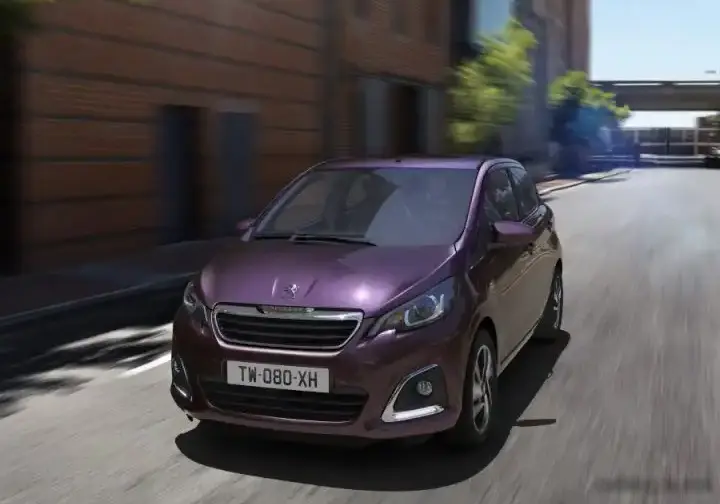
The Peugeot 108 Hatch 1.0 VTi (68 hp) was a city car produced by the French manufacturer Peugeot between 2014 and 2018. Part of the first generation of the 108 model (internally known as X10), it was developed alongside the Citroën C1 and Toyota Aygo as part of a joint venture. This particular variant, powered by the 1.0 VTi engine and paired with a five-speed manual transmission, served as the entry-level offering in the 108 lineup, targeting buyers seeking an affordable and economical vehicle for urban commuting. It was primarily sold in the European market.
Technical Specifications
| Brand | Peugeot |
| Model | 108 |
| Generation | 108 Hatch |
| Type (Engine) | 1.0 VTi (68 Hp) |
| Start of production | 2014 |
| End of production | 2018 |
| Powertrain Architecture | Internal Combustion engine |
| Body type | Hatchback |
| Seats | 5 |
| Doors | 3-5 |
| Fuel consumption (urban) | 5 l/100 km (47 US mpg, 56.5 UK mpg, 20 km/l) |
| Fuel consumption (extra urban) | 3.6 l/100 km (65.3 US mpg, 78.5 UK mpg, 27.8 km/l) |
| Fuel consumption (combined) | 4.1 l/100 km (57.4 US mpg, 68.9 UK mpg, 24.4 km/l) |
| CO2 emissions | 95 g/km |
| Fuel Type | Petrol (Gasoline) |
| Acceleration 0 – 100 km/h | 13 sec |
| Acceleration 0 – 62 mph | 13 sec |
| Acceleration 0 – 60 mph | 12.4 sec |
| Maximum speed | 160 km/h (99.42 mph) |
| Emission standard | Euro 5 |
| Weight-to-power ratio | 12.4 kg/Hp |
| Weight-to-torque ratio | 8.8 kg/Nm |
| Power | 68 Hp @ 6000 rpm |
| Torque | 95 Nm @ 4300 rpm (70.07 lb.-ft. @ 4300 rpm) |
| Engine layout | Front, Transverse |
| Engine Model/Code | 1KR-FE EB0 |
| Engine displacement | 998 cm3 (60.9 cu. in.) |
| Number of cylinders | 3 |
| Engine configuration | Inline |
| Number of valves per cylinder | 4 |
| Fuel injection system | Multi-port manifold injection |
| Engine aspiration | Naturally aspirated |
| Engine oil capacity | 2.8 l (2.96 US qt, 2.46 UK qt) |
| Kerb Weight | 840 kg (1851.88 lbs) |
| Max. weight | 1240 kg (2733.73 lbs) |
| Max load | 400 kg (881.85 lbs) |
| Trunk (boot) space – minimum | 180 l (6.36 cu. ft.) |
| Trunk (boot) space – maximum | 780 l (27.55 cu. ft.) |
| Fuel tank capacity | 35 l (9.25 US gal, 7.7 UK gal) |
| Length | 3475 mm (136.81 in) |
| Width | 1615 mm (63.58 in) |
| Height | 1460 mm (57.48 in) |
| Wheelbase | 2340 mm (92.13 in) |
| Front track | 1425 mm (56.1 in) |
| Rear track | 1420 mm (55.91 in) |
| Minimum turning circle | 9.6 m (31.5 ft) |
| Drivetrain | Front wheel drive |
| Number of gears | 5 |
| Gearbox type | Manual transmission |
| Front suspension | Independent, McPherson with coil spring and anti-roll bar |
| Rear suspension | Semi-independent, coil spring |
| Front brakes | Ventilated discs |
| Rear brakes | Drum |
| Assisting systems | ABS (Anti-lock braking system) |
| Steering type | Steering rack and pinion |
| Tires size | 165/65 R14 T |
| Wheel rims size | 14 |
Powertrain & Engine Architecture
The 1.0 VTi engine, designated 1KR-FE EB0, is a naturally aspirated, three-cylinder petrol engine. This engine was co-developed by Peugeot and Toyota, and is also found in the Toyota Aygo and Citroën C1. It features a multi-point fuel injection system and four valves per cylinder. The engine’s relatively simple design prioritized fuel efficiency and low emissions over outright performance. The five-speed manual transmission was chosen for its affordability and contribution to fuel economy. The gearbox featured a conventional shift pattern, optimized for city driving with relatively short gear ratios. The engine’s modest 68 horsepower and 70 lb-ft of torque were directed solely to the front wheels.
Driving Characteristics
The 1.0 VTi engine in the 108 Hatch delivered modest performance. Acceleration from 0-60 mph took approximately 12.4 seconds, and top speed was limited to 99.42 mph. The engine felt most comfortable in urban environments, where its light throttle response and nimble handling were advantageous. The five-speed manual transmission required frequent shifting to maintain momentum, especially when overtaking or climbing hills. Compared to the more powerful 1.2 PureTech engine option available in the 108 range, the 1.0 VTi felt noticeably slower. However, the 1.0 VTi offered a more engaging driving experience than the automated manual transmission options available on some trims.
Equipment & Trim Levels
The 1.0 VTi variant of the Peugeot 108 typically came with a basic level of equipment. Standard features included power steering, central locking, electric front windows, and an ABS anti-lock braking system. Interior upholstery was typically cloth, and the dashboard featured a simple, functional design. Optional extras included air conditioning, a touchscreen infotainment system with Bluetooth connectivity, and alloy wheels. Higher trim levels, such as Active and Allure, added more features as standard, but the 1.0 VTi remained the most affordable entry point into the 108 range.
Chassis & Braking
The Peugeot 108 Hatch featured a lightweight chassis designed to maximize fuel efficiency. The front suspension utilized a McPherson strut setup with a coil spring and anti-roll bar, while the rear suspension employed a semi-independent torsion beam arrangement. This configuration provided a comfortable ride quality, particularly on smooth urban roads. The braking system consisted of ventilated discs on the front wheels and drum brakes on the rear. While adequate for the vehicle’s weight and performance, the rear drum brakes were a cost-saving measure compared to the all-disc setup found on some higher-spec models.
Market Reception & Comparison
The Peugeot 108 1.0 VTi was generally well-received as an affordable and economical city car. Critics praised its nimble handling, low running costs, and compact dimensions. However, the engine’s lack of power was a common criticism, particularly when compared to competitors offering larger engines or turbocharging. In terms of fuel economy, the 1.0 VTi performed competitively, achieving around 57.4 US mpg on the combined cycle. Reliability was generally good, although some owners reported minor issues with the engine’s timing chain. Compared to the Citroën C1 and Toyota Aygo, which shared the same powertrain, the 108 offered a slightly more refined interior and a more distinctive exterior design.
Legacy
The Peugeot 108 1.0 VTi remains a popular choice in the used car market, particularly for first-time drivers or those seeking an inexpensive and reliable city car. The 1KR-FE engine is known for its durability, although regular maintenance, including oil changes, is essential. While not a performance car, the 1.0 VTi offers a practical and economical solution for urban transportation. Its compact size and low running costs continue to make it an attractive option for buyers on a budget. The 108, in general, helped solidify Peugeot’s position in the competitive city car segment, and its collaborative development with Citroën and Toyota demonstrated the benefits of shared engineering resources.