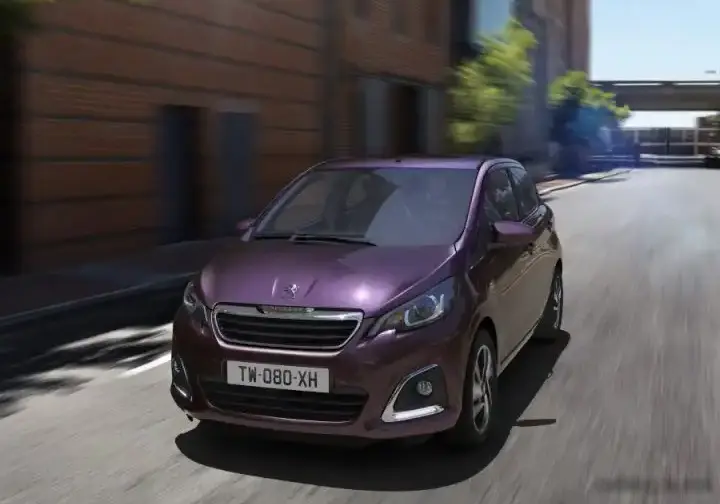
The Peugeot 108 Hatch 1.0i (72 hp) 2-Tronic is a city car produced by the French manufacturer Peugeot from 2018 onwards. Part of the first generation of the 108 model (internally known as X1), it represents Peugeot’s entry into the competitive segment of small, fuel-efficient hatchbacks. The 108, along with its sister vehicles the Citroën C1 and Toyota Aygo, were developed as part of a joint venture and share a common platform and many components. This particular variant, equipped with the 1.0-liter engine and the 2-Tronic automated manual transmission, served as a key entry point into the 108 range, targeting buyers prioritizing affordability and ease of use over outright performance.
Technical Specifications
| Brand | Peugeot |
| Model | 108 |
| Generation | 108 Hatch |
| Type (Engine) | 1.0i (72 Hp) 2-Tronic |
| Start of production | 2018 |
| Powertrain Architecture | Internal Combustion engine |
| Body type | Hatchback |
| Seats | 5 |
| Doors | 3-5 |
| Fuel consumption (combined) | 5.1-5.5 l/100 km (46.1 – 42.8 US mpg, 55.4 – 51.4 UK mpg, 19.6 – 18.2 km/l) |
| CO2 emissions | 95-96 g/km |
| Fuel Type | Petrol (Gasoline) |
| Acceleration 0 – 100 km/h | 15.2 sec |
| Acceleration 0 – 62 mph | 15.2 sec |
| Acceleration 0 – 60 mph | 14.4 sec |
| Maximum speed | 159 km/h (98.8 mph) |
| Emission standard | Euro 6c |
| Weight-to-power ratio | 11.9 kg/Hp, 83.7 Hp/tonne |
| Weight-to-torque ratio | 6.8 kg/Nm, 146.5 Nm/tonne |
| Power | 72 Hp @ 6000 rpm |
| Power per litre | 72.1 Hp/l |
| Torque | 126 Nm @ 4400 rpm (92.93 lb.-ft. @ 4400 rpm) |
| Engine layout | Front, Transverse |
| Engine Model/Code | CFB 1KR |
| Engine displacement | 998 cm3 (60.9 cu. in.) |
| Number of cylinders | 3 |
| Engine configuration | Inline |
| Number of valves per cylinder | 4 |
| Fuel injection system | Multi-port manifold injection |
| Engine aspiration | Naturally aspirated engine |
| Engine oil capacity | 2.8 l (2.96 US qt | 2.46 UK qt) |
| Kerb Weight | 860 kg (1895.98 lbs.) |
| Max. weight | 1240 kg (2733.73 lbs.) |
| Max load | 380 kg (837.76 lbs.) |
| Trunk (boot) space – minimum | 227 l (8.02 cu. ft.) |
| Trunk (boot) space – maximum | 868 l (30.65 cu. ft.) |
| Fuel tank capacity | 35 l (9.25 US gal | 7.7 UK gal) |
| Length | 3475 mm (136.81 in.) |
| Width | 1615 mm (63.58 in.) |
| Width including mirrors | 1884 mm (74.17 in.) |
| Height | 1460 mm (57.48 in.) |
| Wheelbase | 2340 mm (92.13 in.) |
| Front track | 1425 mm (56.1 in.) |
| Rear (Back) track | 1420 mm (55.91 in.) |
| Front overhang | 675 mm (26.57 in.) |
| Rear overhang | 460 mm (18.11 in.) |
| Drivetrain Architecture | Front wheel drive |
| Number of gears and type of gearbox | 5 gears, automatic transmission 2-Tronic |
| Front suspension | Independent type McPherson |
| Rear suspension | Elastic beam |
| Front brakes | Ventilated discs |
| Rear brakes | Drum |
| Assisting systems | ABS (Anti-lock braking system) |
| Steering type | Steering rack and pinion |
| Tires size | 165/65 R14; 165/60 R15 |
| Wheel rims size | 14; 15 |
INTRODUCTION
The Peugeot 108 1.0i 2-Tronic, launched in 2018, is a front-wheel-drive hatchback designed primarily for urban environments. It’s built on the shared CMP (Common Modular Platform) with the Citroën C1 and Toyota Aygo, resulting in a lightweight and compact vehicle. This variant occupied the entry-level position in the 108 lineup, offering a more affordable option compared to higher-trim models with more powerful engines. The 2-Tronic transmission, a five-speed automated manual, aimed to provide the convenience of an automatic without the fuel economy penalty often associated with traditional torque-converter automatics. The 108 aimed to appeal to first-time car buyers, city dwellers, and those seeking a low-cost, reliable vehicle.
Powertrain & Engine Architecture
At the heart of the 108 1.0i 2-Tronic lies the CFB 1KR engine, a naturally aspirated, three-cylinder petrol engine displacing 998cc. This engine utilizes a multi-point fuel injection system and four valves per cylinder. The engine is known for its simplicity and relatively low maintenance requirements. The 2-Tronic transmission is a five-speed automated manual gearbox. Unlike a traditional automatic, it uses actuators to shift gears, controlled by the car’s computer. This system allows for manual-like control without the need for a clutch pedal. However, it can sometimes exhibit slightly slower and less smooth shifts compared to a conventional automatic. The engine produces 72 horsepower at 6000 rpm and 92.93 lb-ft of torque at 4400 rpm. The engine’s compact size and lightweight construction contribute to the 108’s overall efficiency.
Driving Characteristics
The 108 1.0i 2-Tronic delivers modest performance, prioritizing fuel economy over acceleration. The 0-60 mph time of around 14.4 seconds and a top speed of 98.8 mph reflect this focus. The 2-Tronic transmission, while convenient, can feel somewhat hesitant during quick acceleration or when navigating hilly terrain. Gear changes aren’t as seamless as those found in a traditional automatic, and there can be a noticeable pause between shifts. The relatively low torque output means the engine needs to be revved to extract the most performance. Compared to the 1.2-liter PureTech engine offered in higher trims, the 1.0-liter feels noticeably less powerful, especially when fully loaded. However, the light weight of the vehicle helps to mitigate the lack of power, making it reasonably nimble in city traffic.
Equipment & Trim Levels
The 108 1.0i 2-Tronic typically came equipped with basic but essential features. Standard equipment generally included air conditioning, central locking, electric front windows, and a basic audio system with USB connectivity. Safety features such as ABS, electronic stability control, and multiple airbags were also standard. Higher trim levels, such as Active and Allure, added features like alloy wheels, a touchscreen infotainment system, and parking sensors. Interior upholstery was typically cloth, with a functional and durable design. Optional extras included a panoramic sunroof, navigation system, and rear parking sensors.
Chassis & Braking
The 108 utilizes a McPherson strut independent suspension at the front and an elastic beam suspension at the rear. This setup provides a comfortable ride quality, particularly on smooth roads. The front brakes are ventilated discs, while the rear brakes are drums. The braking system is adequate for the vehicle’s weight and performance, with ABS providing additional safety. The steering is light and responsive, making it easy to maneuver in tight spaces. The relatively narrow tires (typically 165/65 R14 or 165/60 R15) contribute to fuel efficiency but offer limited grip in wet or slippery conditions.
Market Reception & Comparison
The Peugeot 108 1.0i 2-Tronic was generally well-received as an affordable and practical city car. Critics praised its fuel efficiency, low running costs, and nimble handling. However, the 2-Tronic transmission received mixed reviews, with some testers finding it sluggish and unrefined. Compared to the manual version of the 1.0-liter engine, the 2-Tronic offered convenience but at the expense of performance and responsiveness. The 1.2-liter PureTech engine, while more expensive, provided a significantly more enjoyable driving experience. In terms of fuel economy, the 1.0-liter 2-Tronic performed competitively with other city cars in its class.
Legacy
The Peugeot 108 1.0i 2-Tronic has proven to be a relatively reliable vehicle, with the 1.0-liter engine known for its durability. The 2-Tronic transmission, however, has been reported to experience occasional issues, such as jerky shifts or actuator failures. On the used car market, these models represent an affordable entry point into Peugeot ownership. Their low running costs and compact size continue to appeal to buyers seeking a practical and economical city car. While not a performance icon, the 108 1.0i 2-Tronic served a valuable role in Peugeot’s lineup, providing a budget-friendly and efficient transportation option.