
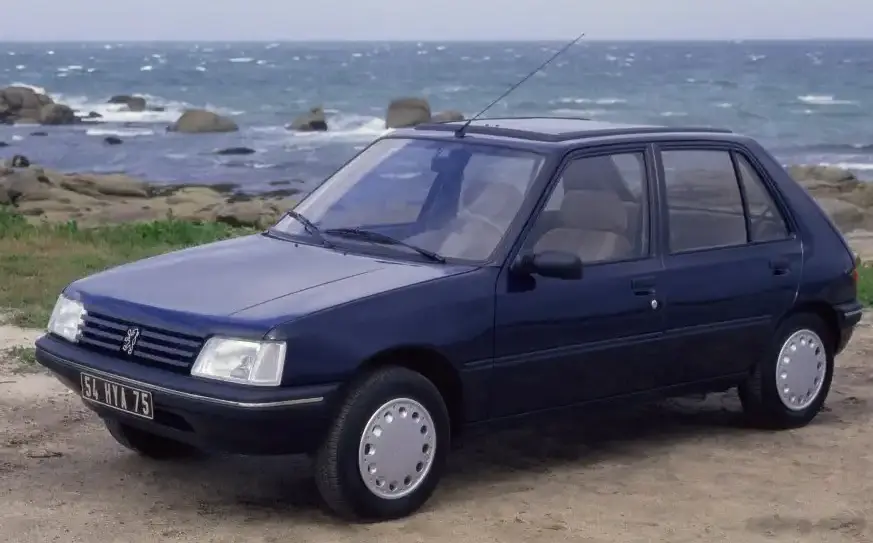
The Peugeot 205 1.0, produced from 1987 to 1995, represents the entry point into the hugely successful 205 range. Part of the 20A/C facelift series, this variant was a mainstay of the European small car market, offering affordable and economical transportation. While not known for outright performance, the 1.0-liter model played a crucial role in establishing the 205’s reputation for practicality and durability. It was positioned as the most accessible version of the 205, aimed at budget-conscious buyers and those prioritizing fuel efficiency over speed.
Technical Specifications
| Brand | Peugeot |
| Model | 205 |
| Generation | 205 I (20A/C, facelift 1987) |
| Type (Engine) | 1.0 (45 Hp) |
| Start of production | 1987 |
| End of production | 1995 |
| Powertrain Architecture | Internal Combustion engine |
| Body type | Hatchback |
| Seats | 5 |
| Doors | 3-5 |
| Fuel consumption (urban) | 6.8 l/100 km (34.6 US mpg, 41.5 UK mpg, 14.7 km/l) |
| Fuel consumption (extra urban) | 4.6 l/100 km (51.1 US mpg, 61.4 UK mpg, 21.7 km/l) |
| Fuel consumption (combined) | 6.3 l/100 km (37.3 US mpg, 44.8 UK mpg, 15.9 km/l) |
| Fuel Type | Petrol (Gasoline) |
| Acceleration 0 – 100 km/h | 18.8 sec |
| Acceleration 0 – 62 mph | 18.8 sec |
| Acceleration 0 – 60 mph | 17.9 sec |
| Maximum speed | 143 km/h (88.86 mph) |
| Weight-to-power ratio | 16.9 kg/Hp, 59.2 Hp/tonne |
| Weight-to-torque ratio | 10.4 kg/Nm, 96.1 Nm/tonne |
| Power | 45 Hp @ 5200 rpm |
| Power per litre | 47.2 Hp/l |
| Torque | 73 Nm @ 2400 rpm (53.84 lb.-ft. @ 2400 rpm) |
| Engine layout | Front, Transverse |
| Engine Model/Code | TU9, C1A, C1B |
| Engine displacement | 954 cm3 (58.22 cu. in.) |
| Number of cylinders | 4 |
| Engine configuration | Inline |
| Cylinder Bore | 70 mm (2.76 in.) |
| Piston Stroke | 62 mm (2.44 in.) |
| Compression ratio | 9.4:1 |
| Number of valves per cylinder | 2 |
| Fuel injection system | Carburettor |
| Engine aspiration | Naturally aspirated engine |
| Engine oil capacity | 4.5 l (4.76 US qt | 3.96 UK qt) |
| Coolant | 6 l (6.34 US qt | 5.28 UK qt) |
| Kerb Weight | 760 kg (1675.51 lbs.) |
| Max. weight | 1140 kg (2513.27 lbs.) |
| Max load | 380 kg (837.76 lbs.) |
| Trunk (boot) space – minimum | 290 l (10.24 cu. ft.) |
| Trunk (boot) space – maximum | 585 l (20.66 cu. ft.) |
| Fuel tank capacity | 50 l (13.21 US gal | 11 UK gal) |
| Length | 3705 mm (145.87 in.) |
| Width | 1560 mm (61.42 in.) |
| Height | 1375 mm (54.13 in.) |
| Wheelbase | 2420 mm (95.28 in.) |
| Front track | 1350 mm (53.15 in.) |
| Rear (Back) track | 1300 mm (51.18 in.) |
| Drivetrain Architecture | The Internal combustion engine (ICE) drives the front wheels of the vehicle. |
| Drive wheel | Front wheel drive |
| Number of gears and type of gearbox | 4 gears, manual transmission |
| Front suspension | Coil spring |
| Rear suspension | Torsion |
| Front brakes | Disc |
| Rear brakes | Drum |
| Assisting systems | ABS (Anti-lock braking system) |
| Steering type | Steering rack and pinion |
| Power steering | Hydraulic Steering |
| Tires size | 135/80 SR13 |
INTRODUCTION
The Peugeot 205 1.0, launched as part of the 205 series’ facelift in 1987, was a crucial model for Peugeot. The 205, built on the 1HX0/A3 platform, quickly became a European icon, known for its nimble handling and stylish design. The 1.0-liter version, however, prioritized affordability and fuel economy. It served as the entry-level option, appealing to first-time car buyers, city dwellers, and those seeking a practical and reliable vehicle. Production continued until 1995, with the 1.0 remaining a consistent seller throughout its lifespan.
Powertrain & Engine Architecture
The heart of the 205 1.0 is the TU9 engine, specifically coded C1A or C1B depending on minor variations. This 954cc inline-four cylinder engine is a naturally aspirated unit, utilizing a single overhead camshaft and two valves per cylinder. Crucially, this variant employed a carburetor – typically a Solex – rather than fuel injection, a cost-saving measure that contributed to its lower price point. The carburetor system, while simpler, resulted in slightly lower performance and increased emissions compared to fuel-injected counterparts. The engine produces 45 horsepower at 5200 rpm and 73 Nm (54 lb-ft) of torque at 2400 rpm. The engine’s relatively low compression ratio of 9.4:1 further emphasized reliability over outright power. The 205 1.0 was almost exclusively paired with a four-speed manual transmission, designed for simplicity and durability. An automatic transmission was rarely offered, and when available, it was a three-speed unit, further impacting performance.
Driving Characteristics
The driving experience in the 205 1.0 is best described as utilitarian. Acceleration is leisurely, taking approximately 18.8 seconds to reach 62 mph (100 km/h). Top speed is around 89 mph (143 km/h). The four-speed gearbox has relatively long ratios, prioritizing fuel economy over spirited driving. Compared to the more powerful 1.4, 1.6, or GTI versions of the 205, the 1.0 feels significantly underpowered, particularly when fully loaded or tackling hills. However, the 205’s inherent light weight and well-tuned suspension contribute to surprisingly nimble handling, even with the modest power output. The steering is direct and communicative, making it enjoyable to drive around town. The automatic transmission, when equipped, further dulled performance, making the car feel even slower and less responsive.
Equipment & Trim Levels
The 205 1.0 was typically offered in a basic trim level, reflecting its position as the entry-level model. Standard features included cloth upholstery, a basic dashboard layout, and manual windows and door locks. Optional extras were limited but could include a sunroof, upgraded stereo, and central locking. Interior plastics were durable but basic, prioritizing functionality over luxury. Later models within the facelifted range saw some minor improvements to interior trim and equipment, but the 1.0 generally remained sparsely equipped compared to higher-spec versions.
Chassis & Braking
The 205 1.0 utilizes a simple yet effective chassis design. Front suspension consists of coil springs and independent wishbones, while the rear employs a torsion beam setup. This configuration provides a good balance of ride comfort and handling. Brakes are disc on the front wheels and drum brakes on the rear, adequate for the car’s weight and performance. ABS (Anti-lock Braking System) was not standard on all models, often being an optional extra. The steering is a rack and pinion system with hydraulic assistance, providing light and precise steering feel. Tire size is typically 135/80 SR13.
Market Reception & Comparison
The 205 1.0 was well-received as an affordable and economical city car. Critics praised its fuel efficiency and nimble handling, but acknowledged its lack of outright performance. Compared to the 1.4 and 1.6-liter versions, the 1.0 offered significantly lower running costs but at the expense of speed and refinement. The 1.9 TDI diesel version, while more expensive to purchase, offered superior fuel economy and torque. The 1.0’s simplicity and reliability made it a popular choice for learner drivers and those seeking a dependable second car.
Legacy
The Peugeot 205 1.0 has proven to be a remarkably durable vehicle. Many examples are still on the road today, testament to the robustness of the TU9 engine and the overall build quality of the 205. In the used car market, the 1.0 is highly affordable, making it an attractive option for those seeking a classic French hatchback on a budget. While not a collector’s item like the GTI models, the 1.0 retains a loyal following among enthusiasts who appreciate its simplicity, reliability, and charming character. Maintenance is generally straightforward and inexpensive, thanks to the readily available parts and the engine’s uncomplicated design. However, potential buyers should be aware of the carburetor’s potential for requiring periodic adjustment and rebuilding.
