
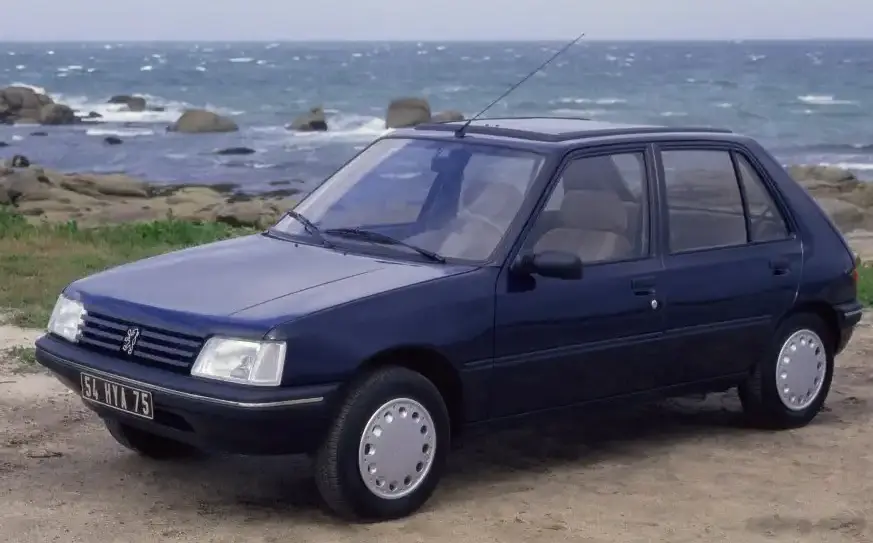
The Peugeot 205 1.1 i, produced from 1989 to 1998, represents the entry point into the hugely successful 205 range. Part of the 20A/C series, which benefited from a facelift in 1987, this variant was designed to offer affordable and economical transportation within the European market. It served as a practical and reliable option for first-time car buyers, urban commuters, and those seeking a small, nimble hatchback. The 1.1 i model occupied the base trim level, positioned below the more powerful 1.4, 1.6, and performance-oriented GTI versions.
Technical Specifications
| Brand | Peugeot |
| Model | 205 |
| Generation | 205 I (20A/C, facelift 1987) |
| Type (Engine) | 1.1 i (60 Hp) |
| Start of production | 1989 |
| End of production | 1998 |
| Powertrain Architecture | Internal Combustion engine |
| Body type | Hatchback |
| Seats | 5 |
| Doors | 3-5 |
| Fuel consumption (urban) | 7.1 l/100 km (33.1 US mpg, 39.8 UK mpg, 14.1 km/l) |
| Fuel consumption (extra urban) | 4.8 l/100 km (49 US mpg, 58.9 UK mpg, 20.8 km/l) |
| Fuel consumption (combined) | 6.3 l/100 km (37.3 US mpg, 44.8 UK mpg, 15.9 km/l) |
| Fuel Type | Petrol (Gasoline) |
| Acceleration 0 – 100 km/h | 13.9 sec |
| Acceleration 0 – 62 mph | 13.9 sec |
| Acceleration 0 – 60 mph | 13.2 sec |
| Maximum speed | 164 km/h (101.9 mph) |
| Weight-to-power ratio | 12.8 kg/Hp, 78.4 Hp/tonne |
| Weight-to-torque ratio | 8.4 kg/Nm, 119 Nm/tonne |
| Power | 60 Hp @ 5500 rpm |
| Power per litre | 53.4 Hp/l |
| Torque | 91 Nm @ 2600 rpm (67.12 lb.-ft. @ 2600 rpm) |
| Engine layout | Front, Transverse |
| Engine Model/Code | HDZ TU1M |
| Engine displacement | 1124 cm3 (68.59 cu. in.) |
| Number of cylinders | 4 |
| Engine configuration | Inline |
| Cylinder Bore | 72 mm (2.83 in.) |
| Piston Stroke | 69 mm (2.72 in.) |
| Compression ratio | 10.2:1 |
| Number of valves per cylinder | 2 |
| Fuel injection system | Multi-port manifold injection |
| Engine aspiration | Naturally aspirated engine |
| Valvetrain | OHC |
| Engine oil capacity | 3.2 l (3.38 US qt | 2.82 UK qt) |
| Coolant capacity | 5.8 l (6.13 US qt | 5.1 UK qt) |
| Kerb Weight | 765 kg (1686.54 lbs.) |
| Max. weight | 1195 kg (2634.52 lbs.) |
| Max load | 430 kg (947.99 lbs.) |
| Trunk (boot) space – minimum | 290 l (10.24 cu. ft.) |
| Trunk (boot) space – maximum | 585 l (20.66 cu. ft.) |
| Fuel tank capacity | 50 l (13.21 US gal | 11 UK gal) |
| Length | 3705 mm (145.87 in.) |
| Width | 1560 mm (61.42 in.) |
| Height | 1375 mm (54.13 in.) |
| Wheelbase | 2420 mm (95.28 in.) |
| Front track | 1350 mm (53.15 in.) |
| Rear track | 1300 mm (51.18 in.) |
| Drivetrain Architecture | Front wheel drive |
| Number of gears | 5 |
| Gearbox type | Manual transmission |
| Front suspension | Coil spring |
| Rear suspension | Torsion |
| Front brakes | Disc |
| Rear brakes | Drum |
| Assisting systems | ABS (Anti-lock braking system) |
| Steering type | Steering rack and pinion |
| Power steering | Hydraulic |
| Tires size | 145/80 SR13 |
Powertrain & Engine Architecture
The 1.1 i 205 was powered by the Peugeot-developed HDZ engine, a member of the TU1M family. This 1124cc inline-four cylinder engine featured a single overhead camshaft (OHC) and two valves per cylinder. Fuel delivery was handled by a multi-port fuel injection system, a significant upgrade from the carbureted engines found in earlier 205 models. The HDZ engine produced 60 horsepower at 5500 rpm and 91 Nm (67.12 lb-ft) of torque at 2600 rpm. The engine’s relatively low compression ratio of 10.2:1 prioritized fuel economy and reliability over outright performance. The engine was transversely mounted, driving the front wheels. The standard transmission was a five-speed manual gearbox, optimized for efficient cruising and acceptable acceleration.
Driving Characteristics
The 1.1 i 205 offered a modest driving experience. Acceleration was leisurely, taking approximately 13.9 seconds to reach 62 mph (100 km/h). Top speed was around 101.9 mph (164 km/h). The five-speed manual transmission helped to keep the engine within its optimal power band, but overtaking required careful planning. Compared to the more powerful 1.4 and 1.6 liter versions, the 1.1 i felt noticeably slower. However, its lightweight construction and nimble handling made it enjoyable to drive in urban environments. The steering was precise, and the suspension provided a comfortable ride, although it could feel somewhat bouncy on uneven surfaces.
Equipment & Trim Levels
The 1.1 i 205 was typically equipped with basic but functional features. Standard equipment included cloth upholstery, a simple dashboard layout, and manual windows and door locks. A basic radio was often included, though higher-end audio systems were available as options. Safety features were limited by the standards of the time, typically consisting of seatbelts and, later in the production run, an anti-lock braking system (ABS). Optional extras included a sunroof, central locking, and upgraded interior trim.
Chassis & Braking
The 205’s chassis was a monocoque construction, providing a good balance of rigidity and lightness. The front suspension utilized coil springs, while the rear suspension employed a torsion beam. This setup offered a reasonable compromise between ride comfort and handling. The braking system consisted of disc brakes on the front wheels and drum brakes on the rear. The ABS system, when fitted, significantly improved braking performance, particularly on slippery surfaces. The steering was a rack and pinion system, providing precise and responsive control.
Market Reception & Comparison
The Peugeot 205 1.1 i was well-received as an affordable and economical city car. Critics praised its nimble handling, comfortable ride, and low running costs. However, its lack of power was often noted. Compared to the 1.4 and 1.6 liter models, the 1.1 i offered significantly less performance. The 1.4 liter version provided a noticeable improvement in acceleration and overall drivability, while the 1.6 liter offered a more refined driving experience. The diesel-powered 1.8D was also a popular alternative, offering even better fuel economy but with reduced performance. Despite its limitations, the 1.1 i remained a popular choice for budget-conscious buyers.
Legacy
The Peugeot 205 1.1 i has proven to be a remarkably durable and reliable car. Many examples are still on the road today, testament to the quality of its engineering and construction. While not as sought-after as the GTI models, the 1.1 i remains a popular choice for classic car enthusiasts and those seeking a simple, affordable, and reliable vehicle. Parts availability is generally good, and maintenance costs are relatively low. The 1.1 i 205 represents a significant chapter in Peugeot’s history, embodying the spirit of affordable and accessible motoring.
