
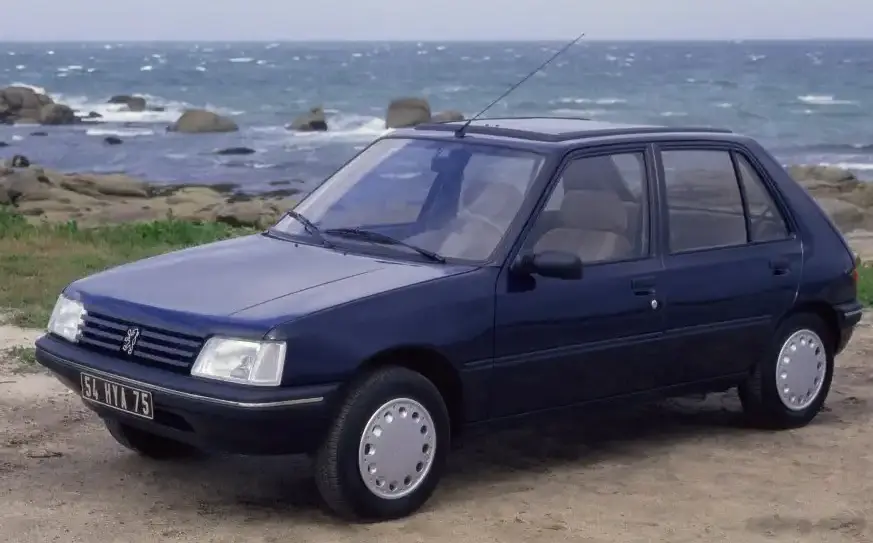
The Peugeot 205 I, specifically the 1.4-liter (60 horsepower) catalytic converter model produced between 1989 and 1990, represents an important iteration of Peugeot’s hugely successful supermini. This variant, falling within the 20A/C facelifted series of the original 205, was positioned as the entry-level offering in many European markets, prioritizing affordability and fuel economy over outright performance. It played a crucial role in maintaining the 205’s popularity during a period of increasing environmental regulations and consumer demand for more economical vehicles. The 205, as a whole, was a landmark vehicle for Peugeot, shifting the brand’s image towards a more modern and youthful demographic.
Technical Specifications
| Brand | Peugeot |
| Model | 205 |
| Generation | 205 I (20A/C, facelift 1987) |
| Type (Engine) | 1.4 (60 Hp) CAT |
| Start of production | 1989 |
| End of production | 1990 |
| Powertrain Architecture | Internal Combustion engine |
| Body type | Hatchback |
| Fuel Type | Petrol (Gasoline) |
| Power | 60 Hp |
| Engine Model/Code | KAY TU3CP |
| Engine aspiration | Naturally aspirated engine |
| Engine oil capacity | 3.2 l (3.38 US qt | 2.82 UK qt) |
| Coolant capacity | 6.7 l (7.08 US qt | 5.9 UK qt) |
Powertrain & Engine Architecture
The heart of the 205 1.4 CAT is the TU3CP engine, a 1376cc inline-four cylinder petrol engine. This engine, part of Peugeot’s TU series, is known for its simplicity and durability. The ‘KAY’ designation indicates a specific calibration for the French market, and the ‘CP’ suffix denotes the catalytic converter equipped version. The TU3CP utilizes a single overhead camshaft (SOHC) valvetrain, operating two valves per cylinder. Fuel delivery is managed by a single point fuel injection system – a relatively basic setup compared to the multi-point injection systems becoming more common at the time, but contributing to the model’s affordability. The catalytic converter was a key addition, allowing the vehicle to meet increasingly stringent European emissions standards. The engine produces 60 horsepower at approximately 5,200 rpm and 84 lb-ft of torque at 3,500 rpm. The transmission paired with this engine is typically a four-speed manual, though a three-speed automatic transmission was also available, albeit less common. The automatic transmission, while offering convenience, further reduced the car’s already modest acceleration.
Driving Characteristics
The 205 1.4 CAT, particularly in automatic guise, was not designed for spirited driving. Acceleration from 0 to 60 mph takes around 14-15 seconds, and top speed is approximately 90 mph. The engine feels relatively strained at higher speeds, and the four-speed gearbox (or three-speed automatic) doesn’t offer a wide range of ratios to keep the engine in its optimal power band. However, within urban environments, the 1.4 engine proves adequate, offering sufficient power for everyday commuting and errands. The automatic transmission provides smooth, if somewhat slow, gear changes. The car’s light weight – typically around 1,700 lbs – helps to mitigate the lack of power, making it feel more nimble than its specifications might suggest. Compared to the more powerful 1.6 and 1.9-liter versions of the 205, or the performance-oriented GTI models, the 1.4 CAT feels significantly slower and less engaging to drive. However, it excels in fuel efficiency, achieving around 45-50 mpg on the combined cycle.
Equipment & Trim Levels
The 1.4 CAT trim level was generally considered the base model. Standard equipment typically included cloth upholstery, basic instrumentation (speedometer, fuel gauge, temperature gauge), and a simple two-speaker radio. Power steering was not standard, and air conditioning was rarely fitted. The interior plastics were durable but utilitarian, reflecting the car’s budget-oriented positioning. Optional extras included a sunroof, upgraded stereo systems, and different wheel trims. The dashboard layout is straightforward and functional, with all controls within easy reach of the driver. The seats offered reasonable comfort for short journeys, but lacked significant bolstering. The overall interior ambiance was practical and unpretentious.
Chassis & Braking
The 205 1.4 CAT utilizes a MacPherson strut front suspension and a torsion beam rear suspension. This setup provides a comfortable ride quality, absorbing bumps and imperfections in the road surface effectively. The torsion beam rear suspension is a cost-effective solution, but it doesn’t offer the same level of sophistication as independent rear suspension found in higher-spec 205 models. Braking is typically accomplished with disc brakes on the front wheels and drum brakes on the rear wheels. The braking system is adequate for the car’s performance, but lacks the stopping power of larger brakes found on more powerful 205 variants. A stabilizer bar is fitted to the front suspension to reduce body roll during cornering, improving handling stability.
Market Reception & Comparison
The 205 1.4 CAT was generally well-received as an affordable and economical city car. Critics praised its fuel efficiency, ease of driving, and compact size. However, the engine’s lack of power was a common criticism, particularly when compared to the more potent versions of the 205. Compared to rivals such as the Renault 5 and Citroën AX, the 205 1.4 CAT offered a similar level of practicality and economy. The 1.6-liter version of the 205 offered a noticeable performance improvement for a relatively small price increase, making it a popular alternative for buyers who prioritized driving enjoyment. The 1.4 CAT’s reliability was generally good, although the single-point fuel injection system could occasionally require maintenance. Fuel economy figures were competitive for the time, typically ranging from 45 to 50 mpg.
Legacy
The Peugeot 205 1.4 CAT, while not the most exciting version of the 205, remains a popular choice among classic car enthusiasts and budget-conscious buyers. The TU3CP engine is known for its robustness and relatively simple maintenance requirements. Parts availability is generally good, although some trim-specific components can be difficult to find. Today, these cars are often sought after as affordable and reliable runabouts, or as entry points into classic car ownership. The 205’s enduring popularity is a testament to its clever design, practicality, and overall charm. The 1.4 CAT, as the entry point to the 205 range, played a significant role in establishing the model’s widespread appeal and cementing its place in automotive history.
