
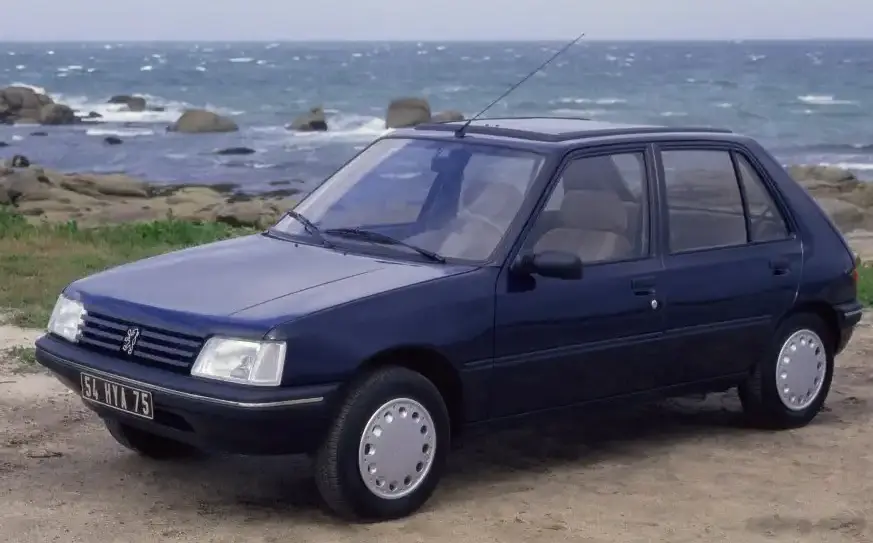
The Peugeot 205, launched in 1983, quickly became a cornerstone of the European supermini segment. The 205 I, encompassing the original production run and a significant facelift in 1987 (designated 20A/C), represented a departure from Peugeot’s larger offerings, focusing on affordability, practicality, and a surprisingly engaging driving experience. The 1.4-liter, 79 horsepower variant, produced from 1988 to 1989, occupied a crucial mid-range position within the 205 lineup, offering a balance between economy and performance for a broad customer base. This model was particularly significant in markets where smaller, fuel-efficient cars were highly valued.
Technical Specifications
| Brand | Peugeot |
| Model | 205 |
| Generation | 205 I (20A/C, facelift 1987) |
| Type (Engine) | 1.4 (79 Hp) |
| Start of production | 1988 |
| End of production | 1989 |
| Powertrain Architecture | Internal Combustion engine |
| Body type | Hatchback |
| Fuel Type | Petrol (Gasoline) |
| Power | 79 Hp |
| Engine Model/Code | 150H XY8, 150B XY8 |
| Engine aspiration | Naturally aspirated engine |
| Engine oil capacity | 5 l (5.28 US qt | 4.4 UK qt) |
| Coolant capacity | 5.8 l (6.13 US qt | 5.1 UK qt) |
Powertrain & Engine Architecture
The 1.4-liter engine, designated 150H XY8 or 150B XY8, was a naturally aspirated, inline-four cylinder unit. It featured a single overhead camshaft (SOHC) valvetrain operating two valves per cylinder. Fuel delivery was managed by a single point fuel injection system – a relatively common setup for the era, balancing cost and efficiency. While not as sophisticated as multi-point injection, it offered improvements over carbureted engines in terms of fuel economy and emissions. The engine’s bore and stroke measured 76mm x 82mm, resulting in a displacement of 1360cc. The 79 horsepower output was achieved at 6000 rpm, with peak torque of approximately 98 lb-ft (133 Nm) at 3500 rpm. This engine was typically paired with a three-speed automatic transmission, although a five-speed manual was also available. The automatic transmission, while providing ease of use, was known for its relatively slow shift times and tendency to hunt for gears, particularly under heavy load.
Driving Characteristics
The 1.4-liter automatic 205 offered a comfortable, if not particularly exhilarating, driving experience. Acceleration was adequate for everyday driving, with a 0-60 mph time estimated around 13-14 seconds. The automatic transmission’s gear ratios were geared towards fuel efficiency rather than outright performance. Compared to the more popular 1.6-liter and 1.9-liter versions, the 1.4 automatic felt noticeably slower, especially when fully loaded or tackling inclines. The manual transmission variants of the 1.4 offered a more engaging driving experience and slightly improved performance. Steering was light and precise, a hallmark of the 205, and the suspension provided a good balance between ride comfort and handling. However, the relatively narrow tires and modest power output limited the car’s cornering ability compared to sportier versions like the GTI.
Equipment & Trim Levels
The 1.4-liter variant of the 205 typically represented a mid-range trim level. Standard equipment generally included cloth upholstery, a basic instrument cluster, and manual windows and door locks. Power steering was often an optional extra. Interior plastics were durable but utilitarian, reflecting the car’s affordable positioning. The dashboard layout was functional and straightforward. Optional extras could include a sunroof, upgraded stereo system, and metallic paint. The 205’s interior space was surprisingly generous for a supermini, offering comfortable seating for four adults. The rear seats could be folded down to increase luggage capacity, adding to the car’s practicality.
Chassis & Braking
The 205 I utilized a front-engine, front-wheel-drive layout. The suspension consisted of independent front suspension with MacPherson struts and a torsion beam rear axle. This setup provided a good compromise between ride comfort and handling. Braking on the 1.4-liter models typically featured disc brakes on the front wheels and drum brakes on the rear. This configuration was common for vehicles in this price range during the late 1980s. The braking system was adequate for normal driving conditions, but lacked the stopping power of the larger disc brakes found on higher-spec models. Stabilizer bars were fitted to both the front and rear axles, helping to reduce body roll during cornering.
Market Reception & Comparison
The 1.4-liter automatic 205 was generally well-received as a practical and affordable city car. Critics praised its fuel efficiency, ease of driving, and surprisingly spacious interior. However, the automatic transmission was often criticized for its sluggish performance and tendency to hunt for gears. Compared to the 1.6-liter version, the 1.4 offered lower running costs but sacrificed performance. The 1.9-liter diesel model provided even better fuel economy but was significantly slower. The 1.4 automatic appealed to buyers who prioritized comfort and convenience over outright performance, such as urban commuters and families.
Legacy
The Peugeot 205, in all its variants, remains a highly regarded classic car. The 1.4-liter engine, while not the most powerful in the lineup, proved to be relatively reliable and durable. The automatic transmission, however, is often considered the weakest link in the powertrain, with some units experiencing issues with wear and tear over time. Today, the 205 is a popular choice among classic car enthusiasts, with well-maintained examples commanding reasonable prices. The 1.4-liter automatic, while not as sought after as the GTI or other high-performance models, offers an affordable entry point into 205 ownership and provides a charmingly retro driving experience. Its simplicity and relatively low maintenance requirements make it a practical choice for those seeking a classic French hatchback.
