
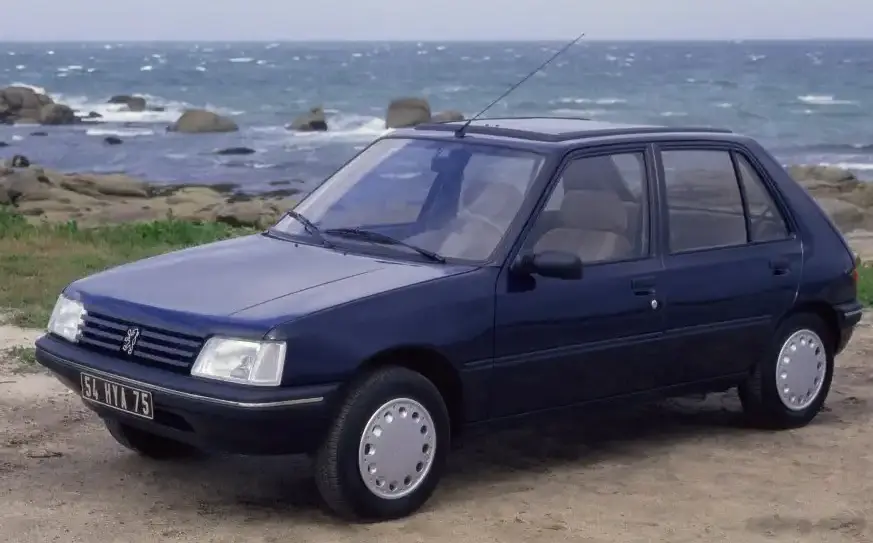
The Peugeot 205, launched in 1983, quickly became a cornerstone of the French automotive landscape and a popular choice across Europe. The 205 I, specifically the facelifted version introduced in 1987 (designated 20A/C), represented a refinement of the original design, offering improved features and a more modern aesthetic. Within the 205 range, the 1.6-liter (72 horsepower) automatic variant, produced from 1987 to 1990, occupied a unique position. It was aimed at buyers prioritizing comfort and ease of use over outright performance, offering a more relaxed driving experience compared to the manual transmission options or the sportier GTI models. This version represented a significant portion of the 205 sales, particularly among those seeking a practical and reliable city car.
Technical Specifications
| Brand | Peugeot |
| Model | 205 |
| Generation | 205 I (20A/C, facelift 1987) |
| Type (Engine) | 1.6 (72 Hp) Automatic |
| Start of production | 1987 |
| End of production | 1990 |
| Powertrain Architecture | Internal Combustion engine |
| Body type | Hatchback |
| Fuel Type | Petrol (Gasoline) |
| Power | 72 Hp |
| Engine Model/Code | B1E XU51C |
| Engine aspiration | Naturally aspirated engine |
| Engine oil capacity | 4.6 l (4.86 US qt | 4.05 UK qt) |
| Coolant capacity | 6.7 l (7.08 US qt | 5.9 UK qt) |
Powertrain & Engine Architecture
The 1.6-liter engine, designated B1E XU51C, was a naturally aspirated, inline-four cylinder unit. It featured a single overhead camshaft (SOHC) valvetrain operating two valves per cylinder. Fuel delivery was managed by a Bosch mechanical fuel injection system, a common setup for the era. While not as sophisticated as later multi-point injection systems, it provided reliable and adequate fuel atomization for the engine’s output. The XU51C engine was known for its durability and relatively simple maintenance requirements. The automatic transmission was a three-speed unit, designed to provide smooth, if not particularly rapid, gear changes. It was a conventional hydraulic automatic, lacking the electronic controls found in more modern transmissions. The transmission’s torque converter played a crucial role in multiplying engine torque at lower speeds, aiding in drivability.
Driving Characteristics
The 1.6-liter automatic 205 offered a distinctly different driving experience compared to its manual counterparts or the performance-oriented GTI models. With 72 horsepower, acceleration was modest, taking approximately 13-14 seconds to reach 60 mph. The three-speed automatic transmission, while providing convenience, resulted in wider gear ratios and a less engaging driving feel. The torque converter, while aiding low-speed acceleration, also introduced some power loss. In real-world conditions, the car felt most comfortable in city driving and on relatively flat roads. Uphill climbs or overtaking maneuvers required careful planning. Compared to the five-speed manual versions, the automatic suffered from a noticeable performance deficit, but offered a more relaxed and forgiving driving experience, particularly for less experienced drivers or those prioritizing comfort.
Equipment & Trim Levels
The 1.6-liter automatic 205 typically came equipped with a fairly basic level of standard features, reflecting its position as a mainstream, affordable model. Interior upholstery was generally cloth, with a simple dashboard layout. Standard equipment included a basic stereo, manual windows, and central locking. Power steering was often an optional extra, and its absence was noticeable, particularly at low speeds. Optional extras could include upgraded stereo systems, alloy wheels (though less common on this trim), and a sunroof. The trim level often dictated the color of the interior trim and the availability of certain cosmetic enhancements. The focus was on practicality and affordability, rather than luxury or high-tech features.
Chassis & Braking
The 205’s chassis was a relatively simple, yet effective, design. It utilized a MacPherson strut front suspension and a torsion beam rear suspension. The torsion beam rear setup was a cost-effective solution that provided adequate ride comfort and handling for everyday driving. Braking on the 1.6 automatic 205 typically consisted of disc brakes on the front wheels and drum brakes on the rear. This configuration was common for vehicles in this price range during the late 1980s. Stabilizer bars were often omitted on the base models, contributing to a slightly more pronounced body roll during cornering. The overall chassis setup prioritized ride comfort and affordability over outright handling performance.
Market Reception & Comparison
The 1.6-liter automatic 205 received generally positive reviews, particularly from those seeking a practical and reliable city car. Critics praised its fuel efficiency and ease of driving, but noted its lack of performance compared to the manual versions and the GTI models. Fuel economy was a strong point, typically achieving around 35-40 mpg in mixed driving conditions. Compared to other vehicles in its class, such as the Renault 5 or the Fiat Uno, the 205 offered a more refined driving experience and a more modern interior. However, the automatic transmission did impact fuel economy slightly compared to the manual versions. Reliability was generally good, with the XU51C engine proving to be a durable and long-lasting unit.
Legacy
The Peugeot 205, in all its variants, left a lasting legacy on the automotive industry. It established Peugeot as a maker of stylish, affordable, and reliable cars. The 1.6-liter automatic version, while not the most exciting model in the range, played a significant role in the 205’s success, appealing to a broad range of buyers. Today, these cars are increasingly sought after by classic car enthusiasts, although the automatic versions are less common than the manual or GTI models. The XU51C engine is known for its robustness, and well-maintained examples can still provide reliable transportation. Parts availability is generally good, although some trim-specific components may be difficult to find. The 205 1.6 automatic remains a testament to Peugeot’s ability to create a practical, affordable, and enduring vehicle.
