
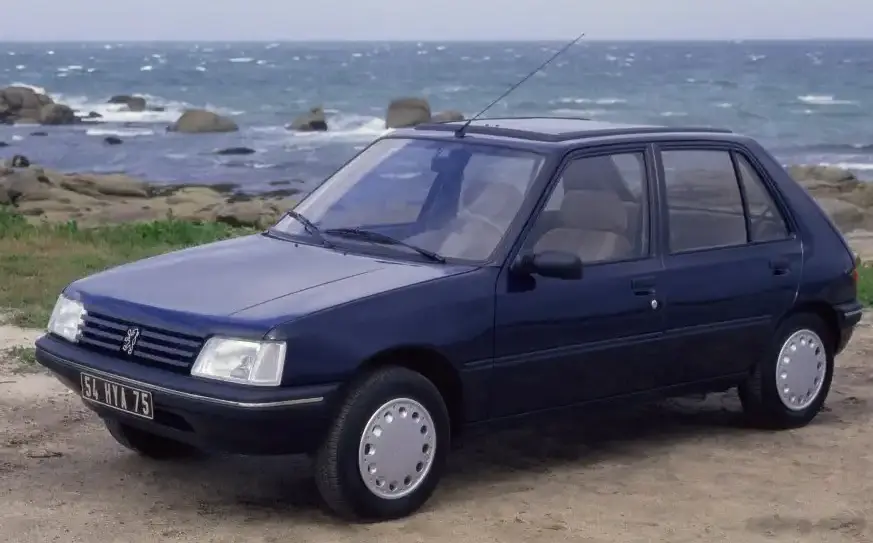
The Peugeot 205 1.6 GTI, produced between 1987 and 1989 as part of the 20A/C facelift of the first-generation 205, represents a pivotal point in the hot hatch segment. Building upon the already successful 205 platform, the 1.6 GTI offered a significant performance upgrade over the base models, establishing itself as a benchmark for handling and driver engagement. This variant occupied the top performance tier of the 205 range, positioned above the 1.4 GTI and significantly below the later, more powerful 1.9 GTI models. It was primarily marketed in Europe, becoming a cultural icon for a generation of driving enthusiasts.
Technical Specifications
| Brand | Peugeot |
| Model | 205 |
| Generation | 205 I (20A/C, facelift 1987) |
| Type (Engine) | 1.6 GTI (103 Hp) |
| Start of production | 1987 |
| End of production | 1989 |
| Powertrain Architecture | Internal Combustion engine |
| Body type | Hatchback |
| Fuel Type | Petrol (Gasoline) |
| Power | 103 Hp |
| Engine Model/Code | 180A XU5J, 180Z XU5J |
| Engine aspiration | Naturally aspirated engine |
| Engine oil capacity | 4.6 l (4.86 US qt | 4.05 UK qt) |
| Coolant capacity | 6.6 l (6.97 US qt | 5.81 UK qt) |
Powertrain & Engine Architecture
The heart of the 205 1.6 GTI is the XU5J engine, specifically the 180A or 180Z variant. This 1580cc, naturally aspirated inline-four engine is a cornerstone of Peugeot-Citroën’s engineering prowess of the era. It features a cast iron block and an aluminum cylinder head, employing a belt-driven single overhead camshaft (SOHC) valvetrain with two valves per cylinder. Fuel delivery is managed by Bosch mechanical fuel injection – a system considered advanced for its time, providing precise fuel metering for optimal performance and emissions. The XU5J engine is known for its robust construction and relatively simple design, contributing to its longevity and ease of maintenance.
Unlike later GTI models that adopted a five-speed manual transmission as standard, the 1.6 GTI was initially offered with a four-speed manual gearbox. A five-speed manual became more common towards the end of production. However, a significant portion of these cars were equipped with a three-speed automatic transmission, a choice that altered the driving experience considerably. The automatic transmission, while offering convenience, impacted acceleration and overall responsiveness compared to the manual options.
Driving Characteristics
The 1.6 GTI, particularly in manual form, was celebrated for its nimble handling and responsive steering. The relatively lightweight chassis, combined with well-tuned suspension, allowed for a playful and engaging driving experience. The 103 horsepower engine, while not overwhelming by modern standards, provided ample power for spirited driving on winding roads. The four-speed manual gearbox, while limiting in terms of overall gearing, offered a direct and satisfying shift feel.
The automatic transmission version, however, presented a different character. While providing smooth gear changes, the three-speed automatic significantly dulled the car’s performance. Acceleration was noticeably slower, and the engine often felt strained during overtaking maneuvers. The automatic’s gear ratios weren’t ideally suited to the engine’s powerband, resulting in a less engaging driving experience. The 0-60 mph time for the manual version was around 8.7 seconds, while the automatic version typically took over 10 seconds.
Equipment & Trim Levels
The 1.6 GTI came reasonably well-equipped for its time, though options were available to enhance the interior and exterior. Standard features typically included sports seats with patterned fabric upholstery, a leather-wrapped steering wheel, and a basic stereo system. The dashboard featured a comprehensive instrument cluster with a tachometer, speedometer, fuel gauge, and coolant temperature gauge.
Exterior features included distinctive GTI badging, alloy wheels (typically 14-inch), and a rear spoiler. Optional extras included a sunroof, central locking, electric windows, and upgraded audio systems. Some models also featured a limited-slip differential, further enhancing handling performance. The interior trim was generally functional and focused on providing a sporty driving environment, rather than luxurious comfort.
Chassis & Braking
The 205 1.6 GTI utilized a MacPherson strut front suspension and a torsion beam rear suspension. This setup provided a good balance between ride comfort and handling precision. The front suspension featured an anti-roll bar, contributing to reduced body roll during cornering. The braking system consisted of disc brakes on the front wheels and drum brakes on the rear wheels. While adequate for most driving situations, the rear drum brakes were a point of criticism, particularly for those engaging in more aggressive driving. The braking system was not assisted by ABS in most markets.
Market Reception & Comparison
The Peugeot 205 1.6 GTI was widely praised by automotive journalists for its handling, responsiveness, and overall driving experience. It was often compared favorably to rivals such as the Volkswagen Golf GTI and the Ford Fiesta XR2. Critics noted the 1.6 GTI’s superior steering feel and more engaging chassis. However, the automatic transmission version received mixed reviews, with many critics lamenting its impact on performance.
Compared to the later 1.9 GTI, the 1.6 GTI offered a more accessible entry point into the hot hatch market. The 1.9 GTI, with its more powerful engine and improved braking system, was aimed at a more performance-focused audience. The 1.6 GTI, with its lower price point and more forgiving nature, appealed to a broader range of buyers. Fuel economy for the 1.6 GTI averaged around 30-35 mpg, depending on driving conditions.
Legacy
The Peugeot 205 1.6 GTI remains a highly sought-after classic car today. Its reputation for reliability, combined with its engaging driving dynamics, has ensured its enduring popularity among enthusiasts. The XU5J engine, in particular, is known for its durability and relatively simple maintenance requirements. However, finding well-maintained examples can be challenging, as many cars have suffered from neglect or modification over the years. Rust is also a common issue, particularly on cars that have spent extended periods exposed to the elements.
The 1.6 GTI, especially in manual form, is considered a significant milestone in the evolution of the hot hatch, and continues to be celebrated as a benchmark for affordable performance and driving enjoyment.
