
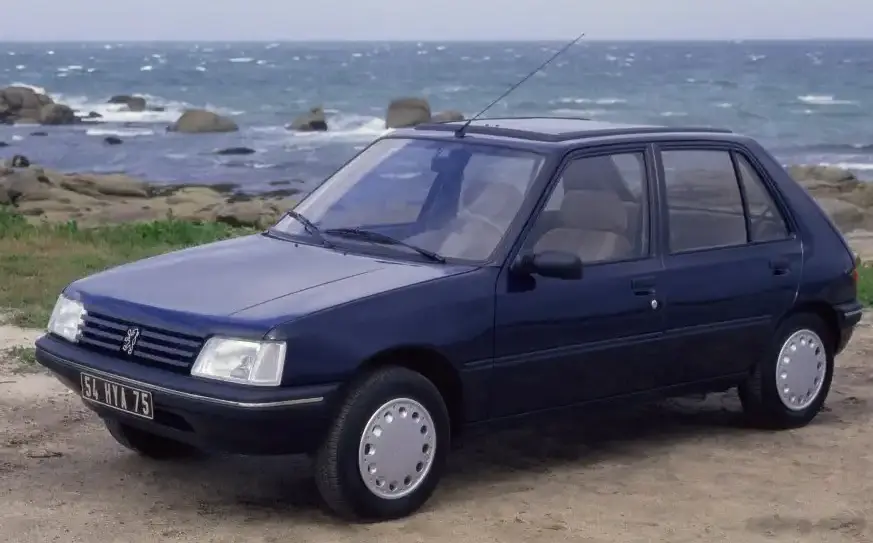
The Peugeot 205 I 1.6 GTI, produced from 1987 to 1989, represents a pivotal point in the iconic 205 series. This variant, part of the 20A/C facelift generation, was designed to deliver a more engaging driving experience than the base models, establishing a reputation for nimble handling and spirited performance. Positioned as the performance flagship of the 205 range, it catered to enthusiasts seeking a compact, affordable, and fun-to-drive hatchback. The 1.6 GTI quickly became a benchmark in its class, influencing a generation of hot hatches and solidifying Peugeot’s reputation for dynamic engineering.
Technical Specifications
| Brand | Peugeot |
| Model | 205 |
| Generation | 205 I (20A/C, facelift 1987) |
| Type (Engine) | 1.6 GTI (113 Hp) |
| Start of production | 1987 |
| End of production | 1989 |
| Powertrain Architecture | Internal Combustion engine |
| Body type | Hatchback |
| Seats | 5 |
| Doors | 3 |
| Fuel consumption (urban) | 9.2 l/100 km (25.6 US mpg, 30.7 UK mpg, 10.9 km/l) |
| Fuel consumption (extra urban) | 5.9 l/100 km (39.9 US mpg, 47.9 UK mpg, 16.9 km/l) |
| Fuel consumption (combined) | 7.5 l/100 km (31.4 US mpg, 37.7 UK mpg, 13.3 km/l) |
| Fuel Type | Petrol (Gasoline) |
| Acceleration 0 – 100 km/h | 9.1 sec |
| Acceleration 0 – 62 mph | 9.1 sec |
| Acceleration 0 – 60 mph | 8.6 sec |
| Maximum speed | 196 km/h (121.79 mph) |
| Weight-to-power ratio | 7.5 kg/Hp, 132.9 Hp/tonne |
| Weight-to-torque ratio | 6.5 kg/Nm, 154.1 Nm/tonne |
| Power | 113 Hp @ 6250 rpm |
| Power per litre | 71.5 Hp/l |
| Torque | 131 Nm @ 4000 rpm (96.62 lb.-ft. @ 4000 rpm) |
| Engine layout | Front, Transverse |
| Engine Model/Code | B6D XU5JA |
| Engine displacement | 1580 cm3 (96.42 cu. in.) |
| Number of cylinders | 4 |
| Engine configuration | Inline |
| Cylinder Bore | 83 mm (3.27 in.) |
| Piston Stroke | 73 mm (2.87 in.) |
| Compression ratio | 9.8:1 |
| Number of valves per cylinder | 2 |
| Fuel injection system | Multi-port manifold injection |
| Engine aspiration | Naturally aspirated engine |
| Engine oil capacity | 4.6 l (4.86 US qt | 4.05 UK qt) |
| Coolant | 6.6 l (6.97 US qt | 5.81 UK qt) |
| Kerb Weight | 850 kg (1873.93 lbs.) |
| Max. weight | 1275 kg (2810.89 lbs.) |
| Max load | 425 kg (936.96 lbs.) |
| Trunk (boot) space – minimum | 215 l (7.59 cu. ft.) |
| Trunk (boot) space – maximum | 565 l (19.95 cu. ft.) |
| Fuel tank capacity | 50 l (13.21 US gal | 11 UK gal) |
| Length | 3705 mm (145.87 in.) |
| Width | 1570 mm (61.81 in.) |
| Height | 1355 mm (53.35 in.) |
| Wheelbase | 2420 mm (95.28 in.) |
| Front track | 1390 mm (54.72 in.) |
| Rear (Back) track | 1330 mm (52.36 in.) |
| Drivetrain Architecture | The Internal combustion engine (ICE) drives the front wheels of the vehicle. |
| Drive wheel | Front wheel drive |
| Number of gears and type of gearbox | 5 gears, manual transmission |
| Front suspension | Coil spring |
| Rear suspension | Torsion |
| Front brakes | Disc |
| Rear brakes | Disc |
| Assisting systems | ABS (Anti-lock braking system) |
| Steering type | Steering rack and pinion |
| Power steering | Hydraulic Steering |
| Tires size | 185/60 R14 |
Powertrain & Engine Architecture
The heart of the 205 1.6 GTI is the B6D (XU5JA) engine, a 1.6-liter inline-four cylinder petrol engine. This engine, part of Peugeot-Citroën’s XU series, was known for its robust construction and willingness to rev. It featured a cast iron block and an aluminum cylinder head, equipped with two valves per cylinder. Fuel delivery was managed by Bosch multi-port fuel injection, providing a responsive throttle and efficient combustion. The engine produced 113 horsepower at 6250 rpm and 131 Nm (96.62 lb-ft) of torque at 4000 rpm. The engine’s relatively high compression ratio of 9.8:1 contributed to its spirited performance. The engine was paired exclusively with a five-speed manual transmission, optimized for quick shifts and maximizing the engine’s power band. This transmission was crucial to the car’s engaging driving experience.
Driving Characteristics
The 205 1.6 GTI offered a distinctly sporty driving experience. Its lightweight construction (approximately 850 kg or 1874 lbs) combined with the 113 hp engine resulted in a brisk 0-60 mph time of around 8.6 seconds and a top speed of 121.79 mph. The car’s short wheelbase and well-tuned suspension provided exceptional agility and cornering ability. The steering was precise and communicative, offering excellent feedback to the driver. Compared to the lower-powered 1.1 and 1.4-liter versions, the 1.6 GTI provided a significantly more engaging and rewarding driving experience. While not as powerful as later hot hatches, the 205 GTI’s balance and responsiveness made it a joy to drive on winding roads. The five-speed gearbox was well-matched to the engine, allowing drivers to keep the engine in its optimal power band.
Equipment & Trim Levels
The 1.6 GTI came reasonably well-equipped for its time, though options were available to enhance the experience. Standard features included sports seats, a leather-wrapped steering wheel, and a basic stereo system. The interior trim was typically cloth upholstery, with a sporty design. Optional extras included a sunroof, central locking, and upgraded audio systems. The dashboard layout was functional and driver-focused, with clear instrumentation. The GTI trim also featured unique exterior styling cues, such as a rear spoiler, alloy wheels, and distinctive badging.
Chassis & Braking
The 205 1.6 GTI utilized a MacPherson strut front suspension and a torsion beam rear suspension. This setup provided a good balance between ride comfort and handling precision. The car was equipped with disc brakes on all four wheels, providing ample stopping power. An anti-lock braking system (ABS) was available as an option, enhancing safety. The steering system was a rack and pinion type with hydraulic power assistance, offering precise control and ease of maneuverability. The 185/60 R14 tires provided good grip and contributed to the car’s handling characteristics.
Market Reception & Comparison
The Peugeot 205 1.6 GTI was widely praised by automotive critics for its engaging driving dynamics, nimble handling, and affordability. It was often compared favorably to rivals such as the Volkswagen Golf GTI and the Ford Escort XR3. The 205 GTI offered a more raw and visceral driving experience than some of its competitors, appealing to enthusiasts who prioritized handling and responsiveness over outright power. Fuel economy was respectable for a performance car of its era, averaging around 31.4 US mpg in combined driving. Reliability was generally good, although regular maintenance was essential to keep the engine in top condition.
Legacy
The Peugeot 205 1.6 GTI has become a highly sought-after classic car, appreciated by enthusiasts for its iconic status and engaging driving experience. Well-maintained examples command premium prices in the used car market. The engine, while relatively simple, is known for its durability when properly maintained. However, age-related issues such as corrosion and wear on suspension components are common. The 205 GTI’s influence can be seen in subsequent generations of hot hatches, and it remains a benchmark for affordable, fun-to-drive cars. It is remembered as a car that prioritized driving pleasure above all else, cementing its place in automotive history.
