
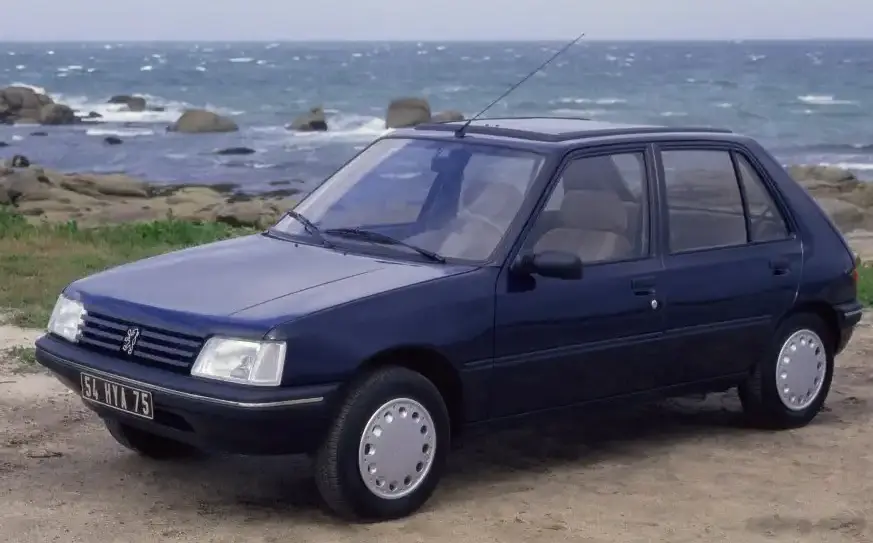
The Peugeot 205 1.8D, produced between 1987 and 1990, represents a distinct variant within the highly successful 205 series. This model, identified internally as the 20A/C following the 1987 facelift, offered a diesel-powered option aimed at buyers prioritizing fuel economy and practicality. It occupied the lower end of the 205 lineup, positioned as an affordable and efficient choice compared to the gasoline-powered variants, particularly the GTI models. The 205, in general, was a pivotal model for Peugeot, becoming a cultural icon in Europe and establishing a reputation for nimble handling and accessible motoring.
Technical Specifications
| Brand | Peugeot |
| Model | 205 |
| Generation | 205 I (20A/C, facelift 1987) |
| Type (Engine) | 1.8 D (59 Hp) |
| Start of production | 1987 |
| End of production | 1990 |
| Powertrain Architecture | Internal Combustion engine |
| Body type | Hatchback |
| Seats | 5 |
| Doors | 3-5 |
| Fuel consumption (urban) | 5.4 l/100 km (43.6 US mpg, 52.3 UK mpg, 18.5 km/l) |
| Fuel consumption (extra urban) | 3.9 l/100 km (60.3 US mpg, 72.4 UK mpg, 25.6 km/l) |
| Fuel consumption (combined) | 5.2 l/100 km (45.2 US mpg, 54.3 UK mpg, 19.2 km/l) |
| Fuel Type | Diesel |
| Acceleration 0 – 100 km/h | 15.1 sec |
| Acceleration 0 – 62 mph | 15.1 sec |
| Acceleration 0 – 60 mph | 14.3 sec |
| Maximum speed | 156 km/h (96.93 mph) |
| Weight-to-power ratio | 14.9 kg/Hp |
| Weight-to-torque ratio | 8 kg/Nm |
| Power | 59 Hp @ 4600 rpm |
| Power per litre | 33.4 Hp/l |
| Torque | 110 Nm @ 2000 rpm (81.13 lb.-ft. @ 2000 rpm) |
| Engine layout | Front, Transverse |
| Engine Model/Code | A9A XUD7 |
| Engine displacement | 1769 cm3 (107.95 cu. in.) |
| Number of cylinders | 4 |
| Engine configuration | Inline |
| Cylinder Bore | 80 mm (3.15 in.) |
| Piston Stroke | 88 mm (3.46 in.) |
| Compression ratio | 23:1 |
| Number of valves per cylinder | 2 |
| Fuel injection system | Precombustion chamber injection |
| Engine aspiration | Naturally aspirated |
| Engine oil capacity | 5 l (5.28 US qt | 4.4 UK qt) |
| Coolant capacity | 8.5 l (8.98 US qt | 7.48 UK qt) |
| Kerb Weight | 880 kg (1940.07 lbs.) |
| Max. weight | 1300 kg (2866.01 lbs.) |
| Max load | 420 kg (925.94 lbs.) |
| Trunk (boot) space – minimum | 290 l (10.24 cu. ft.) |
| Trunk (boot) space – maximum | 585 l (20.66 cu. ft.) |
| Fuel tank capacity | 50 l (13.21 US gal | 11 UK gal) |
| Length | 3705 mm (145.87 in.) |
| Width | 1560 mm (61.42 in.) |
| Height | 1375 mm (54.13 in.) |
| Wheelbase | 2420 mm (95.28 in.) |
| Front track | 1350 mm (53.15 in.) |
| Rear track | 1300 mm (51.18 in.) |
| Drivetrain Architecture | Front wheel drive |
| Number of gears | 5 |
| Gearbox type | Manual transmission |
| Front suspension | Coil spring |
| Rear suspension | Torsion |
| Front brakes | Disc |
| Rear brakes | Drum |
| Assisting systems | ABS (Anti-lock braking system) |
| Steering type | Steering rack and pinion |
| Power steering | Hydraulic |
| Tires size | 155/70 SR13 |
Powertrain & Engine Architecture
The 1.8D variant of the Peugeot 205 utilized the XUD7 engine, specifically the A9A variant. This 1769cc inline-four diesel engine was a mainstay in Peugeot and Citroën vehicles during the 1980s and 1990s. It employed precombustion chamber injection, a system common in diesel engines of the era, which involved injecting fuel into a small pre-chamber connected to the main combustion chamber. This design aided in cold starting and reduced engine noise. The XUD7 engine is known for its robustness and relatively simple mechanical design. The 59 horsepower output was achieved at 4600 rpm, while peak torque of 110 Nm (81.13 lb-ft) was delivered at 2000 rpm. The engine was transversely mounted in the front of the vehicle, driving the front wheels. The 205 1.8D was exclusively offered with a five-speed manual transmission, chosen to maximize fuel efficiency and provide adequate gearing for the engine’s characteristics.
Driving Characteristics
The 205 1.8D offered a distinctly different driving experience compared to the more powerful gasoline variants. Acceleration was modest, taking approximately 15.1 seconds to reach 62 mph. However, the engine’s torque delivery provided reasonable usability in everyday driving situations. The five-speed manual transmission allowed drivers to keep the engine within its optimal operating range. While not sporty, the 205 1.8D benefited from the 205’s inherently good handling characteristics, offering a surprisingly nimble feel for a diesel-powered vehicle. Compared to the gasoline-powered 1.6L engine, the 1.8D traded performance for significantly improved fuel economy.
Equipment & Trim Levels
The 1.8D trim level of the Peugeot 205 was generally considered the entry-level offering. Standard equipment typically included basic cloth upholstery, a simple dashboard layout, and manual windows and door locks. Power steering was often included, but air conditioning and other comfort features were typically optional extras. The interior was functional and durable, prioritizing practicality over luxury. Optional extras could include upgraded stereo systems, different wheel covers, and metallic paint finishes.
Chassis & Braking
The 205 1.8D utilized a relatively simple chassis setup. Front suspension consisted of coil springs, while the rear employed a torsion beam axle. This configuration provided a good balance between ride comfort and handling. The braking system featured disc brakes on the front wheels and drum brakes on the rear. An ABS system was available as an option, enhancing braking performance and safety. The relatively light weight of the 205, around 880 kg (1940 lbs), helped to compensate for the engine’s modest power output.
Market Reception & Comparison
The Peugeot 205 1.8D was well-received in markets where fuel economy was a primary concern. It offered a cost-effective and reliable transportation solution. Critics generally praised its fuel efficiency and durability, but noted its lack of performance compared to the gasoline-powered models. Compared to other diesel-powered hatchbacks of the era, the 205 1.8D offered a compelling combination of affordability, practicality, and driving enjoyment. The 1.6L gasoline version offered more power but at the cost of fuel economy, while the GTI models were significantly more expensive and targeted a different demographic.
Legacy
The Peugeot 205 1.8D, and the XUD7 engine in particular, have earned a reputation for long-term reliability. Many examples remain on the road today, testament to the engine’s robust design and durability. The XUD7 engine is known for its ability to withstand high mileage with proper maintenance. In the used car market, the 205 1.8D is often sought after by enthusiasts looking for a simple, reliable, and affordable classic car. While not as collectible as the GTI models, the 1.8D represents an important part of the 205’s legacy, offering a practical and economical alternative for buyers who prioritized fuel efficiency and durability.
