
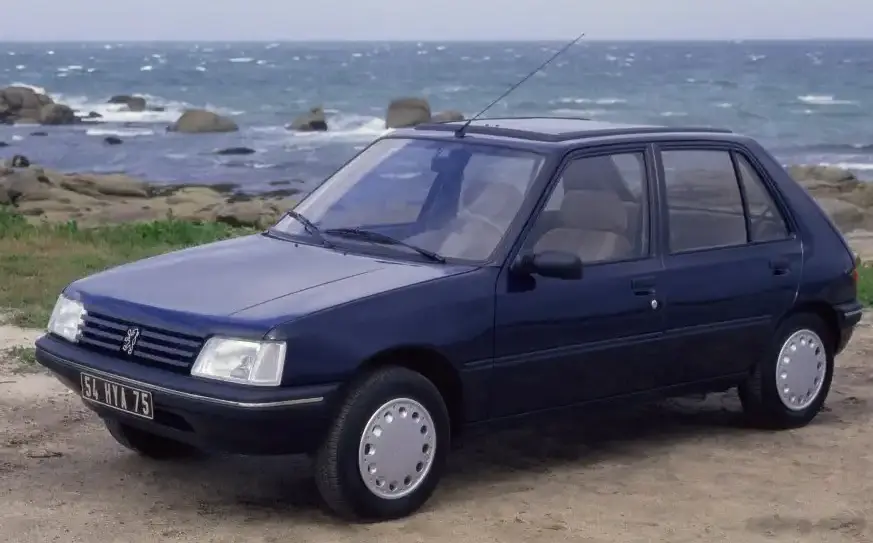
The Peugeot 205 I, specifically the 1.9 Diesel variant produced from 1987 to 1998, represents a significant iteration of Peugeot’s popular supermini. Introduced as part of the 20A/C facelift, this model aimed to provide economical transportation within the European market, capitalizing on the growing demand for fuel-efficient diesel engines. Positioned as a practical and affordable option, the 1.9 Diesel sat towards the base of the 205 lineup, appealing to buyers prioritizing low running costs over outright performance. It was a mainstay of the range throughout its production run, undergoing minor revisions but remaining fundamentally consistent in its core offering.
Technical Specifications
| Brand | Peugeot |
| Model | 205 |
| Generation | 205 I (20A/C, facelift 1987) |
| Type (Engine) | 1.9 Diesel (64 Hp) |
| Start of production | 1987 |
| End of production | 1998 |
| Powertrain Architecture | Internal Combustion engine |
| Body type | Hatchback |
| Seats | 5 |
| Doors | 3-5 |
| Fuel consumption (urban) | 5.9 l/100 km (39.9 US mpg, 47.9 UK mpg, 16.9 km/l) |
| Fuel consumption (extra urban) | 4.4 l/100 km (53.5 US mpg, 64.2 UK mpg, 22.7 km/l) |
| Fuel consumption (combined) | 5.6 l/100 km (42 US mpg, 50.4 UK mpg, 17.9 km/l) |
| Fuel Type | Diesel |
| Acceleration 0 – 100 km/h | 14.2 sec |
| Acceleration 0 – 62 mph | 14.2 sec |
| Acceleration 0 – 60 mph | 13.5 sec |
| Maximum speed | 162 km/h (100.66 mph) |
| Weight-to-power ratio | 13.8 kg/Hp, 72.7 Hp/tonne |
| Weight-to-torque ratio | 7.5 kg/Nm, 134.1 Nm/tonne |
| Power | 64 Hp @ 4600 rpm |
| Power per litre | 33.6 Hp/l |
| Torque | 118 Nm @ 2000 rpm (87.03 lb.-ft. @ 2000 rpm) |
| Engine layout | Front, Transverse |
| Engine Model/Code | DJY XUD9A |
| Engine displacement | 1905 cm3 (116.25 cu. in.) |
| Number of cylinders | 4 |
| Engine configuration | Inline |
| Cylinder Bore | 83 mm (3.27 in.) |
| Piston Stroke | 88 mm (3.46 in.) |
| Compression ratio | 23:1 |
| Number of valves per cylinder | 2 |
| Fuel injection system | Precombustion chamber injection |
| Engine aspiration | Naturally aspirated |
| Engine oil capacity | 4 l (4.23 US qt | 3.52 UK qt) |
| Coolant capacity | 8.5 l (8.98 US qt | 7.48 UK qt) |
| Kerb Weight | 880 kg (1940.07 lbs.) |
| Max. weight | 1300 kg (2866.01 lbs.) |
| Max load | 420 kg (925.94 lbs.) |
| Trunk (boot) space – minimum | 290 l (10.24 cu. ft.) |
| Trunk (boot) space – maximum | 585 l (20.66 cu. ft.) |
| Fuel tank capacity | 50 l (13.21 US gal | 11 UK gal) |
| Length | 3705 mm (145.87 in.) |
| Width | 1560 mm (61.42 in.) |
| Height | 1375 mm (54.13 in.) |
| Wheelbase | 2420 mm (95.28 in.) |
| Front track | 1350 mm (53.15 in.) |
| Rear track | 1300 mm (51.18 in.) |
| Drivetrain Architecture | Front wheel drive |
| Number of gears | 5 |
| Gearbox type | Manual transmission |
| Front suspension | Coil spring |
| Rear suspension | Torsion |
| Front brakes | Disc |
| Rear brakes | Drum |
| Assisting systems | ABS (Anti-lock braking system) |
| Steering type | Steering rack and pinion |
| Power steering | Hydraulic |
| Tires size | 155/70 SR13 |
Powertrain & Engine Architecture
The heart of the 205 1.9 Diesel is the XUD9A engine, a naturally aspirated, inline-four cylinder diesel engine displacing 1905 cc (116.25 cubic inches). This engine, designated with the code DJY in many applications, was a mainstay of Peugeot and Citroën vehicles throughout the 1980s and 1990s. It utilizes a precombustion chamber injection system, a common diesel technology of the era, which improves combustion efficiency and reduces engine noise compared to direct injection systems. The engine produces 64 horsepower at 4600 rpm and 118 Nm (87 lb-ft) of torque at 2000 rpm. The five-speed manual transmission was the standard offering, providing a relatively long-legged gearing setup optimized for fuel economy. The engine’s robust construction and relatively simple design contributed to its reputation for durability.
Driving Characteristics
The 1.9 Diesel 205 was not designed for speed. Acceleration from 0 to 60 mph took around 13.5 seconds, and top speed was approximately 100 mph. However, the engine’s torque characteristics made it surprisingly capable in everyday driving situations. The long gearing meant that the engine rarely felt strained at highway speeds, and the relatively light weight of the 205 (around 1940 lbs) helped to mitigate the lack of outright power. Compared to the more powerful petrol (gasoline) versions of the 205, such as the 1.6 GTI, the 1.9 Diesel offered a significantly different driving experience – one focused on economy and practicality rather than performance. The manual transmission, while not particularly sporty, was precise and easy to use.
Equipment & Trim Levels
The 1.9 Diesel 205 typically came with a fairly basic level of equipment. Standard features included cloth upholstery, a simple dashboard layout, and manual windows and door locks. ABS anti-lock brakes were often included, a notable safety feature for the time. Optional extras included a sunroof, upgraded stereo systems, and central locking. Trim levels were relatively limited, with the focus being on providing a functional and affordable vehicle. The interior was designed for durability and ease of cleaning, reflecting the car’s intended role as a practical everyday vehicle.
Chassis & Braking
The 205’s chassis was a key element of its success. The 1.9 Diesel variant utilized a coil spring suspension at the front and a torsion beam suspension at the rear. The front brakes were discs, while the rear brakes were drums. This setup was adequate for the car’s weight and performance, providing reasonable stopping power and a comfortable ride. The steering was a rack and pinion system with hydraulic assistance, offering a good balance of feel and ease of use. The relatively narrow tires (155/70 SR13) contributed to the car’s fuel efficiency and provided adequate grip in most conditions.
Market Reception & Comparison
The Peugeot 205 1.9 Diesel was well-received in the European market as a practical and economical choice. Critics praised its fuel efficiency and durability, but noted its lack of performance. Compared to other diesel-powered superminis of the time, such as the Renault 5 Diesel, the 205 offered a slightly more refined driving experience and a more modern interior. The 1.9 Diesel was significantly more economical than the petrol-powered versions of the 205, but also considerably slower. Its reliability was generally good, although maintenance costs could be higher than for some of its competitors due to the complexity of the diesel engine.
Legacy
The Peugeot 205 1.9 Diesel has proven to be a remarkably durable vehicle. Many examples are still on the road today, a testament to the robustness of the XUD9A engine and the overall build quality of the 205. In the used car market, these models are often sought after by enthusiasts looking for a simple, reliable, and economical classic car. While not a performance icon like the 205 GTI, the 1.9 Diesel holds a special place in the hearts of many drivers who appreciated its practicality and fuel efficiency. The XUD9 engine itself is considered a classic among diesel enthusiasts, known for its longevity and relatively straightforward mechanical design.
