
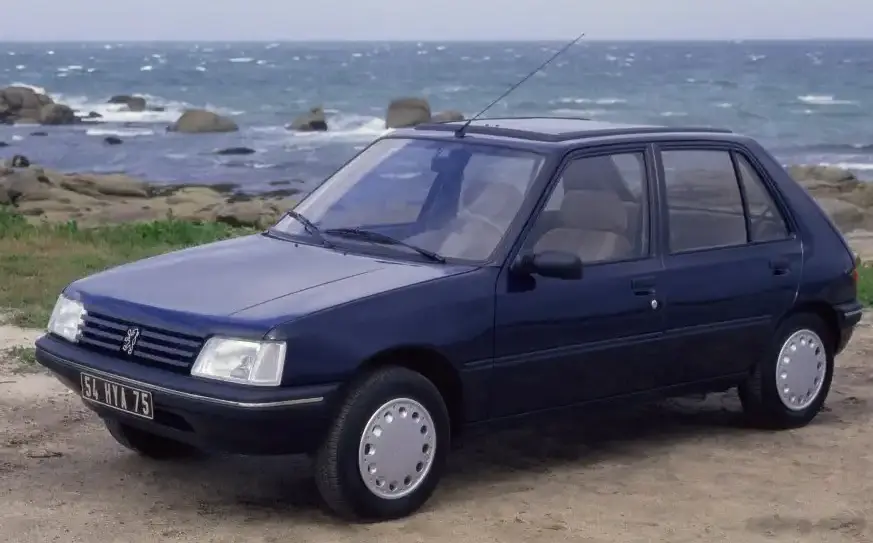
The Peugeot 205 I 1.9 GTI (102 hp) CAT, produced from 1987 to 1994, represents a high-performance variant within the popular 205 series. This model, identifiable by its chassis codes 20A/C and benefitting from the 1987 facelift, quickly became a benchmark for affordable, engaging hot hatches in Europe. Positioned as the top-tier performance model in the 205 lineup (excluding limited editions), the 1.9 GTI offered a significant step up in power and handling compared to the lower-spec 1.0 and 1.6 liter versions. It played a crucial role in establishing Peugeot’s reputation for sporty, well-engineered vehicles and remains a highly sought-after classic today.
Technical Specifications
| Brand | Peugeot |
| Model | 205 |
| Generation | 205 I (20A/C, facelift 1987) |
| Type (Engine) | 1.9 GTI (102 Hp) CAT |
| Start of production | 1987 |
| End of production | 1994 |
| Powertrain Architecture | Internal Combustion engine |
| Body type | Hatchback |
| Seats | 5 |
| Doors | 3-5 |
| Fuel consumption (urban) | 9.9 l/100 km (23.8 US mpg, 28.5 UK mpg, 10.1 km/l) |
| Fuel consumption (extra urban) | 6.3 l/100 km (37.3 US mpg, 44.8 UK mpg, 15.9 km/l) |
| Fuel consumption (combined) | 8.2 l/100 km (28.7 US mpg, 34.4 UK mpg, 12.2 km/l) |
| Fuel Type | Petrol (Gasoline) |
| Acceleration 0 – 100 km/h | 9.5 sec |
| Acceleration 0 – 62 mph | 9.5 sec |
| Acceleration 0 – 60 mph | 9 sec |
| Maximum speed | 190 km/h (118.06 mph) |
| Weight-to-power ratio | 8.6 kg/Hp, 115.9 Hp/tonne |
| Weight-to-torque ratio | 6.2 kg/Nm, 161.4 Nm/tonne |
| Power | 102 Hp @ 6000 rpm |
| Power per litre | 53.5 Hp/l |
| Torque | 142 Nm @ 3000 rpm (104.73 lb.-ft. @ 3000 rpm) |
| Engine layout | Front, Transverse |
| Engine Model/Code | DFZ XU9J1 |
| Engine displacement | 1905 cm3 (116.25 cu. in.) |
| Number of cylinders | 4 |
| Engine configuration | Inline |
| Cylinder Bore | 83 mm (3.27 in.) |
| Piston Stroke | 88 mm (3.46 in.) |
| Compression ratio | 8.4:1 |
| Number of valves per cylinder | 4 |
| Fuel injection system | Multi-port manifold injection |
| Engine aspiration | Naturally aspirated engine |
| Engine oil capacity | 4 l (4.23 US qt | 3.52 UK qt) |
| Coolant capacity | 6.6 l (6.97 US qt | 5.81 UK qt) |
| Kerb Weight | 880 kg (1940.07 lbs.) |
| Max. weight | 1300 kg (2866.01 lbs.) |
| Max load | 420 kg (925.94 lbs.) |
| Trunk (boot) space – minimum | 290 l (10.24 cu. ft.) |
| Trunk (boot) space – maximum | 585 l (20.66 cu. ft.) |
| Fuel tank capacity | 50 l (13.21 US gal | 11 UK gal) |
| Length | 3705 mm (145.87 in.) |
| Width | 1560 mm (61.42 in.) |
| Height | 1375 mm (54.13 in.) |
| Wheelbase | 2420 mm (95.28 in.) |
| Front track | 1350 mm (53.15 in.) |
| Rear (Back) track | 1300 mm (51.18 in.) |
| Drivetrain Architecture | The Internal combustion engine (ICE) drives the front wheels of the vehicle. |
| Drive wheel | Front wheel drive |
| Number of gears and type of gearbox | 5 gears, manual transmission |
| Front suspension | Coil spring |
| Rear suspension | Torsion |
| Front brakes | Disc |
| Rear brakes | Disc |
| Assisting systems | ABS (Anti-lock braking system) |
| Steering type | Steering rack and pinion |
| Power steering | Hydraulic Steering |
| Tires size | 185/60 R14 |
Powertrain & Engine Architecture
The heart of the 205 GTI 1.9 is the DFZ (also known as XU9J1) 1.9-liter inline-four cylinder engine. This engine, a staple of Peugeot and Citroën performance models of the era, featured a cast iron block and an aluminum cylinder head. It utilized a Bosch Motronic multi-port fuel injection system, providing precise fuel delivery for optimal performance and emissions control. The engine boasted a compression ratio of 8.4:1 and employed a single overhead camshaft (SOHC) design with four valves per cylinder. The catalytic converter (“CAT” in the model designation) was a crucial addition for meeting increasingly stringent European emissions standards. The engine was transversely mounted, driving the front wheels. The five-speed manual transmission, known for its precise shift action, was the only gearbox option available for this variant.
Driving Characteristics
The 1.9 GTI offered a distinctly engaging driving experience. With 102 horsepower and 142 Nm (104.73 lb-ft) of torque, it provided brisk acceleration, reaching 60 mph in approximately 9 seconds and achieving a top speed of 190 km/h (118 mph). While not outright the fastest hot hatch of its time, the 205 GTI excelled in its handling. The relatively lightweight chassis, combined with well-tuned suspension – featuring coil springs at the front and a torsion beam at the rear – delivered a responsive and balanced feel. The steering, a rack and pinion system with hydraulic assistance, was precise and communicative. Compared to the earlier 1.6 GTI, the 1.9 offered noticeably more torque, making it more flexible in everyday driving situations. The five-speed gearbox was well-matched to the engine’s powerband, allowing for spirited driving on winding roads.
Equipment & Trim Levels
The 1.9 GTI came reasonably well-equipped for its time. Standard features included power steering, disc brakes on all four wheels, and an anti-lock braking system (ABS), a relatively uncommon feature in this class of vehicle. The interior typically featured sporty cloth upholstery, often with a distinctive checkered pattern. A central console housed the gauges, including a tachometer. Optional extras included a sunroof, central locking, and upgraded audio systems. The GTI trim level also featured unique exterior styling cues, such as a rear spoiler, alloy wheels, and distinctive badging.
Chassis & Braking
The 205 GTI’s chassis was a key element in its success. The lightweight body shell contributed to its nimble handling. The front suspension utilized coil springs and MacPherson struts, while the rear employed a torsion beam setup. This combination provided a good balance between ride comfort and handling precision. The braking system consisted of ventilated disc brakes on all four wheels, providing ample stopping power. The ABS system further enhanced safety by preventing wheel lockup during hard braking.
Market Reception & Comparison
The Peugeot 205 GTI 1.9 was widely praised by automotive journalists and enthusiasts alike. It was lauded for its engaging driving dynamics, responsive engine, and well-balanced chassis. Critics often compared it favorably to rivals such as the Volkswagen Golf GTI and the Ford Escort XR3i. While the Golf GTI offered a more refined and spacious interior, the 205 GTI was often considered more fun to drive. The 1.9 GTI’s fuel economy was respectable for a performance car of its era, averaging around 28.7 US mpg in combined driving. Compared to the 1.6 GTI, the 1.9 offered improved performance and torque, but at a slightly higher price point.
Legacy
The Peugeot 205 GTI 1.9 remains a highly regarded classic car. Its combination of performance, handling, and affordability has made it a favorite among enthusiasts. The DFZ engine, while generally reliable, can be prone to oil leaks and requires regular maintenance. Rust can also be an issue, particularly on older examples. However, well-maintained 205 GTIs continue to command strong prices in the used car market. The 205 GTI’s influence can be seen in subsequent generations of hot hatches, and it is widely considered a benchmark for its class. It cemented Peugeot’s reputation for building engaging and rewarding driver’s cars.
