
Technical Specifications
| Brand | Peugeot |
| Model | 205 |
| Generation | 205 I (20A/C, facelift 1987) |
| Type (Engine) | 1.9 GTI (120 Hp) Automatic |
| Start of production | 1987 |
| End of production | 1994 |
| Powertrain Architecture | Internal Combustion engine |
| Body type | Hatchback |
| Seats | 5 |
| Doors | 3-5 |
| Fuel consumption (urban) | 9.9 l/100 km (23.8 US mpg, 28.5 UK mpg, 10.1 km/l) |
| Fuel consumption (extra urban) | 6.3 l/100 km (37.3 US mpg, 44.8 UK mpg, 15.9 km/l) |
| Fuel consumption (combined) | 8.2 l/100 km (28.7 US mpg, 34.4 UK mpg, 12.2 km/l) |
| Fuel Type | Petrol (Gasoline) |
| Acceleration 0 – 100 km/h | 8.5 sec |
| Acceleration 0 – 62 mph | 8.5 sec |
| Acceleration 0 – 60 mph | 8.1 sec |
| Maximum speed | 202 km/h (125.52 mph) |
| Weight-to-power ratio | 7.3 kg/Hp, 136.4 Hp/tonne |
| Weight-to-torque ratio | 5.5 kg/Nm, 183 Nm/tonne |
| Power | 120 Hp @ 6000 rpm |
| Power per litre | 63 Hp/l |
| Torque | 161 Nm @ 4750 rpm (118.75 lb.-ft. @ 4750 rpm) |
| Engine layout | Front, Transverse |
| Engine Model/Code | DKZ XU9JAZ |
| Engine displacement | 1905 cm3 (116.25 cu. in.) |
| Number of cylinders | 4 |
| Engine configuration | Inline |
| Cylinder Bore | 83 mm (3.27 in.) |
| Piston Stroke | 88 mm (3.46 in.) |
| Compression ratio | 9.6:1 |
| Number of valves per cylinder | 2 |
| Fuel injection system | Multi-port manifold injection |
| Engine aspiration | Naturally aspirated engine |
| Engine oil capacity | 4 l (4.23 US qt | 3.52 UK qt) |
| Coolant capacity | 6.6 l (6.97 US qt | 5.81 UK qt) |
| Kerb Weight | 880 kg (1940.07 lbs.) |
| Max. weight | 1300 kg (2866.01 lbs.) |
| Max load | 420 kg (925.94 lbs.) |
| Trunk (boot) space – minimum | 290 l (10.24 cu. ft.) |
| Trunk (boot) space – maximum | 585 l (20.66 cu. ft.) |
| Fuel tank capacity | 50 l (13.21 US gal | 11 UK gal) |
| Length | 3705 mm (145.87 in.) |
| Width | 1560 mm (61.42 in.) |
| Height | 1375 mm (54.13 in.) |
| Wheelbase | 2420 mm (95.28 in.) |
| Front track | 1350 mm (53.15 in.) |
| Rear (Back) track | 1300 mm (51.18 in.) |
| Drivetrain Architecture | The Internal combustion engine (ICE) drives the front wheels of the vehicle. |
| Drive wheel | Front wheel drive |
| Number of gears and type of gearbox | 4 gears, automatic transmission |
| Front suspension | Coil spring |
| Rear suspension | Torsion |
| Front brakes | Disc |
| Rear brakes | Disc |
| Steering type | Steering rack and pinion |
| Power steering | Hydraulic Steering |
| Tires size | 185/60 R14 |
| Wheel rims size | 14 |
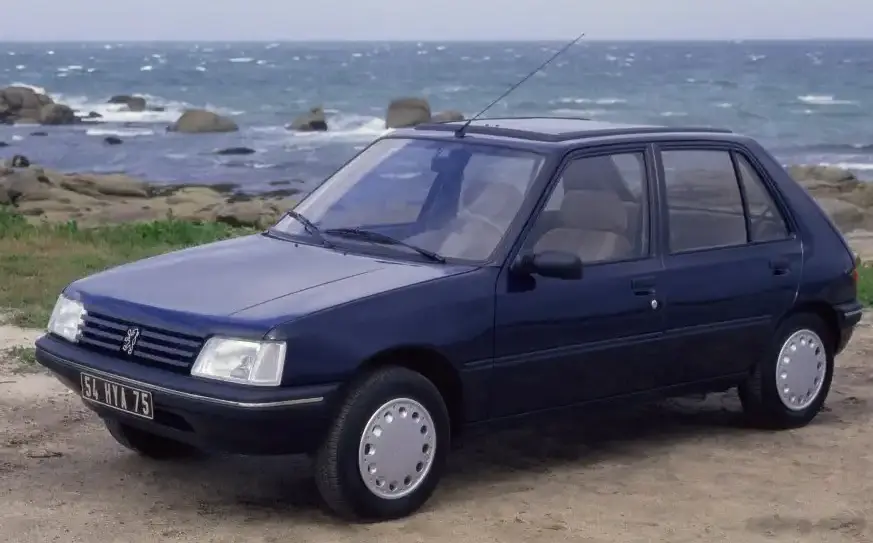
The Peugeot 205 I 1.9 GTI Automatic, produced from 1987 to 1994, represents a unique offering within the highly successful 205 range. Positioned as a more accessible entry point into the GTI performance tier, it combined the potent 1.9-liter engine with the convenience of an automatic transmission. This variant was part of the 20A/C facelift series, which brought revised styling and minor mechanical updates to the original 205 design. While the manual transmission GTI models were celebrated for their driver engagement, the automatic version catered to buyers seeking a blend of performance and ease of use, particularly in urban environments. The 205, in general, was a pivotal model for Peugeot, revitalizing the small car segment and becoming a cultural icon in Europe.
Powertrain & Engine Architecture
The heart of the 205 1.9 GTI Automatic is the DKZ XU9JAZ engine, a 1.9-liter inline-four cylinder powerplant. This engine is a member of the XU series, known for its robustness and tunability. It features a cast iron block and an aluminum cylinder head, equipped with two valves per cylinder. Fuel delivery is managed by a multi-port fuel injection system, providing precise fuel metering for improved efficiency and performance. The engine produces 120 horsepower at 6000 rpm and 161 Nm (118.75 lb-ft) of torque at 4750 rpm. The automatic transmission is a four-speed unit, designed to provide smooth and convenient gear changes. While not as sporty as the five-speed manual found in other GTI models, it was well-suited for everyday driving and offered a more relaxed driving experience.
Driving Characteristics
The 205 1.9 GTI Automatic delivers a respectable level of performance, achieving 0-60 mph in approximately 8.1 seconds and a top speed of 125.52 mph. However, the automatic transmission does impact acceleration compared to the manual version. The gear ratios are tuned for comfort and fuel economy rather than outright speed. Power delivery is linear, but the automatic transmission can sometimes feel hesitant during quick acceleration or when attempting to downshift for overtaking. The car’s relatively light weight (880 kg / 1940 lbs) helps to mitigate some of the performance loss associated with the automatic gearbox. The steering remains precise and responsive, characteristic of the 205 platform, providing a connected feel to the driver.
Equipment & Trim Levels
The 1.9 GTI Automatic typically came equipped with a generous level of standard features for its time. Interior appointments included comfortable cloth upholstery, a basic but functional dashboard layout, and power steering. Optional extras included a sunroof, upgraded audio systems, and alloy wheels. The trim level generally sat between the base model 205s and the more focused, manual-transmission GTI variants. It aimed to provide a balance of performance and comfort, appealing to buyers who prioritized convenience over ultimate driving engagement.
Chassis & Braking
The 205 GTI Automatic utilizes a coil spring suspension at the front and a torsion beam suspension at the rear. This setup provides a good balance of ride comfort and handling. The car is equipped with disc brakes on all four wheels, offering adequate stopping power for its performance level. The steering is a rack and pinion system, providing precise and responsive control. The 185/60 R14 tires offer a good compromise between grip and ride quality.
Market Reception & Comparison
The 205 1.9 GTI Automatic received mixed reviews. While praised for its comfortable ride and ease of use, it was often criticized for its slightly sluggish performance compared to the manual transmission models. Fuel economy was considered reasonable for a performance car of its era, averaging around 28.7 US mpg in combined driving. Compared to the 1.6-liter versions of the 205, the 1.9 GTI Automatic offered a significant performance upgrade. However, it lacked the raw driving experience of the more focused GTI models with manual gearboxes.
Legacy
The Peugeot 205 1.9 GTI Automatic remains a popular choice among classic car enthusiasts. The XU9JAZ engine is known for its durability, and with proper maintenance, these cars can provide many years of reliable service. The automatic transmission, while not as sought after as the manual, offers a unique driving experience and can be a good option for those seeking a more relaxed classic car. Today, well-maintained examples command a respectable price in the used car market, reflecting the 205’s enduring appeal and its status as a French automotive icon.
