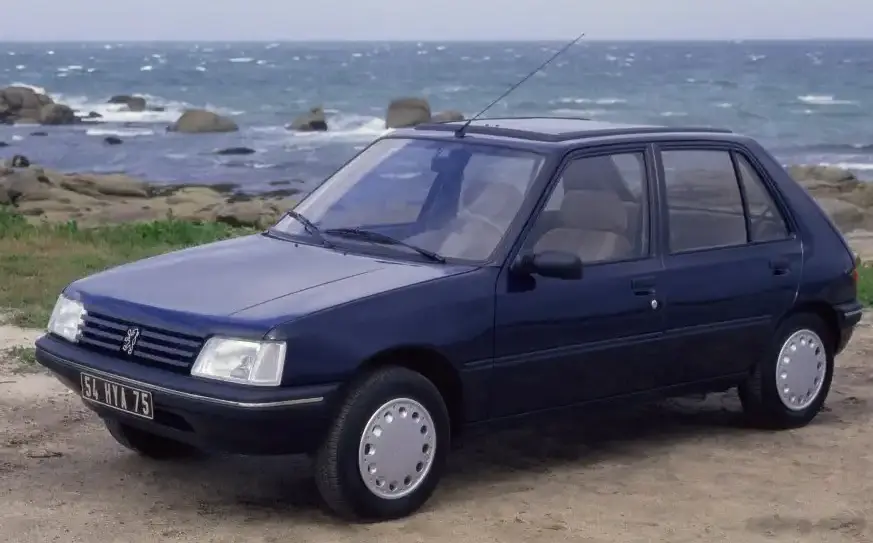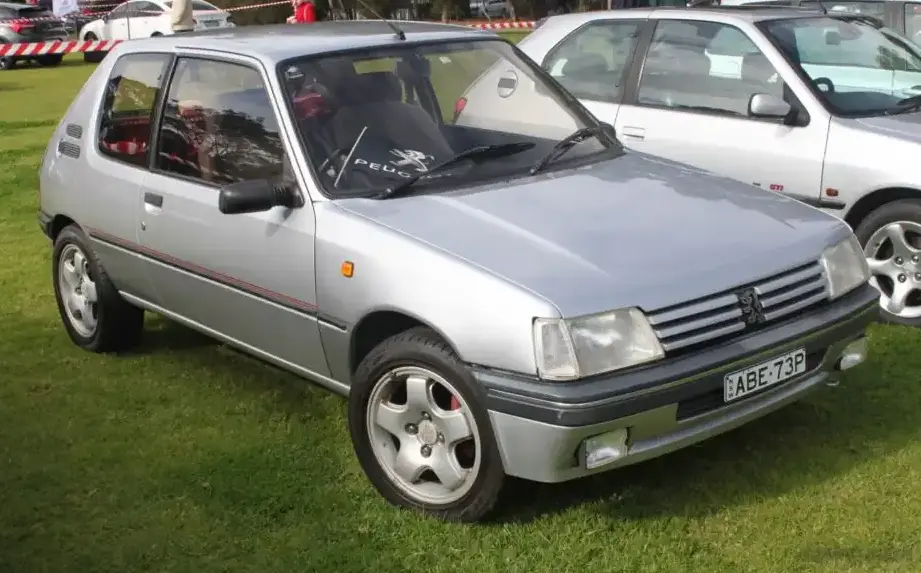
The Peugeot 205, launched in 1983, quickly became a cultural icon and one of Peugeot’s most successful models. The 205 I, specifically the facelifted version introduced in 1987 (designated 20A/C), continued this success, offering a range of engines and trim levels to suit diverse buyers. This article focuses on the 3-door variant equipped with the 1.0-liter engine producing 45 horsepower. Produced from 1987 through 1995, this version represented the entry point into the 205 range, prioritizing affordability and fuel economy over outright performance. It played a significant role in making the 205 accessible to a wider audience, particularly first-time car buyers and those seeking a practical city vehicle.
Technical Specifications
| Brand | Peugeot |
| Model | 205 |
| Generation | 205 I (20A/C, facelift 1987) 3-door |
| Type (Engine) | 1.0 (45 Hp) |
| Start of production | 1987 |
| End of production | 1995 |
| Powertrain Architecture | Internal Combustion engine |
| Body type | Hatchback |
| Seats | 5 |
| Doors | 3 |
| Fuel consumption (urban) | 6.8 l/100 km (34.6 US mpg, 41.5 UK mpg, 14.7 km/l) |
| Fuel consumption (extra urban) | 4.6 l/100 km (51.1 US mpg, 61.4 UK mpg, 21.7 km/l) |
| Fuel consumption (combined) | 6.3 l/100 km (37.3 US mpg, 44.8 UK mpg, 15.9 km/l) |
| Fuel Type | Petrol (Gasoline) |
| Acceleration 0 – 100 km/h | 18.8 sec |
| Acceleration 0 – 62 mph | 18.8 sec |
| Acceleration 0 – 60 mph | 17.9 sec |
| Maximum speed | 143 km/h (88.86 mph) |
| Weight-to-power ratio | 16.4 kg/Hp, 60.8 Hp/tonne |
| Weight-to-torque ratio | 10.1 kg/Nm, 98.6 Nm/tonne |
| Power | 45 Hp @ 5200 rpm |
| Power per litre | 47.2 Hp/l |
| Torque | 73 Nm @ 2400 rpm (53.84 lb.-ft. @ 2400 rpm) |
| Engine layout | Front, Transverse |
| Engine Model/Code | TU9 |
| Engine displacement | 954 cm3 (58.22 cu. in.) |
| Number of cylinders | 4 |
| Engine configuration | Inline |
| Cylinder Bore | 70 mm (2.76 in.) |
| Piston Stroke | 62 mm (2.44 in.) |
| Compression ratio | 9.4:1 |
| Number of valves per cylinder | 2 |
| Fuel injection system | Carburettor |
| Engine aspiration | Naturally aspirated |
| Engine oil capacity | 4.5 l (4.76 US qt | 3.96 UK qt) |
| Coolant capacity | 6 l (6.34 US qt | 5.28 UK qt) |
| Kerb Weight | 740 kg (1631.42 lbs.) |
| Max. weight | 1160 kg (2557.36 lbs.) |
| Max load | 420 kg (925.94 lbs.) |
| Trunk (boot) space – minimum | 216 l (7.63 cu. ft.) |
| Trunk (boot) space – maximum | 564 l (19.92 cu. ft.) |
| Fuel tank capacity | 50 l (13.21 US gal | 11 UK gal) |
| Length | 3705 mm (145.87 in.) |
| Width | 1560 mm (61.42 in.) |
| Height | 1375 mm (54.13 in.) |
| Wheelbase | 2420 mm (95.28 in.) |
| Front track | 1350 mm (53.15 in.) |
| Rear track | 1300 mm (51.18 in.) |
| Drivetrain Architecture | Front wheel drive |
| Number of gears | 4 |
| Gearbox type | Manual transmission |
| Front suspension | Independent, McPherson with coil spring and anti-roll bar |
| Rear suspension | Torsion |
| Front brakes | Disc |
| Rear brakes | Drum |
| Steering type | Steering rack and pinion |
| Tires size | 135/80 R13 |
| Wheel rims size | 13 |
Powertrain & Engine Architecture
The heart of this 205 variant is the Peugeot TU9 engine, a 954cc inline-four cylinder unit. This engine, while modest in displacement, was known for its durability and simplicity. It utilized a single overhead camshaft (SOHC) design with two valves per cylinder. Crucially, this version of the TU9 was equipped with a carburetor – a Solex 32 PHN – rather than fuel injection, which was becoming more common in the late 1980s. This carburetor setup contributed to its lower cost but also resulted in slightly less precise fuel delivery and lower overall performance compared to fuel-injected counterparts. The engine produced 45 horsepower at 5200 rpm and 54 lb-ft of torque at 2400 rpm. The engine was transversely mounted, driving the front wheels. The transmission was a four-speed manual gearbox, chosen for its simplicity and cost-effectiveness. This gearbox featured relatively long gearing, prioritizing fuel economy over rapid acceleration.
Driving Characteristics
The 1.0-liter 205 was not designed for speed. Acceleration was leisurely, taking approximately 18.8 seconds to reach 62 mph. However, its lightweight construction (around 1631 lbs) meant it felt nimble and responsive in city driving. The long gearing of the four-speed gearbox meant that the engine rarely felt strained at highway speeds, but overtaking required careful planning. Compared to the more powerful 1.6-liter and 1.9-liter versions of the 205, this variant lacked the punch for spirited driving. However, it offered a more forgiving and accessible driving experience, particularly for novice drivers. The steering was light and precise, contributing to its enjoyable handling characteristics.
Equipment & Trim Levels
The 1.0-liter 205 was typically offered in a basic trim level, focusing on essential features. Standard equipment included cloth upholstery, a basic dashboard layout, and manual windows and door locks. Options were limited but could include a sunroof, upgraded stereo, and central locking. The interior was functional and durable, prioritizing practicality over luxury. The exterior featured steel wheels with hubcaps, and body-colored bumpers were often an optional extra. This trim level was aimed at buyers who prioritized affordability and reliability over creature comforts.
Chassis & Braking
The 205’s chassis was a key element of its success. It featured an independent McPherson strut front suspension with a coil spring and anti-roll bar, providing good handling and ride comfort. The rear suspension utilized a simple torsion beam setup, which was cost-effective and space-efficient. The braking system consisted of disc brakes on the front wheels and drum brakes on the rear. While adequate for the car’s performance, the drum brakes on the rear were less effective than disc brakes, particularly under heavy braking. The steering was a rack and pinion system, providing precise and responsive steering feel.
Market Reception & Comparison
The 1.0-liter 205 was well-received as an affordable and economical city car. Critics praised its nimble handling and fuel efficiency, but noted its lack of outright performance. Compared to the 1.6-liter and 1.9-liter versions, the 1.0-liter offered significantly lower running costs but sacrificed performance. The 1.9-liter diesel version provided even better fuel economy but was considerably more expensive to purchase. The 1.0-liter 205 appealed to a different segment of the market – those who prioritized affordability and practicality over performance and refinement.
Legacy
The 1.0-liter Peugeot 205 remains a popular choice among classic car enthusiasts and those seeking an affordable and reliable first car. The TU9 engine is known for its durability, and many examples are still on the road today. While not the most powerful or luxurious version of the 205, it represents an important part of the model’s history and appeal. Its simplicity and affordability have made it a popular choice for restoration projects and classic car rallies. In the used car market, well-maintained examples command a reasonable price, reflecting their enduring popularity and the 205’s iconic status.