Technical Specifications
| Brand | Peugeot |
| Model | 205 |
| Generation | 205 I (20A/C, facelift 1987) 3-door |
| Type (Engine) | 1.4 i (75 Hp) |
| Start of production | 1988 |
| End of production | 1998 |
| Powertrain Architecture | Internal Combustion engine |
| Body type | Hatchback |
| Seats | 5 |
| Doors | 3 |
| Fuel consumption (urban) | 8.1 l/100 km (29 US mpg, 34.9 UK mpg, 12.3 km/l) |
| Fuel consumption (extra urban) | 5.6 l/100 km (42 US mpg, 50.4 UK mpg, 17.9 km/l) |
| Fuel Type | Petrol (Gasoline) |
| Acceleration 0 – 100 km/h | 10.6 sec |
| Acceleration 0 – 62 mph | 10.6 sec |
| Acceleration 0 – 60 mph | 10.1 sec |
| Maximum speed | 175 km/h (108.74 mph) |
| Weight-to-power ratio | 10.8 kg/Hp, 92.6 Hp/tonne |
| Weight-to-torque ratio | 7.3 kg/Nm, 137 Nm/tonne |
| Power | 75 Hp @ 5800 rpm |
| Power per litre | 55.1 Hp/l |
| Torque | 111 Nm @ 3400 rpm (81.87 lb.-ft. @ 3400 rpm) |
| Engine layout | Front, Transverse |
| Engine Model/Code | TU3M |
| Engine displacement | 1361 cm3 (83.05 cu. in.) |
| Number of cylinders | 4 |
| Engine configuration | Inline |
| Cylinder Bore | 75 mm (2.95 in.) |
| Piston Stroke | 77 mm (3.03 in.) |
| Compression ratio | 9.3:1 |
| Number of valves per cylinder | 2 |
| Fuel injection system | Single-point injection |
| Engine aspiration | Naturally aspirated engine |
| Valvetrain | OHC |
| Engine oil capacity | 3.2 l (3.38 US qt, 2.82 UK qt) |
| Coolant capacity | 5.8 l (6.13 US qt, 5.1 UK qt) |
| Kerb Weight | 810 kg (1785.74 lbs.) |
| Max. weight | 1275 kg (2810.89 lbs.) |
| Max load | 465 kg (1025.15 lbs.) |
| Trunk (boot) space – minimum | 216 l (7.63 cu. ft.) |
| Trunk (boot) space – maximum | 564 l (19.92 cu. ft.) |
| Fuel tank capacity | 50 l (13.21 US gal, 11 UK gal) |
| Permitted trailer load with brakes (12%) | 800 kg (1763.7 lbs.) |
| Length | 3705 mm (145.87 in.) |
| Width | 1560 mm (61.42 in.) |
| Height | 1375 mm (54.13 in.) |
| Wheelbase | 2420 mm (95.28 in.) |
| Front track | 1350 mm (53.15 in.) |
| Rear track | 1300 mm (51.18 in.) |
| Drag coefficient (Cd) | 0.35 |
| Minimum turning circle | 10.5 m (34.45 ft.) |
| Drivetrain Architecture | Front wheel drive |
| Number of gears and type of gearbox | 5 gears, manual transmission |
| Front suspension | Independent, type McPherson with coil spring and anti-roll bar |
| Rear suspension | Torsion |
| Front brakes | Disc |
| Rear brakes | Drum |
| Steering type | Steering rack and pinion |
| Tires size | 165/70 R13 |
| Wheel rims size | 13 |
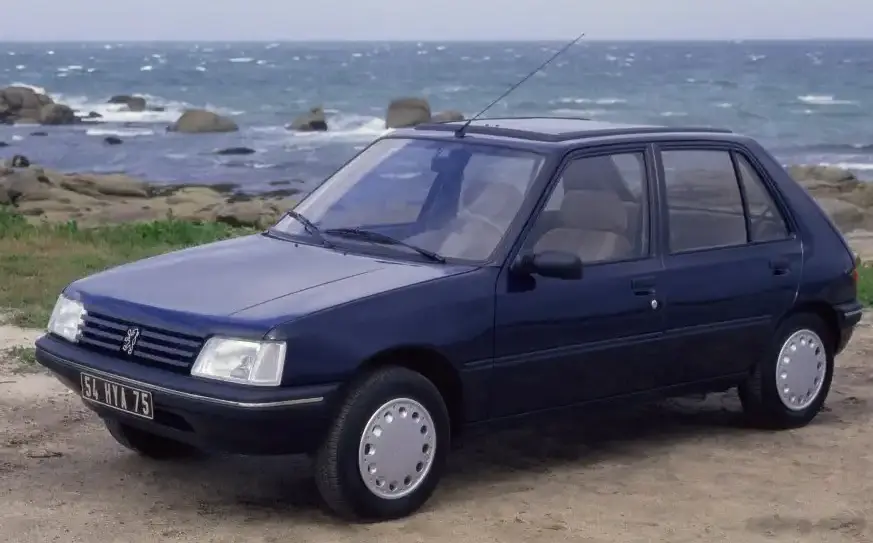
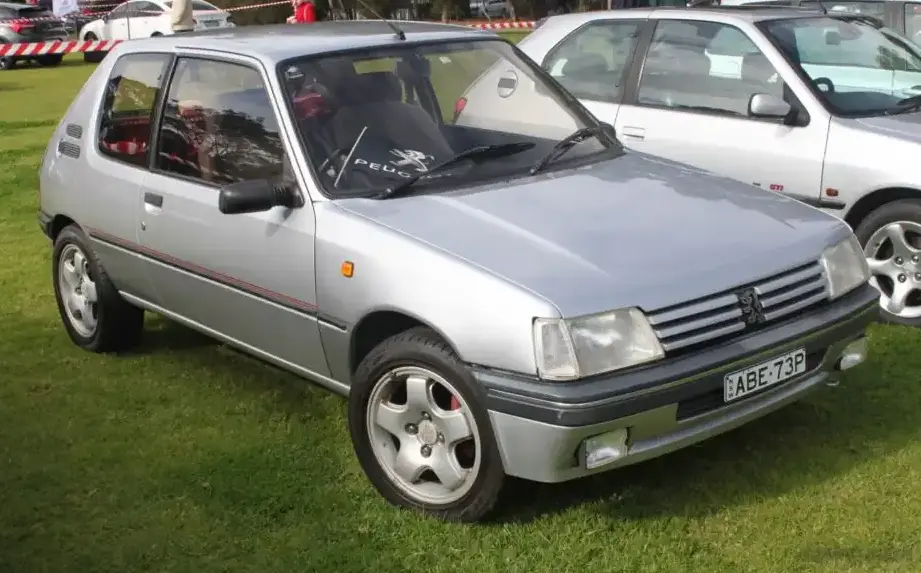
The Peugeot 205 1.4 i, introduced in 1988, was a crucial component of Peugeot’s successful 205 range. Built on the 20A/C platform (later facelifted), the 205 was designed as a replacement for the aging Peugeot 104. The 1.4 i model specifically targeted buyers seeking a practical, economical, and reliable hatchback. It occupied the lower end of the 205 lineup, offering a more affordable entry point compared to the GTI and diesel variants. Production continued until 1998, with the 205 eventually being superseded by the Peugeot 206.
Powertrain & Engine Architecture
At the heart of the 205 1.4 i lies the TU3M engine, a 1361cc inline-four cylinder petrol engine. This engine utilized a single-point fuel injection system, a relatively simple and cost-effective technology for the time. The TU3M featured an overhead camshaft (OHC) valvetrain with two valves per cylinder. The engine produced 75 horsepower at 5800 rpm and 111 Nm (81.87 lb-ft) of torque at 3400 rpm. The engine’s design prioritized fuel efficiency and durability over outright performance. The 205 1.4 i was typically paired with a five-speed manual transmission, although a three-speed automatic transmission was also available, albeit less common. The automatic gearbox, while offering convenience, did impact acceleration and fuel economy.
Driving Characteristics
The 205 1.4 i with the manual transmission offered a reasonably engaging driving experience for its class. While not particularly quick – 0-60 mph took around 10.1 seconds – the car felt nimble and responsive thanks to its light weight (approximately 810 kg or 1786 lbs). The five-speed gearbox allowed for efficient cruising on highways. The automatic transmission version, however, noticeably dulled the driving experience. Gear changes were slow, and the engine often felt strained when accelerating. The gear ratios were optimized for fuel economy rather than performance. Steering was light and precise, making it easy to maneuver in urban environments. The suspension, while basic, provided a comfortable ride on most road surfaces.
Equipment & Trim Levels
The 1.4 i trim level was generally considered the base model. Standard equipment typically included cloth upholstery, a basic dashboard layout, and manual windows and door locks. Power steering was often an optional extra. Interior plastics were durable but utilitarian. Optional extras could include a sunroof, upgraded stereo system, and central locking. The interior was designed with practicality in mind, offering sufficient space for five passengers, although rear legroom was limited. The 3-door configuration prioritized style and ease of parking over rear passenger access.
Chassis & Braking
The 205 1.4 i utilized a front-wheel-drive layout with an independent McPherson strut suspension at the front and a torsion beam suspension at the rear. This setup provided a good balance between ride comfort and handling. Braking consisted of disc brakes on the front wheels and drum brakes on the rear. While adequate for everyday driving, the braking system lacked the stopping power of the higher-spec GTI models. The car’s relatively light weight helped to compensate for the less powerful brakes. A stabilizer bar was fitted to the front suspension to reduce body roll during cornering.
Market Reception & Comparison
The Peugeot 205 1.4 i was generally well-received by automotive critics as a practical and affordable supermini. It was praised for its fuel efficiency, reliability, and nimble handling. However, the engine’s lack of power was often cited as a drawback, particularly when compared to the more potent 1.6 and 2.0-liter versions. Compared to rivals like the Renault 5 and Citroën AX, the 205 1.4 i offered a slightly more refined driving experience and a more stylish interior. Fuel economy was competitive, averaging around 35-40 mpg in mixed driving conditions. Reliability was generally good, although the single-point fuel injection system could occasionally require maintenance.
Legacy
The Peugeot 205 1.4 i remains a popular choice among classic car enthusiasts and budget-conscious buyers. The TU3M engine is known for its durability and relative simplicity, making it relatively easy and inexpensive to maintain. However, age-related issues such as rust and wear and tear on suspension components are common. Parts availability is generally good, although some trim-specific items may be difficult to find. The 205 1.4 i represents a significant milestone in Peugeot’s history, demonstrating the company’s ability to produce a stylish, practical, and affordable supermini that resonated with a wide audience. Today, well-maintained examples command a modest but growing following in the used car market.