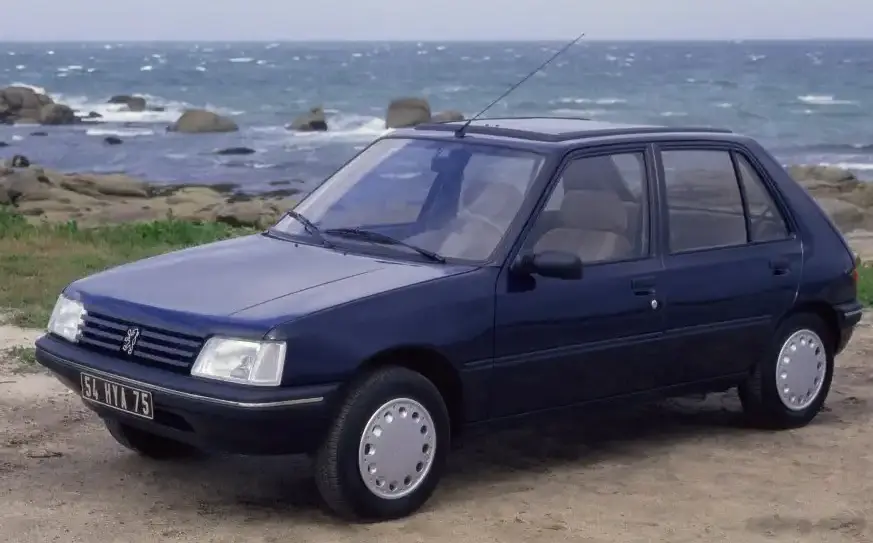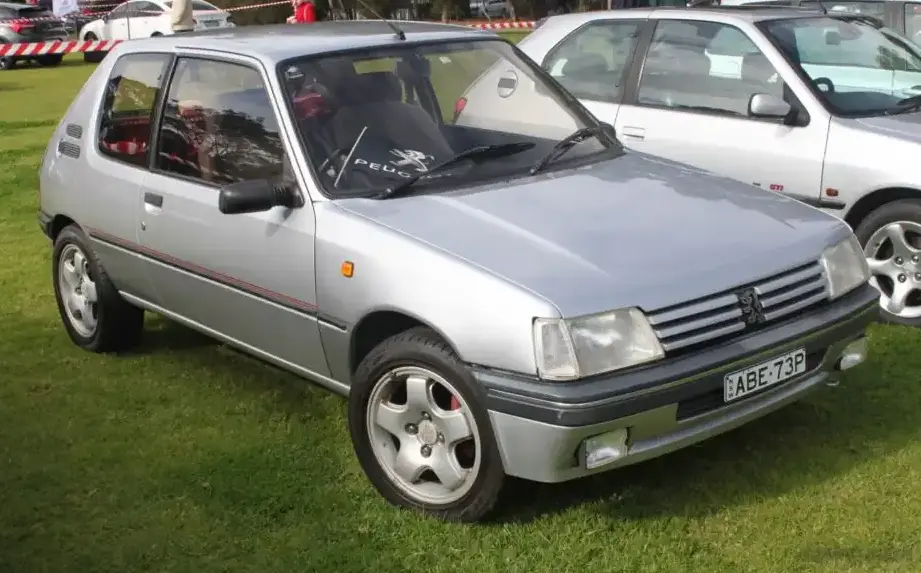
The Peugeot 205 1.8D, produced from 1990 to 1997, represents a practical and economical variant within the highly successful 205 series. Falling under the 20A/C facelift designation, this three-door hatchback offered a diesel-powered option aimed at buyers prioritizing fuel efficiency and low running costs. Positioned as an entry-level to mid-range offering, it provided a more affordable alternative to the gasoline-powered models, particularly the GTI variants. The 205, in general, was a pivotal model for Peugeot, becoming a cultural icon in Europe and establishing a reputation for affordability, reliability, and enjoyable driving dynamics.
Technical Specifications
| Brand | Peugeot |
| Model | 205 |
| Generation | 205 I (20A/C, facelift 1987) 3-door |
| Type (Engine) | 1.8 D (78 Hp) |
| Start of production | 1990 year |
| End of production | 1997 year |
| Powertrain Architecture | Internal Combustion engine |
| Body type | Hatchback |
| Seats | 5 |
| Doors | 3 |
| Fuel consumption (urban) | 6.6 l/100 km (35.6 US mpg, 42.8 UK mpg, 15.2 km/l) |
| Fuel consumption (extra urban) | 4.6 l/100 km (51.1 US mpg, 61.4 UK mpg, 21.7 km/l) |
| Fuel Type | Diesel |
| Acceleration 0 – 100 km/h | 12.2 sec |
| Acceleration 0 – 62 mph | 12.2 sec |
| Acceleration 0 – 60 mph | 11.6 sec |
| Maximum speed | 175 km/h (108.74 mph) |
| Weight-to-power ratio | 11.1 kg/Hp, 90.2 Hp/tonne |
| Weight-to-torque ratio | 5.5 kg/Nm, 181.5 Nm/tonne |
| Power | 78 Hp @ 4300 rpm |
| Power per litre | 44.1 Hp/l |
| Torque | 157 Nm @ 2100 rpm (115.8 lb.-ft. @ 2100 rpm) |
| Engine layout | Front, Transverse |
| Engine Model/Code | XUD7T |
| Engine displacement | 1769 cm3 (107.95 cu. in.) |
| Number of cylinders | 4 |
| Engine configuration | Inline |
| Cylinder Bore | 80 mm (3.15 in.) |
| Piston Stroke | 88 mm (3.46 in.) |
| Compression ratio | 22:1 |
| Number of valves per cylinder | 2 |
| Fuel injection system | Precombustion chamber injection |
| Engine aspiration | Naturally aspirated engine |
| Engine oil capacity | 4 l (4.23 US qt | 3.52 UK qt) |
| Coolant | 8.3 l (8.77 US qt | 7.3 UK qt) |
| Kerb Weight | 865 kg (1907 lbs.) |
| Max. weight | 1325 kg (2921.12 lbs.) |
| Max load | 460 kg (1014.13 lbs.) |
| Trunk (boot) space – minimum | 246 l (8.69 cu. ft.) |
| Trunk (boot) space – maximum | 564 l (19.92 cu. ft.) |
| Fuel tank capacity | 50 l (13.21 US gal | 11 UK gal) |
| Permitted trailer load with brakes (12%) | 800 kg (1763.7 lbs.) |
| Length | 3705 mm (145.87 in.) |
| Width | 1560 mm (61.42 in.) |
| Height | 1375 mm (54.13 in.) |
| Wheelbase | 2420 mm (95.28 in.) |
| Front track | 1350 mm (53.15 in.) |
| Rear (Back) track | 1300 mm (51.18 in.) |
| Drag coefficient (Cd) | 0.35 |
| Minimum turning circle | 10.5 m (34.45 ft.) |
| Drivetrain Architecture | The Internal combustion engine (ICE) drives the front wheels of the vehicle. |
| Drive wheel | Front wheel drive |
| Number of gears and type of gearbox | 5 gears, manual transmission |
| Front suspension | Independent, type McPherson with coil spring and anti-roll bar |
| Rear suspension | Torsion |
| Front brakes | Disc |
| Rear brakes | Drum |
| Steering type | Steering rack and pinion |
| Tires size | 165/70 R13 |
| Wheel rims size | 13 |
Powertrain & Engine Architecture
The heart of the 205 1.8D is the XUD7T engine, a 1.8-liter inline-four diesel. This engine, a mainstay of Peugeot and Citroën vehicles during the 1980s and 1990s, is known for its durability and relatively simple design. It utilizes precombustion chamber injection, a system where fuel is injected into a small pre-chamber connected to the main combustion chamber, promoting more complete combustion and reducing noise. The XUD7T produces 78 horsepower at 4300 rpm and 157 Nm (115.8 lb-ft) of torque at 2100 rpm. The engine’s torque curve is relatively flat, providing usable power across a wide range of engine speeds. The 205 1.8D was exclusively offered with a five-speed manual transmission, chosen for its efficiency and cost-effectiveness. This transmission was not known for particularly short ratios, prioritizing fuel economy over outright performance.
Driving Characteristics
The 205 1.8D offers a distinctly different driving experience compared to its gasoline-powered siblings. Acceleration is modest, taking around 12.2 seconds to reach 62 mph. However, the engine’s torque provides adequate pulling power for everyday driving and cruising on highways. The manual transmission, while not sporty, is precise and easy to use. The 205’s renowned handling characteristics are still present, though somewhat muted by the heavier diesel engine. The suspension provides a comfortable ride, absorbing bumps and imperfections in the road well. Compared to the 205 GTI, the 1.8D lacks the exhilarating acceleration and sharp handling, but it compensates with significantly better fuel economy and lower running costs.
Equipment & Trim Levels
The 1.8D trim level of the 205 was generally basic, reflecting its position as an affordable option. Standard equipment typically included cloth upholstery, a basic dashboard layout, and manual windows and door locks. Power steering was not usually standard, though it could be added as an option. Optional extras included a sunroof, upgraded stereo systems, and central locking. Interior trim was typically functional and durable, prioritizing practicality over luxury. The focus was on providing a comfortable and reliable driving environment without unnecessary frills.
Chassis & Braking
The 205 1.8D utilizes a McPherson strut front suspension with a coil spring and anti-roll bar, providing responsive steering and good handling. The rear suspension employs a torsion beam, a simple and cost-effective design that offers a comfortable ride. Braking is handled by disc brakes on the front wheels and drum brakes on the rear. While adequate for normal driving conditions, the braking system lacks the stopping power of the GTI models. The 165/70 R13 tires provide reasonable grip, but are not designed for high-performance driving.
Market Reception & Comparison
The Peugeot 205 1.8D was well-received in markets where diesel fuel was readily available and affordable, particularly in Europe. Critics praised its fuel efficiency and low running costs, making it an attractive option for budget-conscious buyers. Compared to the gasoline-powered 205 models, the 1.8D offered significantly better fuel economy, but at the expense of performance. The 1.9-liter diesel variants offered slightly more power, but the 1.8D struck a balance between economy and usability. The 205 1.8D was often seen as a sensible and practical choice, appealing to buyers who prioritized reliability and affordability over sporty driving dynamics.
Legacy
The Peugeot 205 1.8D has proven to be a remarkably durable and reliable vehicle. The XUD7T engine is known for its longevity, and many examples are still on the road today. While not highly sought after by collectors, the 205 1.8D remains a popular choice for those seeking an affordable and economical classic car. Parts availability is generally good, and maintenance is relatively straightforward. The 205 1.8D represents a significant chapter in Peugeot’s history, embodying the brand’s commitment to producing practical, reliable, and affordable vehicles.