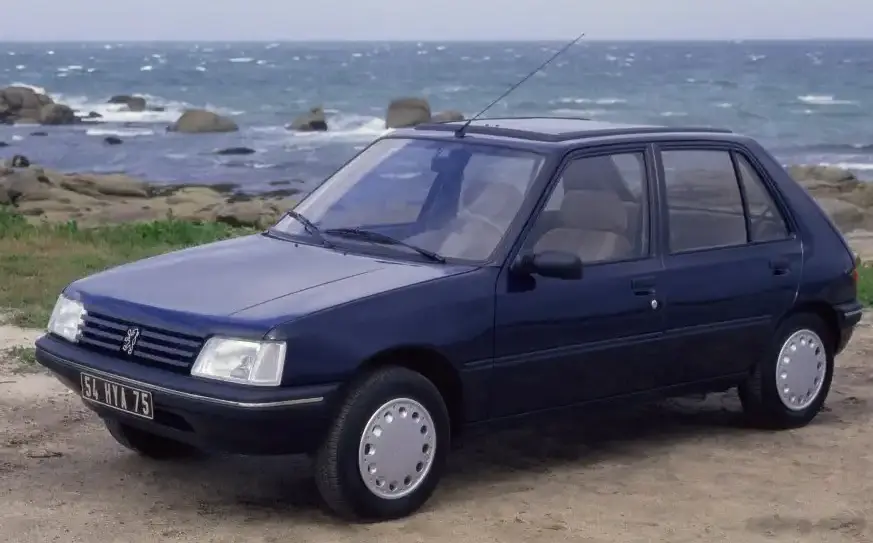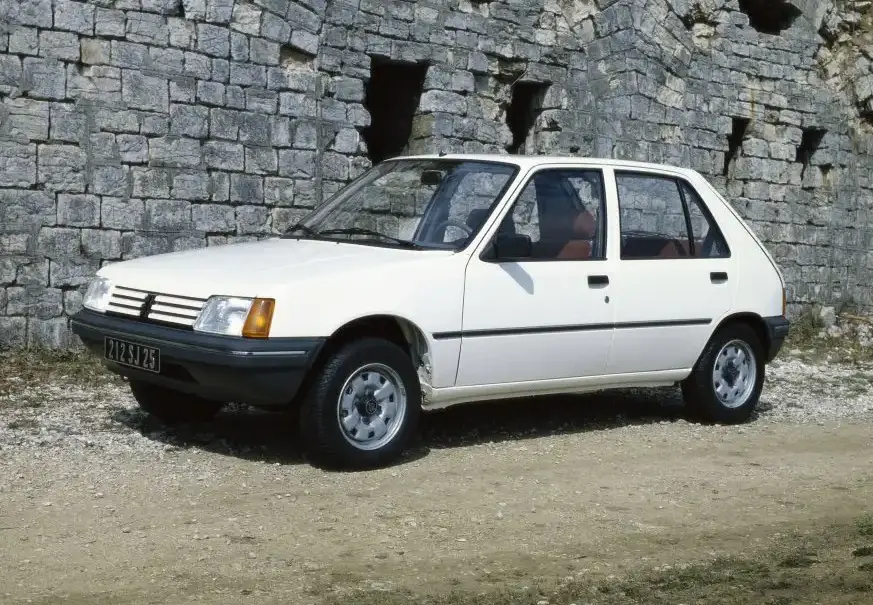
The Peugeot 205 I 1.7 Diesel, produced between 1983 and 1987, represents an important entry point into the hugely successful 205 series. Falling within the 741A/C generation, this variant was specifically designed to offer economical motoring in the European market, particularly appealing to buyers seeking a practical and fuel-efficient hatchback. It occupied the lower end of the 205 lineup, serving as the diesel-powered alternative to the gasoline-fueled models. While not known for outright performance, the 1.7 Diesel carved a niche for itself as a reliable and affordable everyday vehicle.
Technical Specifications
| Brand | Peugeot |
| Model | 205 |
| Generation | 205 I (741A/C) |
| Type (Engine) | 1.7 Diesel (60 Hp) |
| Start of production | 1983 |
| End of production | 1987 |
| Powertrain Architecture | Internal Combustion engine |
| Body type | Hatchback |
| Seats | 4 |
| Doors | 5 |
| Fuel consumption (urban) | 5.4 l/100 km (43.6 US mpg, 52.3 UK mpg, 18.5 km/l) |
| Fuel consumption (extra urban) | 3.9 l/100 km (60.3 US mpg, 72.4 UK mpg, 25.6 km/l) |
| Fuel Type | Diesel |
| Acceleration 0 – 100 km/h | 15.1 sec |
| Acceleration 0 – 62 mph | 15.1 sec |
| Acceleration 0 – 60 mph | 14.3 sec |
| Maximum speed | 155 km/h (96.31 mph) |
| Weight-to-power ratio | 14.3 kg/Hp, 69.8 Hp/tonne |
| Weight-to-torque ratio | 8 kg/Nm, 125.6 Nm/tonne |
| Power | 60 Hp @ 4600 rpm |
| Power per litre | 33.9 Hp/l |
| Torque | 108 Nm @ 2000 rpm (79.66 lb.-ft. @ 2000 rpm) |
| Engine layout | Front, Transverse |
| Engine Model/Code | XUD7 |
| Engine displacement | 1768 cm3 (107.89 cu. in.) |
| Number of cylinders | 4 |
| Engine configuration | Inline |
| Cylinder Bore | 80 mm (3.15 in.) |
| Piston Stroke | 88 mm (3.46 in.) |
| Compression ratio | 23:1 |
| Number of valves per cylinder | 2 |
| Fuel injection system | Precombustion chamber injection |
| Engine aspiration | Naturally aspirated engine |
| Valvetrain | OHC |
| Engine oil capacity | 4.75 l (5.02 US qt | 4.18 UK qt) |
| Coolant | 8.3 l (8.77 US qt | 7.3 UK qt) |
| Kerb Weight | 860 kg (1895.98 lbs.) |
| Max. weight | 1330 kg (2932.15 lbs.) |
| Max load | 470 kg (1036.17 lbs.) |
| Trunk (boot) space – minimum | 216 l (7.63 cu. ft.) |
| Trunk (boot) space – maximum | 546 l (19.28 cu. ft.) |
| Fuel tank capacity | 50 l (13.21 US gal | 11 UK gal) |
| Permitted trailer load with brakes (12%) | 600 kg (1322.77 lbs.) |
| Length | 3705 mm (145.87 in.) |
| Width | 1572 mm (61.89 in.) |
| Height | 1373 mm (54.06 in.) |
| Wheelbase | 2420 mm (95.28 in.) |
| Front track | 1350 mm (53.15 in.) |
| Rear (Back) track | 1300 mm (51.18 in.) |
| Front overhang | 680 mm (26.77 in.) |
| Rear overhang | 605 mm (23.82 in.) |
| Drag coefficient (Cd) | 0.35 |
| Minimum turning circle (turning diameter) | 10.5 m (34.45 ft.) |
| Drivetrain Architecture | The Internal combustion engine (ICE) drives the front wheels of the vehicle. |
| Drive wheel | Front wheel drive |
| Number of gears and type of gearbox | 5 gears, manual transmission |
| Front suspension | Independent, type McPherson with coil spring and anti-roll bar |
| Rear suspension | Torsion |
| Front brakes | Disc |
| Rear brakes | Drum |
| Steering type | Steering rack and pinion |
| Tires size | 145/70 R13 |
| Wheel rims size | 13 |
Powertrain & Engine Architecture
The heart of the 205 I 1.7 Diesel is the XUD7 engine, a 1.8-liter (1768 cc) inline-four cylinder diesel. This engine was a mainstay of Peugeot and Citroën vehicles throughout the 1980s and 90s, known for its durability and relatively simple design. The XUD7 utilizes precombustion chamber injection, a system where fuel is injected into a small pre-chamber connected to the main combustion chamber, promoting more complete combustion. It features a single overhead camshaft (OHC) operating two valves per cylinder. The engine produces 60 horsepower at 4600 rpm and 108 Nm (79.66 lb-ft) of torque at 2000 rpm. The transmission is a five-speed manual, chosen for its efficiency and cost-effectiveness. The engine’s transverse mounting contributed to maximizing interior space within the compact 205 chassis.
Driving Characteristics
The 1.7 Diesel 205 was never intended to be a performance car. Acceleration from 0 to 100 km/h (0-62 mph) takes around 15.1 seconds, and top speed is limited to 155 km/h (96.31 mph). The focus was on fuel economy and usability. The engine’s torque delivery is relatively flat, providing adequate pulling power for everyday driving, but lacking the responsiveness of the gasoline-powered versions. The five-speed manual transmission allows for efficient cruising, and the gear ratios are optimized for maximizing fuel efficiency rather than outright speed. Compared to the more powerful gasoline variants, the 1.7 Diesel feels significantly slower, but it offers a more relaxed and economical driving experience.
Equipment & Trim Levels
The 1.7 Diesel 205 typically came with a fairly basic level of equipment, reflecting its position as the entry-level model. Standard features generally included cloth upholstery, a basic dashboard layout, and manual windows and door locks. Optional extras, such as a sunroof, upgraded stereo, and central locking, were available, but were not commonly fitted to this trim level. The interior was designed with practicality in mind, offering a functional and durable environment. Trim levels were relatively limited, with most examples featuring a simple, utilitarian interior finish.
Chassis & Braking
The 205 I utilized a McPherson strut front suspension with coil springs and an anti-roll bar, providing a reasonable level of handling for a small hatchback. The rear suspension employed a torsion beam setup, which was cost-effective and provided adequate ride comfort. Braking was accomplished via disc brakes on the front wheels and drum brakes on the rear. The braking system was adequate for the car’s weight and performance, but lacked the stopping power of the higher-spec models with all-round disc brakes. The relatively lightweight construction of the 205 (860 kg / 1895.98 lbs) helped to offset the limitations of the braking system.
Market Reception & Comparison
The Peugeot 205 I 1.7 Diesel was well-received in the European market as an affordable and fuel-efficient option. Critics praised its economy and reliability, but noted its lack of performance. Compared to the gasoline-powered 205 models, the diesel version offered significantly better fuel economy, but at the expense of acceleration and refinement. Against competitors like the Renault 5 Diesel and Citroën AX Diesel, the 205 offered a good balance of practicality, economy, and build quality. Its reputation for durability and low running costs made it a popular choice for fleet operators and private buyers alike.
Legacy
The XUD7 engine, found in the 205 I 1.7 Diesel, is renowned for its longevity and robustness. Many examples of this engine are still running today, often with high mileage. The 205 I 1.7 Diesel remains a relatively affordable classic car, appealing to enthusiasts seeking a simple and reliable vehicle. While not a collector’s item in the same vein as the GTI models, it represents an important part of the 205 story and a testament to Peugeot’s engineering prowess. Its enduring popularity in the used car market is a reflection of its inherent durability and low running costs.