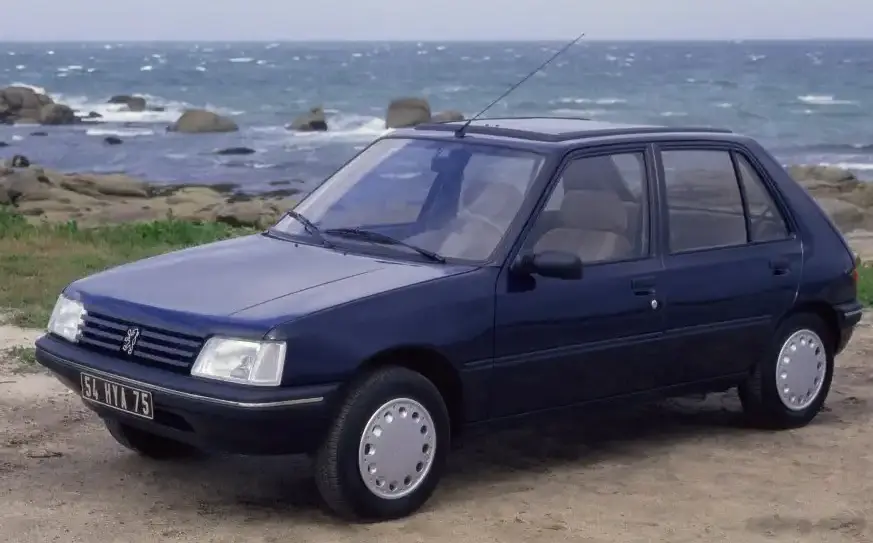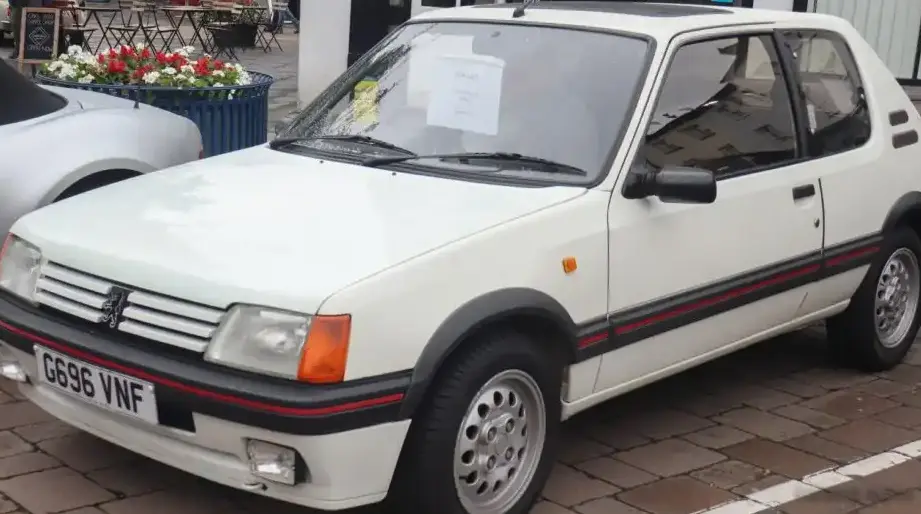
The Peugeot 205 I 1.9 GTI, produced from 1987, represents a high-performance variant within the popular 205 series. Falling under the 741A/C chassis code designation, this 3-door hatchback quickly became a benchmark for affordable, engaging driving dynamics in Europe. It was positioned as the flagship performance model in the 205 range, offering a significant step up in power and handling compared to lower-spec versions. The 205 GTI played a crucial role in establishing Peugeot’s reputation for sporty, well-engineered vehicles, and remains a highly sought-after classic today.
Technical Specifications
| Brand | Peugeot |
| Model | 205 |
| Generation | 205 I (741A/C) 3-door |
| Type (Engine) | 1.9 GTI (130 Hp) |
| Start of production | 1987 |
| End of production | 1987 |
| Powertrain Architecture | Internal Combustion engine |
| Body type | Hatchback |
| Seats | 4 |
| Doors | 3 |
| Fuel consumption (urban) | 9.7 l/100 km (24.2 US mpg) |
| Fuel consumption (extra urban) | 5.9 l/100 km (39.9 US mpg) |
| Fuel Type | Petrol (Gasoline) |
| Acceleration 0 – 100 km/h | 7.8 sec |
| Acceleration 0 – 62 mph | 7.8 sec |
| Acceleration 0 – 60 mph | 7.4 sec |
| Maximum speed | 208 km/h (129.25 mph) |
| Weight-to-power ratio | 6.6 kg/Hp |
| Weight-to-torque ratio | 5.3 kg/Nm |
| Power | 130 Hp @ 6000 rpm |
| Torque | 161 Nm @ 4750 rpm (118.75 lb.-ft. @ 4750 rpm) |
| Engine layout | Front, Transverse |
| Engine Model/Code | XU9JA |
| Engine displacement | 1905 cm3 (116.25 cu. in.) |
| Number of cylinders | 4 |
| Engine configuration | Inline |
| Cylinder Bore | 83 mm (3.27 in.) |
| Piston Stroke | 88 mm (3.46 in.) |
| Compression ratio | 9.6:1 |
| Number of valves per cylinder | 2 |
| Fuel injection system | Multi-port manifold injection |
| Engine aspiration | Naturally aspirated |
| Valvetrain | OHC |
| Engine oil capacity | 4.5 l (4.76 US qt | 3.96 UK qt) |
| Coolant capacity | 6.6 l (6.97 US qt | 5.81 UK qt) |
| Kerb Weight | 855 kg (1884.95 lbs.) |
| Max. weight | 1300 kg (2866.01 lbs.) |
| Max load | 445 kg (981.06 lbs.) |
| Trunk (boot) space – minimum | 216 l (7.63 cu. ft.) |
| Trunk (boot) space – maximum | 564 l (19.92 cu. ft.) |
| Fuel tank capacity | 50 l (13.21 US gal | 11 UK gal) |
| Permitted trailer load with brakes (12%) | 800 kg (1763.7 lbs.) |
| Length | 3705 mm (145.87 in.) |
| Width | 1572 mm (61.89 in.) |
| Height | 1373 mm (54.06 in.) |
| Wheelbase | 2420 mm (95.28 in.) |
| Front track | 1350 mm (53.15 in.) |
| Rear track | 1300 mm (51.18 in.) |
| Front overhang | 680 mm (26.77 in.) |
| Rear overhang | 605 mm (23.82 in.) |
| Drag coefficient (Cd) | 0.35 |
| Minimum turning circle | 10.5 m (34.45 ft.) |
| Drivetrain | Front wheel drive |
| Number of gears | 5 |
| Gearbox type | Manual transmission |
| Front suspension | Independent, McPherson with coil spring and anti-roll bar |
| Rear suspension | Torsion |
| Front brakes | Ventilated discs |
| Rear brakes | Disc |
| Steering type | Steering rack and pinion |
| Power steering | Hydraulic |
| Tires size | 185/55 R15 |
| Wheel rims size | 15 |
Introduction
The Peugeot 205 I 1.9 GTI, launched in 1987, was the performance halo car for the 205 range. Built on the 741A/C platform, it quickly gained a reputation for its nimble handling, responsive engine, and overall driving enjoyment. The 205 GTI wasn’t just about straight-line speed; it was engineered to be a driver’s car, offering a balanced and engaging experience. It became a cultural icon in Europe, particularly among young enthusiasts, and helped solidify Peugeot’s image as a manufacturer of fun-to-drive vehicles.
Powertrain & Engine Architecture
The heart of the 205 GTI is the XU9JA engine, a 1.9-liter inline-four cylinder petrol engine. This engine featured a cast iron block and an aluminum cylinder head, utilizing a single overhead camshaft (OHC) design with two valves per cylinder. Fuel delivery was handled by Bosch multi-port fuel injection, contributing to its responsive throttle response. The XU9JA produced 130 horsepower at 6,000 rpm and 161 Nm (118.75 lb-ft) of torque at 4,750 rpm. The engine’s design prioritized drivability and torque delivery over outright peak power. The 205 GTI exclusively came with a five-speed manual transmission, chosen for its direct connection and enhanced driving experience. This transmission was known for its precise shift action and well-matched gear ratios.
Driving Characteristics
The 1.9 GTI offered a distinctly engaging driving experience. The relatively lightweight chassis (855 kg / 1885 lbs) combined with the engine’s torque output resulted in brisk acceleration – 0 to 60 mph in approximately 7.4 seconds. The gear ratios were well-chosen to keep the engine within its powerband, providing strong acceleration in all gears. Compared to the later 1.6-liter GTI models, the 1.9 offered more low-end torque, making it more forgiving in everyday driving situations. While not as raw or demanding as some contemporary sports cars, the 205 GTI provided a rewarding and balanced driving experience, praised for its communicative steering and predictable handling.
Equipment & Trim Levels
The 205 GTI was relatively well-equipped for its time, though focused more on driving experience than luxury. Standard features included sports seats, a leather-wrapped steering wheel, and a basic stereo system. Interior trim was typically cloth upholstery, with a sporty, minimalist design. Optional extras included a sunroof, central locking, and upgraded audio systems. The GTI trim level was clearly differentiated from lower-spec 205 models by its unique badging, alloy wheels, and subtle body styling enhancements.
Chassis & Braking
The 205 GTI featured an independent McPherson strut front suspension with coil springs and an anti-roll bar, providing responsive steering and good body control. The rear suspension utilized a torsion beam setup, which was simple, lightweight, and effective. Braking was handled by ventilated discs on the front wheels and discs on the rear, offering adequate stopping power for the car’s performance capabilities. The steering was a rack-and-pinion system with hydraulic power assistance, providing a good balance of feel and ease of use.
Market Reception & Comparison
The Peugeot 205 GTI was widely praised by automotive journalists and enthusiasts alike. It was lauded for its engaging handling, responsive engine, and overall value for money. Compared to rivals like the Volkswagen Golf GTI, the 205 GTI was often considered to be more focused on driving enjoyment, with a more direct and communicative feel. Fuel economy was reasonable for a performance car of the era, averaging around 24.2 mpg in urban driving and 39.9 mpg on the highway. Reliability was generally good, although the XU9JA engine could be prone to overheating if not properly maintained.
Legacy
The Peugeot 205 GTI remains a highly collectible classic car today. Its combination of performance, handling, and affordability has made it a favorite among enthusiasts. The XU9JA engine is known for its durability and tunability, and many examples have been modified for increased power. While finding well-maintained examples can be challenging, the 205 GTI continues to offer a rewarding and engaging driving experience, cementing its place as a true icon of the 1980s hot hatch scene. Its influence can still be seen in modern performance cars, which strive to replicate its blend of agility, responsiveness, and driver involvement.