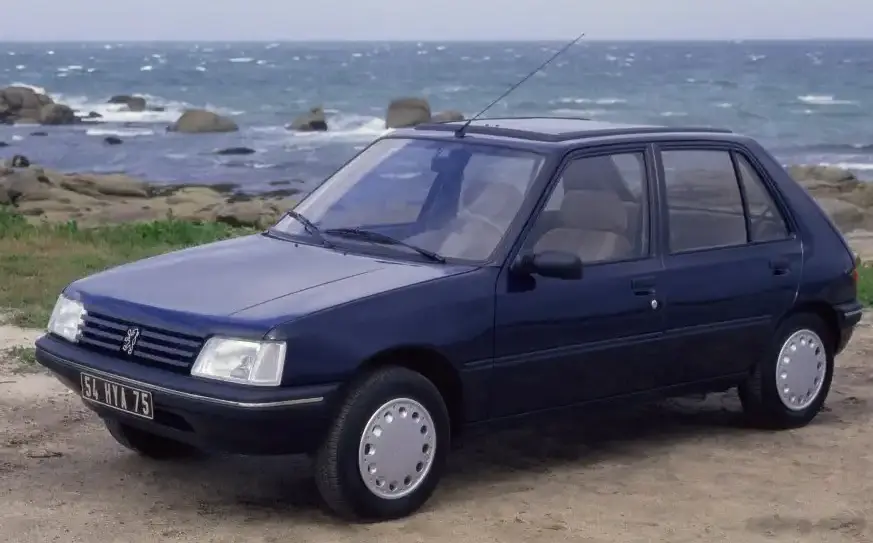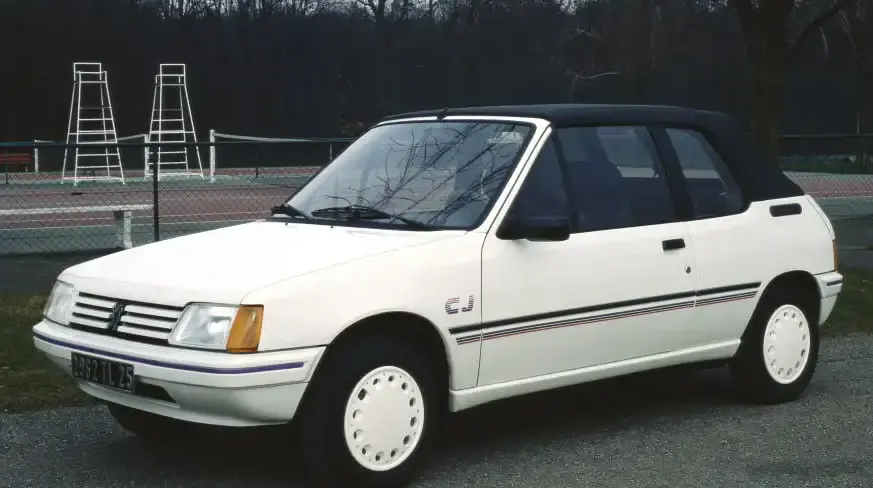
The Peugeot 205 I Cabrio 1.4 CJ (69 hp) was a popular variant of the iconic 205 series, produced between 1989 and 1994. Positioned as an entry-level offering within the 205 Cabriolet range, it provided an accessible route to open-top motoring for European buyers. This model, designated chassis code 741B and 20D, was part of the first generation (Series 1) of the 205, built on the 1HX0 platform. It aimed to combine the 205’s renowned handling characteristics with the enjoyment of a convertible, appealing to a broad demographic seeking a stylish and affordable vehicle.
Technical Specifications
| Brand | Peugeot |
| Model | 205 |
| Generation | 205 I Cabrio (741B,20D) |
| Type (Engine) | 1.4 CJ (69 Hp) |
| Start of production | 1989 |
| End of production | 1994 |
| Powertrain Architecture | Internal Combustion engine |
| Body type | Cabriolet |
| Seats | 4 |
| Doors | 2 |
| Fuel consumption (urban) | 7.2 l/100 km (32.7 US mpg) |
| Fuel consumption (extra urban) | 4.7 l/100 km (50 US mpg) |
| Fuel Type | Petrol (Gasoline) |
| Acceleration 0 – 100 km/h | 12.7 sec |
| Acceleration 0 – 62 mph | 12.7 sec |
| Acceleration 0 – 60 mph | 12.1 sec |
| Maximum speed | 162 km/h (100.66 mph) |
| Weight-to-power ratio | 12.8 kg/Hp |
| Weight-to-torque ratio | 8 kg/Nm |
| Power | 69 Hp @ 5600 rpm |
| Torque | 111 Nm @ 3400 rpm (81.87 lb.-ft. @ 3400 rpm) |
| Engine layout | Front, Transverse |
| Engine Model/Code | TU3A |
| Engine displacement | 1360 cm3 (82.99 cu. in.) |
| Number of cylinders | 4 |
| Engine configuration | Inline |
| Cylinder Bore | 75 mm (2.95 in.) |
| Piston Stroke | 77 mm (3.03 in.) |
| Compression ratio | 9.3:1 |
| Number of valves per cylinder | 2 |
| Fuel injection system | Carburettor |
| Engine aspiration | Naturally aspirated |
| Valvetrain | OHC |
| Engine oil capacity | 3.2 l (3.38 US qt | 2.82 UK qt) |
| Coolant capacity | 5.8 l (6.13 US qt | 5.1 UK qt) |
| Kerb Weight | 885 kg (1951.09 lbs.) |
| Max. weight | 1215 kg (2678.62 lbs.) |
| Max load | 330 kg (727.53 lbs.) |
| Trunk (boot) space – minimum | 216 l (7.63 cu. ft.) |
| Trunk (boot) space – maximum | 564 l (19.92 cu. ft.) |
| Fuel tank capacity | 50 l (13.21 US gal | 11 UK gal) |
| Permitted trailer load with brakes (12%) | 900 kg (1984.16 lbs.) |
| Length | 3705 mm (145.87 in.) |
| Width | 1572 mm (61.89 in.) |
| Height | 1375 mm (54.13 in.) |
| Wheelbase | 2420 mm (95.28 in.) |
| Front track | 1350 mm (53.15 in.) |
| Rear track | 1304 mm (51.34 in.) |
| Minimum turning circle | 10.5 m (34.45 ft.) |
| Drivetrain Architecture | Front wheel drive |
| Number of gears | 5 gears, manual transmission |
| Front suspension | Independent, McPherson with coil spring and anti-roll bar |
| Rear suspension | Torsion |
| Front brakes | Disc |
| Rear brakes | Drum |
| Steering type | Steering rack and pinion |
| Tires size | 165/70 R13 |
| Wheel rims size | 13 |
Powertrain & Engine Architecture
The 1.4 CJ variant of the 205 Cabriolet was powered by the Peugeot TU3A engine, a naturally aspirated, inline-four cylinder unit displacing 1360cc. This engine was a mainstay in many Peugeot and Citroën models of the era. It utilized a single overhead camshaft (OHC) valvetrain with two valves per cylinder. Crucially, this version employed a carburetor for fuel delivery, rather than fuel injection, which was becoming more common in the early 1990s. The carburetor setup contributed to its lower cost but also resulted in slightly less precise fuel metering and potentially higher emissions compared to injected engines. The engine produced 69 horsepower at 5600 rpm and 111 Nm (81.87 lb-ft) of torque at 3400 rpm. The engine was transversely mounted, driving the front wheels. The transmission was a five-speed manual gearbox, offering a reasonable balance between fuel economy and drivability.
Driving Characteristics
The 1.4 CJ Cabriolet offered a relaxed driving experience. With 69 hp propelling approximately 885 kg (1951 lbs), acceleration was modest, taking around 12.7 seconds to reach 62 mph. The carburetor-fed engine delivered power in a linear fashion, but lacked the punch of higher-spec 205 models like the 1.6 or 2.0 GTI. The five-speed gearbox was well-matched to the engine’s characteristics, allowing drivers to keep the engine in its optimal power band. Compared to the more powerful 205s, the 1.4 CJ prioritized fuel economy and ease of driving over outright performance. The Cabriolet body style added some weight compared to the coupe, slightly impacting handling, but the 205’s inherently nimble chassis still provided a fun and engaging driving experience.
Equipment & Trim Levels
The 1.4 CJ Cabriolet was generally equipped with basic, but functional features. Standard equipment typically included cloth upholstery, a basic instrument cluster, and manual windows and door locks. The interior trim was relatively simple, reflecting the car’s entry-level positioning. Optional extras included upgraded upholstery, a radio/cassette player, and sometimes, power steering. The convertible top was manually operated. The trim level was designed to appeal to buyers seeking an affordable and stylish open-top car, rather than luxury or high performance.
Chassis & Braking
The 205 Cabriolet utilized a McPherson strut front suspension with coil springs and an anti-roll bar, providing responsive steering and good handling. The rear suspension employed a torsion beam setup, which was cost-effective and provided adequate ride comfort. Braking was handled by disc brakes at the front and drum brakes at the rear. The braking system was adequate for the car’s performance, but lacked the stopping power of larger, more powerful vehicles. The steering was a rack and pinion system, offering precise control and a direct feel.
Market Reception & Comparison
The Peugeot 205 Cabriolet 1.4 CJ was well-received as an affordable and stylish entry into the convertible market. Critics praised its handling and the overall driving experience, even with the modest engine output. Compared to the higher-spec 205 Cabriolet models (like the 1.6 or 2.0), the 1.4 CJ offered significantly better fuel economy. However, it lacked the performance and refinement of its more expensive siblings. The 1.4 CJ competed with other small, affordable convertibles of the era, such as the Fiat Punto Cabriolet and the Renault 5 Cabriolet. Its combination of style, affordability, and Peugeot’s reputation for reliability made it a popular choice.
Legacy
The Peugeot 205 Cabriolet 1.4 CJ has become a popular classic car, particularly in Europe. The TU3A engine is known for its durability and relative simplicity, making it relatively easy to maintain. However, age-related issues such as carburetor wear and corrosion can require attention. The convertible top mechanism can also be prone to wear and tear. Today, these cars are sought after by enthusiasts who appreciate their classic styling and engaging driving experience. While not the fastest or most luxurious 205 variant, the 1.4 CJ offers an accessible and enjoyable way to experience the iconic Peugeot 205 in open-top form. Good examples command reasonable prices in the used car market, reflecting their growing popularity as a classic.