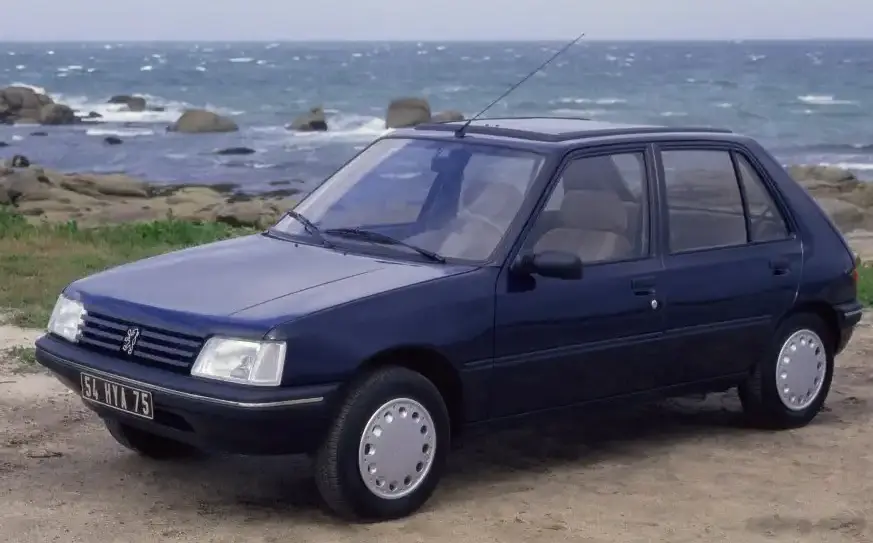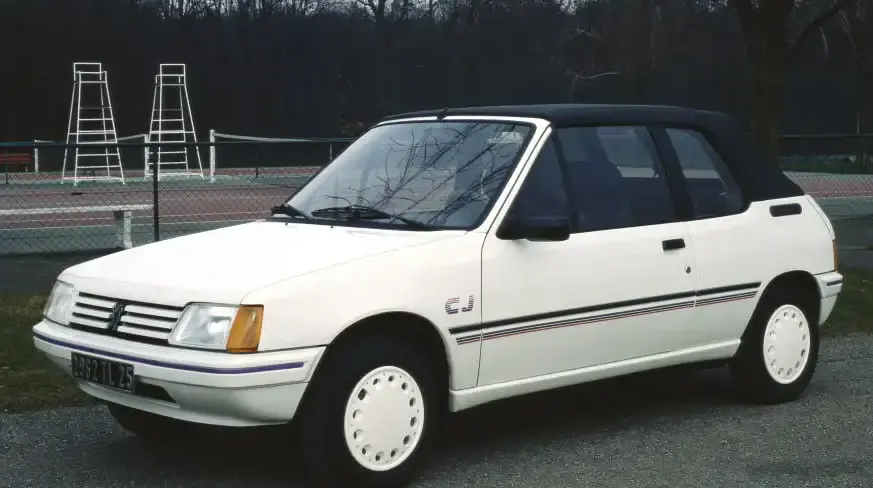
The Peugeot 205 I Cabrio 1.4 CT (79 hp), produced between 1986 and 1988, represents a charming and accessible entry point into the iconic 205 range. Falling within the 741B/20D series, this variant offered open-top motoring to a wider audience, positioned as a more affordable alternative to the higher-performance GTI models. It was a key part of Peugeot’s strategy to revitalize its image and appeal to a younger demographic in the mid-1980s, capitalizing on the growing popularity of small, stylish convertibles. The 205 Cabrio, in general, was a significant success for Peugeot, bringing a touch of French flair to the convertible market.
Technical Specifications
| Brand | Peugeot |
| Model | 205 |
| Generation | 205 I Cabrio (741B,20D) |
| Type (Engine) | 1.4 CT (79 Hp) |
| Start of production | 1986 |
| End of production | 1988 |
| Powertrain Architecture | Internal Combustion engine |
| Body type | Cabriolet |
| Seats | 4 |
| Doors | 2 |
| Fuel consumption (urban) | 9.2 l/100 km (25.6 US mpg) |
| Fuel consumption (extra urban) | 5.4 l/100 km (43.6 US mpg) |
| Fuel Type | Petrol (Gasoline) |
| Acceleration 0 – 100 km/h | 12.4 sec |
| Acceleration 0 – 62 mph | 12.4 sec |
| Acceleration 0 – 60 mph | 11.8 sec |
| Maximum speed | 166 km/h (103.15 mph) |
| Weight-to-power ratio | 11.2 kg/Hp |
| Weight-to-torque ratio | 8 kg/Nm |
| Power | 79 Hp @ 5800 rpm |
| Power per litre | 58.1 Hp/l |
| Torque | 110 Nm @ 2800 rpm (81.13 lb.-ft. @ 2800 rpm) |
| Engine layout | Front, Transverse |
| Engine Model/Code | XY8 |
| Engine displacement | 1360 cm3 (82.99 cu. in.) |
| Number of cylinders | 4 |
| Engine configuration | Inline |
| Cylinder Bore | 75 mm (2.95 in.) |
| Piston Stroke | 77 mm (3.03 in.) |
| Compression ratio | 9.3:1 |
| Number of valves per cylinder | 2 |
| Fuel injection system | Carburettor |
| Engine aspiration | Naturally aspirated engine |
| Valvetrain | OHC |
| Engine oil capacity | 5 l (5.28 US qt | 4.4 UK qt) |
| Coolant | 5.8 l (6.13 US qt | 5.1 UK qt) |
| Kerb Weight | 885 kg (1951.09 lbs.) |
| Max. weight | 1215 kg (2678.62 lbs.) |
| Max load | 330 kg (727.53 lbs.) |
| Trunk (boot) space – minimum | 216 l (7.63 cu. ft.) |
| Trunk (boot) space – maximum | 564 l (19.92 cu. ft.) |
| Fuel tank capacity | 50 l (13.21 US gal | 11 UK gal) |
| Permitted trailer load with brakes (12%) | 900 kg (1984.16 lbs.) |
| Length | 3705 mm (145.87 in.) |
| Width | 1590 mm (62.6 in.) |
| Height | 1375 mm (54.13 in.) |
| Wheelbase | 2420 mm (95.28 in.) |
| Front track | 1395 mm (54.92 in.) |
| Rear (Back) track | 1330 mm (52.36 in.) |
| Minimum turning circle | 10.5 m (34.45 ft.) |
| Drivetrain Architecture | Front wheel drive |
| Number of gears and type of gearbox | 5 gears, manual transmission |
| Front suspension | Independent, type McPherson with coil spring and anti-roll bar |
| Rear suspension | Torsion |
| Front brakes | Disc |
| Rear brakes | Drum |
| Steering type | Steering rack and pinion |
| Tires size | 165/70 R13 |
| Wheel rims size | 13 |
Powertrain & Engine Architecture
The 1.4 CT Cabrio variant of the 205 was powered by the XY8 engine, a naturally aspirated, inline-four cylinder unit displacing 1360cc. This engine, a mainstay in various Peugeot and Citroën models of the era, utilized a single overhead camshaft (OHC) valvetrain with two valves per cylinder. Fuel delivery was managed by a carburetor, a common feature for vehicles of this period, offering simplicity and relatively low cost. The XY8 engine produced 79 horsepower at 5800 rpm and 110 Nm (81.13 lb-ft) of torque at 2800 rpm. The engine’s design prioritized fuel economy and smooth operation over outright performance. The transmission was a standard five-speed manual, providing adequate control for everyday driving. While an automatic transmission was offered on some 205 models, it wasn’t typically paired with the 1.4 CT engine in the Cabriolet version.
Driving Characteristics
The 1.4 CT Cabrio offered a relaxed and enjoyable driving experience. Acceleration was modest, taking around 12.4 seconds to reach 62 mph, and a top speed of 103.15 mph. The engine’s torque curve was relatively flat, providing usable power across a reasonable rev range, but it lacked the punch of the GTI models. The five-speed manual transmission allowed drivers to keep the engine in its optimal power band, but frequent downshifts were often necessary for overtaking or climbing hills. The Cabriolet’s open-top design added to the driving pleasure, but also introduced some body flex, typical of convertibles of this era. The McPherson strut front suspension and torsion beam rear suspension provided a comfortable ride, although handling was not as sharp as the more performance-oriented 205 variants.
Equipment & Trim Levels
The 1.4 CT trim level represented a mid-range offering in the 205 Cabrio lineup. Standard features typically included cloth upholstery, basic instrumentation, and a steering wheel adjustable for rake. Power steering was not standard, requiring more effort at low speeds. Optional extras included upgraded audio systems, alloy wheels, and a more luxurious interior trim. The convertible top was manually operated, adding to the car’s simplicity. The interior design was functional and straightforward, reflecting the 205’s focus on affordability and practicality.
Chassis & Braking
The 205 Cabrio 1.4 CT utilized a front-wheel-drive chassis with independent McPherson strut suspension at the front and a torsion beam setup at the rear. Braking was provided by disc brakes on the front wheels and drum brakes on the rear. This configuration was typical for vehicles in this class during the 1980s. The steering system employed a rack and pinion setup, offering reasonably precise control. The relatively lightweight construction of the 205, with a kerb weight of 885 kg (1951.09 lbs), helped to offset the modest engine output and contributed to its nimble handling.
Market Reception & Comparison
The Peugeot 205 Cabrio 1.4 CT was generally well-received by critics as an affordable and stylish convertible. It offered a good balance of practicality, fuel economy, and open-top driving enjoyment. Compared to the higher-performance GTI models, the 1.4 CT was significantly less expensive to purchase and maintain. However, it lacked the GTI’s exhilarating performance and sporty handling. Fuel economy was a strong point, with combined fuel consumption figures around 7.3 l/100km (32.2 US mpg). Reliability was generally good, although carburetor maintenance could be required over time. The 1.4 CT appealed to buyers who prioritized style and affordability over outright performance.
Legacy
The Peugeot 205 Cabrio 1.4 CT remains a popular classic car today, appreciated for its charming design and relatively simple mechanicals. The XY8 engine, while not particularly powerful, is known for its durability and ease of maintenance. Parts availability is generally good, although some trim-specific components may be difficult to find. The 205 Cabrio, in all its variants, helped to establish Peugeot as a maker of stylish and desirable cars. The 1.4 CT variant, in particular, offers an accessible entry point into the world of classic French motoring, providing a taste of open-top driving without the high cost and complexity of the more performance-focused models. Well-maintained examples continue to command reasonable prices in the used car market, attracting enthusiasts who appreciate the 205’s unique character and enduring appeal.