
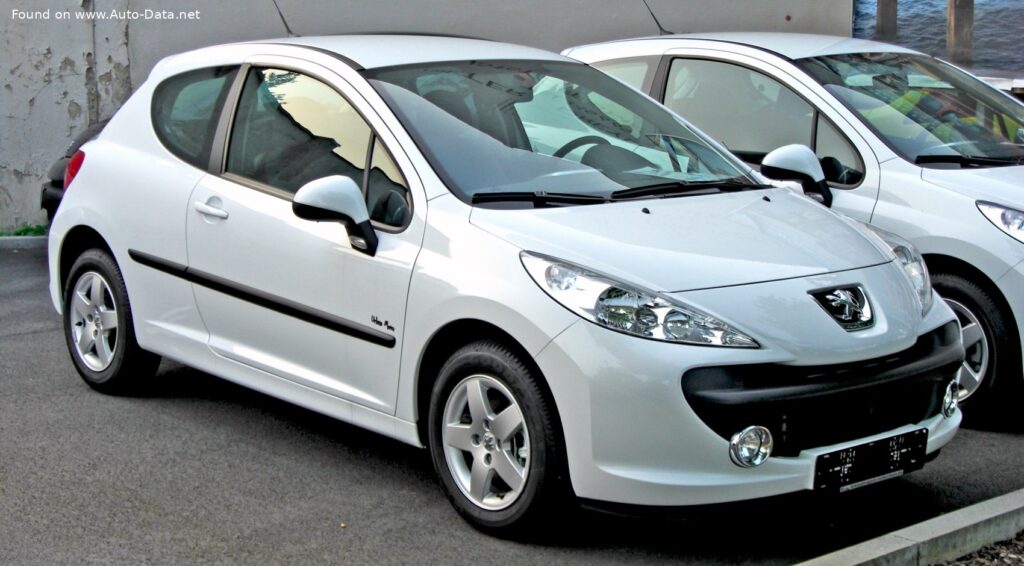
The Peugeot 207 1.4 i 16V (90 hp) Automatic was a popular entry-level variant of the 207 hatchback, produced between 2006 and 2009. Part of the second-generation 207 series (A8 chassis), this model aimed to provide affordable and practical transportation with the convenience of an automatic transmission. It occupied the lower end of the 207 lineup, positioned below the more powerful 1.6-liter and diesel engine options. The 207 itself was designed as a replacement for the Peugeot 206, offering a more modern design and improved features while maintaining the core values of the successful predecessor.
Powertrain & Engine Architecture
The heart of the 207 1.4 i 16V Automatic is the KFU (ET3J4) engine, a 1.360-liter (82.99 cubic inches) inline-four cylinder gasoline engine. This engine utilizes a multi-port fuel injection system, delivering fuel directly into the intake manifold. The engine features a double overhead camshaft (DOHC) valvetrain with four valves per cylinder, contributing to its relatively efficient operation. The compression ratio is set at 10.5:1. The engine produces a maximum power output of 90 horsepower at 5250 rpm and 98 Nm (72.28 lb-ft) of torque at 3250 rpm. The engine oil capacity is 3.25 liters (3.43 US quarts), and the cooling system requires 5.7 liters (6.02 US quarts) of coolant.
Paired with the 1.4L engine is a 5-speed automatic transmission. This transmission was chosen to appeal to drivers seeking ease of use, particularly in urban environments. While not known for its sporty performance, the automatic transmission provided smooth shifts and predictable behavior. The transmission’s gear ratios were optimized for fuel efficiency and everyday drivability rather than outright acceleration.
Engine Code Specifics
The KFU engine code designates a specific iteration of Peugeot’s 1.4-liter engine family. Variations within this engine family existed, but the KFU version used in the 207 1.4 i 16V Automatic was tuned for a balance of fuel economy and acceptable performance for its intended market segment. Maintenance on the KFU engine is generally straightforward, with readily available parts and a relatively simple design. However, like many engines of this era, regular oil changes and adherence to the manufacturer’s maintenance schedule are crucial for longevity.
Driving Characteristics
The Peugeot 207 1.4 i 16V Automatic offered a comfortable, if not particularly exhilarating, driving experience. Acceleration from 0 to 100 km/h (0-62 mph) took approximately 12.7 seconds, and 0-60 mph was achieved in around 12.1 seconds. The top speed was limited to 180 km/h (111.85 mph). The automatic transmission, while convenient, did contribute to a slight reduction in performance compared to the available manual transmission versions of the 1.4L engine. The power delivery was linear, but the engine felt strained at higher RPMs. The gear ratios were spaced to prioritize fuel economy, meaning the engine often operated at higher revolutions during acceleration, resulting in a noticeable engine note.
Compared to the more powerful 1.6-liter variants, the 1.4L Automatic felt noticeably slower, especially when fully loaded or tackling inclines. The 1.6L offered a more responsive driving experience and better overall performance. However, the 1.4L Automatic provided a more economical option for drivers who prioritized fuel efficiency and ease of driving over outright speed.
Equipment & Trim Levels
The 207 1.4 i 16V Automatic typically came equipped with a reasonable level of standard features for its price point. These generally included power steering, central locking, electric front windows, and an audio system with radio and CD player. Air conditioning was often an optional extra, as were alloy wheels and upgraded interior trim. Interior upholstery was typically cloth, with a relatively simple dashboard layout. Safety features included ABS (Anti-lock Braking System) and driver and passenger airbags. Higher trim levels, often denoted by names like “Sport” or “Comfort,” added features such as rear electric windows, a multi-function steering wheel, and upgraded audio systems.
Chassis & Braking
The 207 1.4 i 16V Automatic utilized an independent McPherson strut suspension system at the front, providing a comfortable ride and decent handling. The rear suspension employed a semi-independent coil spring arrangement with an elastic beam. This setup was chosen to balance cost-effectiveness with acceptable ride quality. The front brakes were ventilated discs, offering good stopping power, while the rear brakes were drums. This combination was typical for vehicles in this weight class and price range. The steering system was a rack and pinion type, providing precise and responsive steering feel. The vehicle rode on 185/65 R15 tires mounted on 15-inch wheels.
Market Reception & Comparison
The Peugeot 207 1.4 i 16V Automatic was generally well-received as a practical and affordable city car. Critics praised its comfortable ride, ease of use, and relatively low running costs. However, the engine’s lack of power and the automatic transmission’s somewhat sluggish performance were often cited as drawbacks. Compared to competitors like the Renault Clio and Volkswagen Polo, the 207 offered a stylish design and a comfortable interior, but its performance was often considered slightly inferior. Fuel economy was a strong point, with combined fuel consumption figures of around 6.2 l/100 km (37.9 US mpg). Reliability was generally good, although some owners reported minor issues with the electrical system.
Technical Specifications
| Brand | Peugeot |
| Model | 207 |
| Type (Engine) | 1.4 i 16V (90 Hp) Automatic |
| Start of production | 2006 |
| End of production | 2009 |
| Fuel consumption (urban) | 7.9 l/100 km (29.8 US mpg) |
| Fuel consumption (extra urban) | 5.2 l/100 km (45.2 US mpg) |
| Fuel consumption (combined) | 6.2 l/100 km (37.9 US mpg) |
| Fuel Type | Petrol (Gasoline) |
| Acceleration 0 – 100 km/h | 12.7 sec |
| Acceleration 0 – 62 mph | 12.7 sec |
| Acceleration 0 – 60 mph | 12.1 sec |
| Maximum speed | 180 km/h (111.85 mph) |
| Power | 90 Hp @ 5250 rpm |
| Torque | 98 Nm @ 3250 rpm (72.28 lb.-ft. @ 3250 rpm) |
| Engine Displacement | 1360 cm3 (82.99 cu. in.) |
| Number of cylinders | 4 |
| Kerb Weight | 1148 kg (2530.91 lbs.) |
| Max. weight | 1640 kg (3615.58 lbs.) |
| Trunk (boot) space (minimum) | 270 l (9.53 cu. ft.) |
| Trunk (boot) space (maximum) | 923 l (32.6 cu. ft.) |
| Fuel tank capacity | 50 l (13.21 US gal) |
| Length | 4030 mm (158.66 in.) |
| Width | 1720 mm (67.72 in.) |
| Height | 1472 mm (57.95 in.) |
| Wheelbase | 2540 mm (100 in.) |
| Number of gears | 5 |
| Gearbox type | Automatic transmission |
Legacy
The Peugeot 207 1.4 i 16V Automatic, while not a performance icon, remains a relatively common sight on used car markets. The KFU engine, when properly maintained, is known for its durability and reliability. However, potential buyers should be aware of the possibility of age-related issues, such as worn suspension components and minor electrical faults. The automatic transmission, while convenient, may require more frequent servicing than a manual gearbox. Overall, the 207 1.4 i 16V Automatic represents a sensible and affordable option for those seeking a practical and economical city car.
