
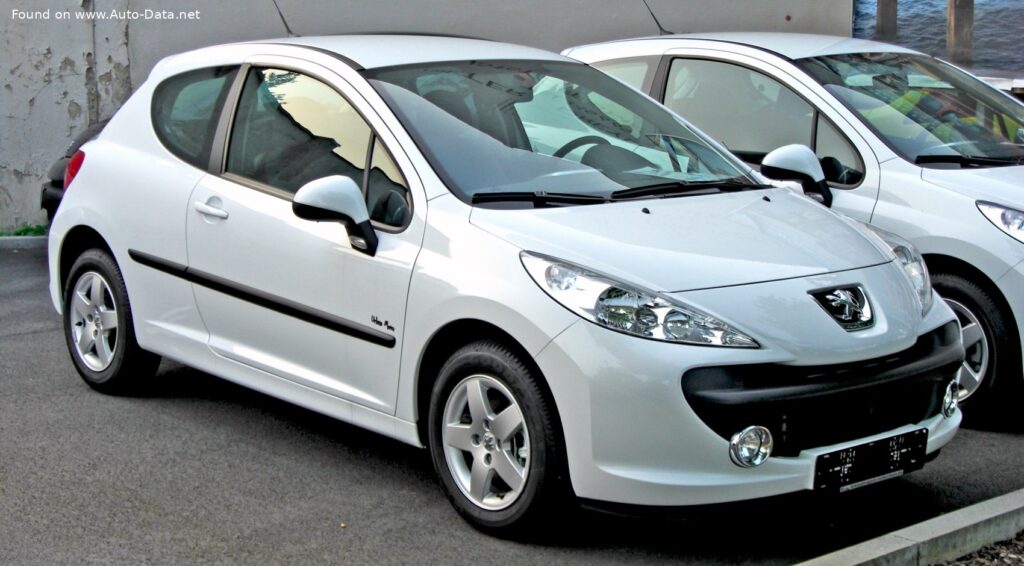
The Peugeot 207 1.4 i (75 Hp), produced from 2006 to 2009, was a key variant within the second generation of Peugeot’s highly successful 207 supermini. Building upon the legacy of the 206, the 207 aimed to offer a stylish and practical compact car for the European market. The 1.4 i (75 Hp) model served as the entry-level powertrain option, prioritizing affordability, fuel efficiency, and usability for everyday driving. It was positioned as a pragmatic choice for urban commuters and drivers seeking a low-cost, reliable vehicle. While never officially sold in the United States, the 207 was a significant competitor in the competitive European B-segment.
The 1.4 i (75 Hp) in the 207 Lineup
Within the Peugeot 207 range, the 1.4 i (75 Hp) occupied the entry-level position. It sat below more powerful and often more expensive variants like the 1.6 VTi (110 hp) and the diesel-powered HDi models. The target audience for the 1.4 i was cost-conscious buyers, first-time car owners, and those who prioritized fuel economy over outright performance. Compared to the higher-spec models, the 1.4 i typically featured a more basic level of standard equipment, though options were available to enhance the interior and features. The diesel variants, while more expensive initially, offered superior fuel economy, appealing to drivers covering high annual mileages. The 1.6 VTi, on the other hand, catered to those seeking a more engaging driving experience.
Powertrain & Engine Architecture
The Peugeot 207 1.4 i (75 Hp) was powered by Peugeot’s TU3A engine, a naturally aspirated 1.4-liter (1360 cc) inline four-cylinder gasoline engine. This engine, known for its simplicity and durability, had been a mainstay in Peugeot’s lineup for many years. The engine code is commonly identified as KFV. It featured a single overhead camshaft (SOHC) valvetrain with two valves per cylinder. Fuel delivery was managed by a multi-point sequential fuel injection system, providing adequate atomization for efficient combustion. The engine produced 75 horsepower (56 kW) at 5400 rpm and 90 Nm (66.4 lb-ft) of torque at 3300 rpm. The standard transmission was a five-speed manual gearbox, although a four-speed automatic transmission was also offered as an option, albeit less common. The automatic transmission, while providing convenience, resulted in a slight reduction in fuel economy and acceleration compared to the manual version.
Automatic Transmission Details
The optional four-speed automatic transmission was a conventional hydraulic automatic, offering smooth but not particularly rapid gear changes. It was designed for comfort and ease of use rather than sporty performance. The gear ratios were optimized for fuel efficiency and drivability in urban conditions. While it provided a more relaxed driving experience, the automatic version typically saw a slight decrease in fuel economy and a slower 0-60 mph time compared to the manual transmission.
Driving Characteristics
The Peugeot 207 1.4 i (75 Hp) offered a predictable and undemanding driving experience. Acceleration from 0 to 60 mph took approximately 14.8 seconds, and the top speed was around 103.77 mph (167 km/h). The engine’s torque delivery was adequate for city driving and overtaking on slower roads, but it lacked the punch of the more powerful 1.6 VTi. The five-speed manual transmission provided precise gear changes, while the optional automatic offered a more relaxed driving experience. The car’s relatively light weight (around 2509 lbs) helped to mitigate the effects of the modest power output. The steering was light and responsive, making it easy to maneuver in tight spaces. The suspension, tuned for comfort, absorbed bumps and imperfections in the road surface effectively, providing a pleasant ride quality.
Equipment & Trim Levels
The standard equipment level for the 207 1.4 i (75 Hp) was typically modest, reflecting its entry-level positioning. Common features included power steering, power front windows, central locking, and an adjustable steering column. Air conditioning was often an optional extra. Higher trim levels, such as ‘Sport’ or ‘S’, added features like alloy wheels, upgraded interior trim, and a CD player with additional speakers. Safety features included ABS (Anti-lock Braking System) and front airbags as standard equipment. Optional extras included rear power windows, a sunroof, and parking sensors. Interior upholstery was typically cloth, with a range of colors and patterns available. The dashboard layout was functional and user-friendly, with clearly labeled controls.
Chassis & Braking
The Peugeot 207 1.4 i (75 Hp) featured a front-wheel-drive layout with an independent McPherson strut suspension at the front and a semi-independent elastic beam suspension at the rear. The front suspension incorporated a coil spring and anti-roll bar to improve handling and stability. The rear suspension was designed to provide a comfortable ride and minimize body roll. The braking system consisted of ventilated disc brakes at the front and drum brakes at the rear. ABS (Anti-lock Braking System) was standard, enhancing braking performance and control, particularly on slippery surfaces. The steering system utilized a rack and pinion setup, providing precise and responsive steering feel.
Market Reception & Comparison
The Peugeot 207 1.4 i (75 Hp) received generally positive reviews for its affordability, fuel efficiency, and comfortable ride. Critics praised its practicality and ease of driving, making it a suitable choice for urban commuters and first-time car buyers. However, some reviewers noted that the engine lacked power, particularly when fully loaded or driving on uphill roads. Compared to the 1.6 VTi, the 1.4 i offered significantly less performance, but it also came with a lower price tag and better fuel economy. The diesel-powered HDi models offered even better fuel economy but were more expensive to purchase. In terms of reliability, the TU3A engine was generally considered to be robust and dependable, although regular maintenance was essential to ensure long-term durability. Fuel economy averaged around 37.3 US mpg (combined cycle).
Technical Specifications
| Brand | Peugeot |
| Model | 207 |
| Generation | 207 |
| Engine Type | 1.4 i (75 Hp) |
| Production Start | 2006 |
| Production End | 2009 |
| Powertrain Architecture | Internal Combustion engine |
| Body Type | Hatchback |
| Seats | 5 |
| Doors | 3-5 |
| Fuel Consumption (Urban) | 8.4 l/100 km (28 US mpg) |
| Fuel Consumption (Extra Urban) | 5 l/100 km (47 US mpg) |
| Fuel Consumption (Combined) | 6.3 l/100 km (37.3 US mpg) |
| Fuel Type | Petrol (Gasoline) |
| Acceleration 0-60 mph | 14.8 sec |
| Acceleration 0-100 km/h | 15.6 sec |
| Maximum Speed | 167 km/h (103.77 mph) |
| Weight-to-Power Ratio | 15.2 kg/Hp (65.9 Hp/tonne) |
| Weight-to-Torque Ratio | 12.6 kg/Nm (79.1 Nm/tonne) |
| Power | 75 Hp @ 5400 rpm |
| Power per liter | 55.1 Hp/l |
| Torque | 90 Nm @ 3300 rpm (66.38 lb.-ft. @ 3300 rpm) |
| Engine Layout | Front, Transverse |
| Engine Model/Code | KFV TU3A |
| Engine Displacement | 1360 cm3 (82.99 cu. in.) |
| Number of Cylinders | 4 |
| Engine Configuration | Inline |
| Cylinder Bore | 75 mm (2.95 in.) |
| Piston Stroke | 77 mm (3.03 in.) |
| Number of Valves per Cylinder | 2 |
| Fuel Injection System | Multi-port manifold injection |
| Engine Aspiration | Naturally aspirated engine |
| Curb Weight | 1138 kg (2508.86 lbs.) |
| Trunk Space (Minimum) | 270 l (9.53 cu. ft.) |
| Trunk Space (Maximum) | 923 l (32.6 cu. ft.) |
| Fuel Tank Capacity | 50 l (13.21 US gal) |
| Length | 4030 mm (158.66 in.) |
| Width | 1720 mm (67.72 in.) |
| Height | 1472 mm (57.95 in.) |
| Wheelbase | 2540 mm (100 in.) |
Legacy
The Peugeot 207 1.4 i (75 Hp) remains a relatively common sight on European roads today, testament to its durability and reliability. The TU3A engine is known for its longevity, and with regular maintenance, it can continue to provide years of dependable service. In the used car market, the 1.4 i models are typically more affordable than the higher-spec variants, making them an attractive option for budget-conscious buyers. While not a performance icon, the 207 1.4 i (75 Hp) represents a solid and practical choice for those seeking a reliable and economical compact car. Its enduring presence is a reflection of Peugeot’s commitment to building well-engineered and durable vehicles.
