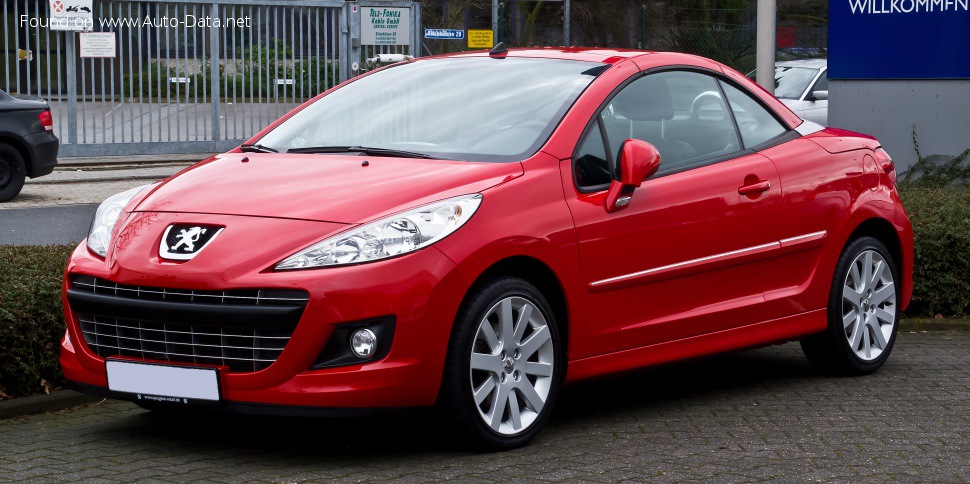
The Peugeot 207 CC (facelift 2009) represents a significant chapter in the French automaker’s commitment to the compact coupe-cabriolet segment, a niche it largely pioneered with the immensely popular 206 CC. Launched in 2007 as the convertible variant of the 207 supermini, the CC model received a mid-cycle refresh in 2009, bringing subtle styling updates and minor mechanical refinements. While never officially sold in the United States, the Peugeot 207 CC (facelift 2009) was a prominent player in the European market, offering a blend of chic styling, open-air motoring, and everyday practicality in a compact, front-wheel-drive package. It aimed to deliver an accessible taste of convertible luxury, transforming from a snug coupe to a breezy cabriolet with the press of a button, thanks to its sophisticated retractable hardtop roof.
1.6 VTi Automatic: Positioning and Overview
This particular iteration, equipped with the 1.6 VTi (Variable Valve Lift and Timing) engine producing 120 horsepower and paired with a 4-speed automatic transmission, was positioned as a comfortable and user-friendly option for urban dwellers and those seeking a stylish cruiser. It occupied a mid-range position within the 207 CC lineup, offering a balance between affordability and features. Compared to the base models with smaller engines, the 1.6 VTi provided noticeably more power and refinement. However, it didn’t aim to compete with the performance-oriented trims, which were not offered with the automatic transmission. Its four-seat configuration, though the rear seats were admittedly compact, provided a degree of versatility often lacking in smaller two-seat roadsters. The facelift ensured the 207 CC remained contemporary against a backdrop of increasing competition in the European B-segment and the waning popularity of compact hardtop convertibles in the later part of its production run.
Powertrain & Engine Architecture
At the heart of the Peugeot 207 CC (facelift 2009) 1.6 VTi lies a 1,598 cm³ (97.52 cu. in.) naturally aspirated inline four-cylinder engine. This powerplant, designated by the engine code 5FS EP6C, was part of the “Prince” family of engines, a collaborative development between PSA Peugeot Citroën and BMW. Known for its advanced engineering for the time, it featured Dual Overhead Camshafts (DOHC) and Variable Valve Timing (VVT) for optimized performance and fuel efficiency across the rev range. It delivered a respectable 120 horsepower at 6000 rpm, translating to a power-per-liter output of 75.1 horsepower per liter. Peak torque stood at 160 Nm (118.01 lb.-ft.) available at 4250 rpm, providing adequate pulling power for its class.
The engine utilizes a multi-port fuel injection system, delivering fuel directly into the intake ports. The valvetrain employs four valves per cylinder, enhancing breathing and contributing to the engine’s overall efficiency. The 4-speed automatic transmission, while not the most modern by today’s standards, was a reliable and commonly used unit in the segment. It featured a conventional torque converter and electronic control for smooth shifting. Gear ratios were optimized for comfortable cruising rather than aggressive acceleration. First gear was relatively short for quick take-offs, while the higher gears were geared for fuel efficiency at highway speeds. The transmission was designed to provide a seamless driving experience, particularly in urban environments.
Driving Characteristics
The 1.6 VTi engine paired with the 4-speed automatic transmission delivers a relaxed and refined driving experience. Acceleration is adequate for everyday driving, but it’s not a particularly sporty setup. The 0 to 60 mph time of approximately 12 seconds reflects this. Compared to the manual transmission versions of the 1.6 VTi, the automatic sacrifices some responsiveness due to the inherent losses in the torque converter and the slower shift times. However, the automatic provides a level of convenience that appeals to many drivers, especially in congested city traffic. The gear ratios are spaced to prioritize fuel economy and smooth cruising, rather than maximizing performance. The engine feels most comfortable in the mid-range, providing sufficient power for overtaking maneuvers. The automatic transmission tends to hold onto gears longer to maintain engine speed, which can sometimes feel slightly sluggish when accelerating uphill or with a full load.
Equipment & Trim Levels
The 207 CC 1.6 VTi Automatic typically came equipped with a reasonable level of standard features. Air conditioning was standard, as were power windows and central locking. The interior featured cloth upholstery, although leather options were available as an upgrade. The dashboard layout was typical of Peugeot at the time, with a focus on ergonomics and ease of use. An integrated audio system with CD player and auxiliary input was also standard. Optional extras included alloy wheels, a panoramic sunroof, parking sensors, and a more advanced audio system with Bluetooth connectivity. Safety features included ABS (Anti-lock Braking System) and front airbags. The facelifted models often featured upgraded interior trim materials and revised dashboard graphics.
Chassis & Braking
The Peugeot 207 CC utilized a McPherson strut front suspension and a semi-independent coil spring rear suspension. This setup provided a good balance between ride comfort and handling. The front suspension offered precise steering and good control, while the rear suspension helped to absorb bumps and maintain stability. Stabilizer bars were fitted to both the front and rear axles to reduce body roll during cornering. The braking system consisted of ventilated discs at the front and solid discs at the rear. ABS (Anti-lock Braking System) was standard, providing enhanced braking performance and control in emergency situations. The brake calipers were sized appropriately for the vehicle’s weight and performance capabilities. The steering was a rack and pinion system, providing precise and responsive steering feel.
Market Reception & Comparison
Critics generally viewed the Peugeot 207 CC 1.6 VTi Automatic as a stylish and comfortable convertible, but noted that it wasn’t a particularly exciting performer. The automatic transmission was praised for its smoothness and ease of use, but criticized for its lack of responsiveness compared to the manual gearbox. Fuel economy was considered reasonable for a convertible, averaging around 32.2 US mpg in combined driving. Reliability was generally good, although some owners reported minor issues with the retractable hardtop mechanism. Compared to other trims in the 207 CC lineup, the 1.6 VTi Automatic offered a good balance between price and features. It was more affordable than the higher-powered versions, but provided more performance and refinement than the base models. Against competitors like the Opel Tigra TwinTop and Nissan Micra C+C, the 207 CC stood out with its more sophisticated styling and higher-quality interior.
Technical Specifications
| General Information | |
| Brand | Peugeot |
| Model | 207 |
| Generation | 207 CC (facelift 2009) |
| Type (Engine) | 1.6 VTi (120 Hp) Automatic |
| Start of Production | 2009 year |
| End of Production | 2015 year |
| Powertrain Architecture | Internal Combustion engine |
| Body type | Coupe – Cabriolet |
| Seats | 4 |
| Doors | 2 |
| Performance Specifications | |
| Fuel Consumption (Urban) | 10.3 l/100 km (22.8 US mpg) |
| Fuel Consumption (Extra Urban) | 5.6 l/100 km (42 US mpg) |
| Fuel Consumption (Combined) | 7.3 l/100 km (32.2 US mpg) |
| CO2 Emissions | 169 g/km |
| Fuel Type | Petrol (Gasoline) |
| Acceleration 0-60 mph | 12 seconds |
| Acceleration 0-100 km/h | 12.6 seconds |
| Maximum Speed | 195 km/h (121.17 mph) |
| Emission Standard | Euro 5 |
| Weight-to-Power Ratio | 11.5 kg/Hp (86.8 Hp/tonne) |
| Weight-to-Torque Ratio | 8.6 kg/Nm (115.7 Nm/tonne) |
| Engine Specifications | |
| Power | 120 Hp @ 6000 rpm |
| Power per liter | 75.1 Hp/l |
| Torque | 160 Nm @ 4250 rpm (118.01 lb.-ft. @ 4250 rpm) |
| Engine Layout | Front, Transverse |
| Engine Model/Code | 5FS EP6C |
| Engine Displacement | 1598 cm³ (97.52 cu. in.) |
| Number of Cylinders | 4 |
| Engine Configuration | Inline |
| Cylinder Bore | 77 mm (3.03 in.) |
| Piston Stroke | 85.8 mm (3.38 in.) |
| Compression Ratio | 11:1 |
| Number of Valves per Cylinder | 4 |
| Fuel Injection System | Multi-port manifold injection |
| Engine Aspiration | Naturally aspirated engine |
| Valvetrain | DOHC-VVT |
| Engine Oil Capacity | 4.25 l (4.49 US qt) |
| Coolant Capacity | 5.7 l (6.02 US qt) |
| Space, Volume and Weights | |
| Kerb Weight | 1383 kg (3048.99 lbs.) |
| Max. Weight | 1767 kg (3895.57 lbs.) |
| Max Load | 384 kg (846.58 lbs.) |
| Trunk (Boot) Space – Minimum | 145 l (5.12 cu. ft.) |
| Trunk (Boot) Space – Maximum | 370 l (13.07 cu. ft.) |
| Fuel Tank Capacity | 50 l (13.21 US gal) |
| Permitted Trailer Load with Brakes (12%) | 1060 kg (2336.9 lbs.) |
| Permitted Trailer Load without Brakes | 600 kg (1322.77 lbs.) |
| Dimensions | |
| Length | 4044 mm (159.21 in.) |
| Width | 1748 mm (68.82 in.) |
| Width with Mirrors Folded | 1818 mm (71.57 in.) |
| Width including Mirrors | 1972 mm (77.64 in.) |
| Height | 1393 mm (54.84 in.) |
| Wheelbase | 2540 mm (100 in.) |
| Front Track | 1469 mm (57.83 in.) |
| Rear (Back) Track | 1470 mm (57.87 in.) |
| Drag Coefficient (Cd) | 0.31 |
| Minimum Turning Circle (Turning Diameter) | 11.0 m (36.09 ft.) |
| Drivetrain, Brakes and Suspension Specifications | |
| Drivetrain Architecture | Front wheel drive. Internal Combustion engine drives the front wheels. |
| Drive Wheel | Front wheel drive |
| Number of Gears and Type of Gearbox | 4 gears, automatic transmission |
| Front Suspension | Independent type McPherson |
| Rear Suspension | Semi-independent, coil spring |
| Front Brakes | Ventilated discs |
| Rear Brakes | Disc |
| Assisting Systems | ABS (Anti-lock braking system) |
| Steering Type | Steering rack and pinion |
| Tires Size | 195/55 R16 |
| Wheel Rims Size | 16 inches |
Legacy
The Peugeot 207 CC, including the 1.6 VTi Automatic variant, has generally proven to be a reliable vehicle, particularly when well-maintained. The “Prince” engine is known for its durability, although regular servicing is essential. The automatic transmission, while not the most advanced, is generally robust. The most common issues reported by owners relate to the retractable hardtop mechanism, which can experience problems with the seals, motors, or sensors. In the used car market today, the 207 CC 1.6 VTi Automatic represents an affordable entry point into the world of open-top motoring. Its stylish design and comfortable driving experience continue to appeal to buyers looking for a fun and practical convertible. However, potential buyers should be aware of the potential issues with the hardtop and ensure that the vehicle has been properly maintained.