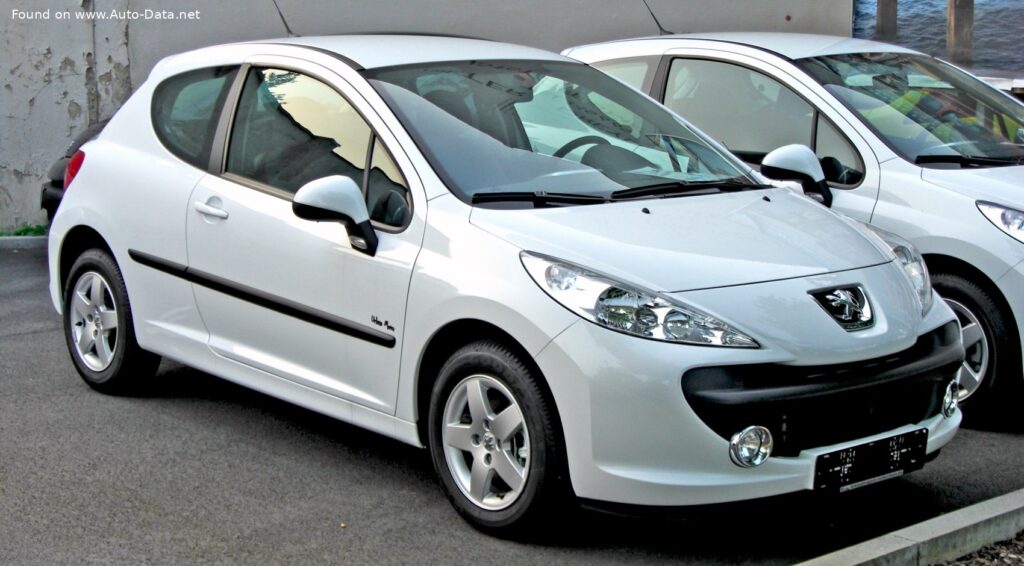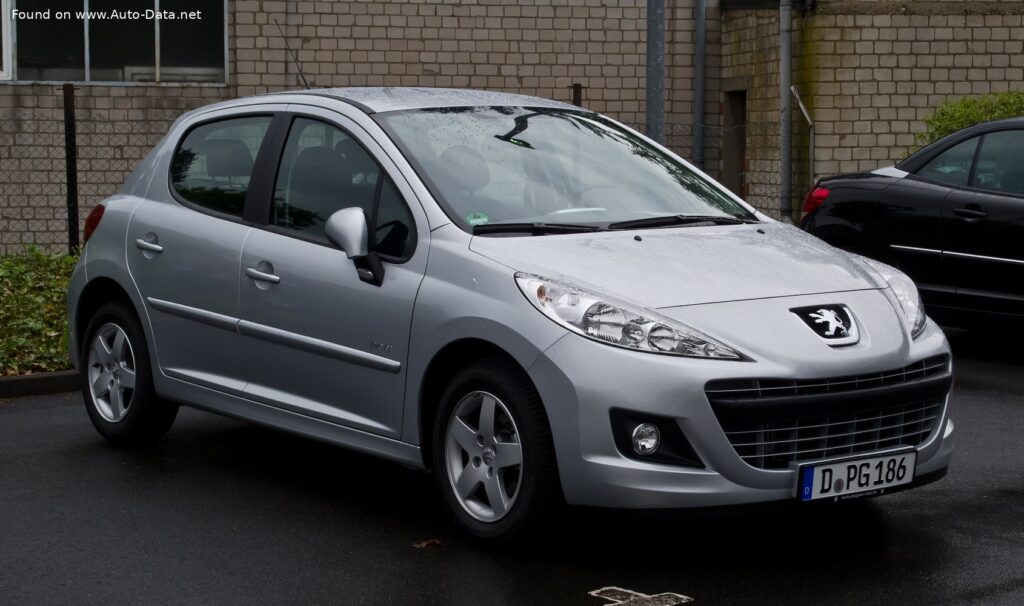
The Peugeot 207, a prominent B-segment (subcompact) vehicle in the European market, received a significant refresh in 2009, ushering in the iteration known as the Peugeot 207 (facelift 2009) 1.4 VTi (95 Hp). This updated model built upon the success of its predecessor, which had been introduced in 2006 as the successor to the immensely popular Peugeot 206. The 207 aimed to elevate the brand’s presence in the fiercely competitive small car segment, offering improved refinement, enhanced safety features, and more efficient powertrains. While not a common sight on American roads, the 207 was a cornerstone of Peugeot’s global sales strategy, particularly strong in Europe, where it competed against a host of well-established rivals. This specific variant, featuring the 1.4-liter VTi engine with 95 horsepower, represented a popular choice for consumers seeking a balance of economy and adequate performance for urban and suburban driving. Produced from 2009 to 2012, this facelifted generation maintained the 207’s reputation for distinctive French styling and a comfortable ride, adapted to the preferences of its primary markets.
Peugeot 207 (Facelift 2009) 1.4 VTi (95 Hp): A Detailed Overview
Variant Positioning
The 1.4 VTi (95 Hp) variant of the facelifted Peugeot 207 occupied a mid-range position within the model lineup. It served as a step up from the base 1.4-liter non-VTi engine, offering improved performance and refinement thanks to the variable valve timing technology. However, it sat below the more powerful 1.6-liter VTi models and the diesel-powered HDi variants, which catered to drivers prioritizing higher performance or even greater fuel economy. This trim level was specifically targeted towards buyers who wanted a reasonably equipped and efficient small car for everyday use, without the added cost of the higher-spec models.
Powertrain & Engine Architecture
At the heart of this particular Peugeot 207 (facelift 2009) 1.4 VTi (95 Hp) model lies a 1.4-liter (1397 cm³, or 85.25 cubic inches) naturally aspirated inline-four gasoline engine, designated with the model code 8FR EP3. This engine was part of the “Prince” engine family, a collaborative effort between PSA Peugeot Citroën and BMW, renowned for its advanced engineering and efficiency for its time. Featuring a DOHC-VVT (Double Overhead Camshaft with Variable Valve Timing) valvetrain and multi-port manifold injection, the engine was designed to offer a smooth power delivery and improved fuel economy compared to previous generations.
The engine produces a respectable 95 horsepower at 6000 rpm, translating to 68 horsepower per liter, which is quite competitive for a non-turbocharged small-displacement engine from that era. Torque output stands at 136 Nm (100.31 lb.-ft.) delivered at 4000 rpm, providing sufficient pulling power for daily driving scenarios. Power is sent to the front wheels via a 5-speed manual transmission, a common and reliable setup for a vehicle in this class. While an automated manual transmission (often marketed as a “robotized” manual) was available as an option, the 5-speed manual was the most prevalent choice.
Transmission Details
The 5-speed manual transmission used in the 207 1.4 VTi is a conventional gearbox, known for its durability and relatively simple maintenance. Gear ratios are tuned for a balance between fuel efficiency and acceptable acceleration. First gear is relatively short, providing good launch capability, while fifth gear is geared for comfortable highway cruising. The transmission’s shift quality is generally smooth, although not as refined as some of the more advanced gearboxes found in higher-end vehicles.
Driving Characteristics
In terms of acceleration, the Peugeot 207 (facelift 2009) 1.4 VTi (95 Hp) accelerates from 0 to 60 mph in a calculated 11.5 seconds, while the 0-100 km/h sprint takes 12.1 seconds. Its maximum speed is rated at 185 km/h, or approximately 115 mph. These figures indicate a car that is perfectly capable for city driving and occasional highway journeys, prioritizing efficiency and ease of use over outright speed. The vehicle’s weight-to-power ratio is 12 kg/Hp (or 83 Hp/tonne), reflecting its compact nature and the engine’s adequate power delivery for its size.
Compared to the higher-output 1.6 VTi models, the 1.4 VTi feels noticeably less powerful, particularly when accelerating from highway speeds or climbing hills. However, the 1.4 VTi offers a more relaxed driving experience, with less need to constantly downshift. The manual transmission allows for precise control over the engine’s power band, and the relatively light weight of the 207 helps to mitigate the effects of the lower horsepower. The 1.4 VTi is also more fuel-efficient than its more powerful siblings, making it a more economical choice for drivers who primarily use their cars for commuting or short trips.
Equipment & Trim Levels
The Peugeot 207 (facelift 2009) 1.4 VTi (95 Hp) was typically offered in several trim levels, each adding more features and equipment. Standard features generally included air conditioning, power steering, electric front windows, a CD player with MP3 compatibility, and ABS brakes with electronic brakeforce distribution (EBD). Higher trim levels added features such as alloy wheels, a multi-function steering wheel, cruise control, automatic headlights and rain-sensing wipers, and upgraded interior trim.
Interior upholstery was typically cloth, with a range of colors and patterns available. The dashboard layout was functional and ergonomically designed, with easy-to-read instruments and intuitive controls. Optional extras included a panoramic sunroof, a navigation system, and a premium sound system. The 3-door and 5-door body styles offered different levels of practicality, with the 5-door version providing easier access to the rear seats.
Chassis & Braking
The 207’s front suspension utilized an independent McPherson strut setup with coil springs and an anti-roll bar, while the rear featured a semi-independent setup with coil springs and an elastic beam, a typical arrangement for a subcompact car offering a good balance of comfort and handling. The steering system was a responsive rack and pinion unit.
Braking was handled by ventilated discs at the front and drum brakes at the rear, a cost-effective and adequate solution for a vehicle of this size and performance. The 185/65 R15 tires mounted on 15-inch wheel rims provided a comfortable ride and predictable handling. The use of drum brakes on the rear was a common cost-saving measure in this segment, and while they offered sufficient stopping power for normal driving conditions, they lacked the performance and fade resistance of disc brakes.
Market Reception & Comparison
The Peugeot 207 (facelift 2009) 1.4 VTi (95 Hp) received generally positive reviews from automotive critics. It was praised for its stylish design, comfortable ride, and fuel efficiency. However, some critics noted that the engine lacked outright power, particularly when fully loaded or driving uphill. Compared to its rivals, such as the Renault Clio and Ford Fiesta, the 207 offered a slightly more refined driving experience, but it was often more expensive to purchase.
Fuel economy was a key strength of the 1.4 VTi, with combined fuel consumption rated at 5.9 liters per 100 km (39.9 US mpg). This made it a competitive option for drivers looking to minimize their fuel costs. Reliability was generally good, although some owners reported minor issues with the electrical system. Overall, the 207 1.4 VTi was considered a solid and dependable small car that offered a good balance of value and practicality.
Technical Specifications
| General Information | Brand: Peugeot |
| Model: 207 | |
| Generation: 207 (facelift 2009) | |
| Type (Engine): 1.4 VTi (95 Hp) | |
| Start of Production: 2009 year | |
| End of Production: 2012 year | |
| Powertrain Architecture: Internal Combustion engine, Front Wheel Drive | |
| Body type: Hatchback | |
| Seats: 5 | |
| Doors: 3-5 | |
| Performance Specifications | Fuel consumption (urban): 7.7 l/100 km (30.5 US mpg) |
| Fuel consumption (extra urban): 4.9 l/100 km (48 US mpg) | |
| Fuel consumption (combined): 5.9 l/100 km (39.9 US mpg) | |
| CO2 emissions: 137 g/km | |
| Fuel Type: Petrol (Gasoline) | |
| Acceleration 0 – 60 mph: 11.5 sec | |
| Acceleration 0 – 100 km/h: 12.1 sec | |
| Maximum speed: 185 km/h (114.95 mph) | |
| Emission standard: Euro 5 | |
| Weight-to-power ratio: 12 kg/Hp (83 Hp/tonne) | |
| Weight-to-torque ratio: 8.4 kg/Nm (118.9 Nm/tonne) | |
| Engine Specifications | Power: 95 Hp @ 6000 rpm |
| Power per liter: 68 Hp/l | |
| Torque: 136 Nm @ 4000 rpm (100.31 lb.-ft.) | |
| Engine layout: Front, Transverse | |
| Engine Model/Code: 8FR EP3 | |
| Engine displacement: 1397 cm³ (1.4 liters, 85.25 cu. in.) | |
| Number of cylinders: 4 | |
| Engine configuration: Inline | |
| Cylinder Bore: 77 mm (3.03 in.) | |
| Piston Stroke: 75 mm (2.95 in.) | |
| Compression ratio: 11:1 | |
| Number of valves per cylinder: 4 | |
| Fuel injection system: Multi-port manifold injection | |
| Engine aspiration: Naturally aspirated engine | |
| Valvetrain: DOHC-VVT | |
| Engine oil capacity: 4.25 l (4.49 US qt) | |
| Coolant capacity: 6 l (6.34 US qt) | |
| Space, Volume and Weights | Kerb Weight: 1144 kg (2522.09 lbs) |
| Max. weight: 1626 kg (3584.72 lbs) | |
| Max load: 482 kg (1062.63 lbs) | |
| Trunk (boot) space – minimum: 270 l (9.53 cu. ft.) | |
| Trunk (boot) space – maximum: 923 l (32.6 cu. ft.) | |
| Fuel tank capacity: 50 l (13.21 US gal) | |
| Permitted trailer load with brakes (12%): 1150 kg (2535.32 lbs) | |
| Permitted trailer load without brakes: 600 kg (1322.77 lbs) | |
| Dimensions | Length: 4045 mm (159.25 in.) |
| Width: 1748 mm (68.82 in.) | |
| Width with mirrors folded: 1818 mm (71.57 in.) | |
| Width including mirrors: 1972 mm (77.64 in.) | |
| Height: 1472 mm (57.95 in.) | |
| Wheelbase: 2540 mm (100 in.) | |
| Front track: 1475 mm (58.07 in.) | |
| Rear (Back) track: 1468 mm (57.8 in.) | |
| Drag coefficient (Cd): 0.30 | |
| Minimum turning circle (turning diameter): 10.8 m (35.43 ft.) | |
| Drivetrain, Brakes and Suspension Specifications | Drivetrain Architecture: Front-wheel drive, Internal Combustion engine |
| Drive wheel: Front wheel drive | |
| Number of gears and type of gearbox: 5 gears, manual transmission | |
| Front suspension: Independent, type McPherson with coil spring and anti-roll bar | |
| Rear suspension: Semi-independent, coil spring, Elastic beam | |
| Front brakes: Ventilated discs | |
| Rear brakes: Drum | |
| Assisting systems: ABS (Anti-lock braking system) | |
| Steering type: Steering rack and pinion | |
| Tires size: 185/65 R15 | |
| Wheel rims size: 15 |
Legacy
The Peugeot 207, particularly the facelifted models from 2009 to 2012, played a crucial role in Peugeot’s strategy to maintain a strong foothold in the fiercely competitive European B-segment. As a direct successor to the iconic 206, which had sold millions globally, the 207 had big shoes to fill. While it didn’t quite replicate the 206’s monumental sales success, the 207 was a solid performer, consistently ranking among the top-selling small cars in many European countries. The Peugeot 207 (facelift 2009) 1.4 VTi (95 Hp) variant, with its balanced engine and efficiency, was particularly popular among private buyers and fleet operators looking for a reliable and economical daily driver.
On the used car market today, the 207 1.4 VTi remains an affordable and practical option. The “Prince” engine, while not without its quirks, has proven to be relatively durable when properly maintained. Common issues include occasional oil leaks and problems with the electronic throttle body, but these are generally not major concerns. The 207’s simple mechanical design makes it relatively easy and inexpensive to repair, and parts availability is still good. Its enduring appeal lies in its combination of French style, comfortable ride, and fuel efficiency, making it a compelling choice for buyers seeking a budget-friendly small car.