
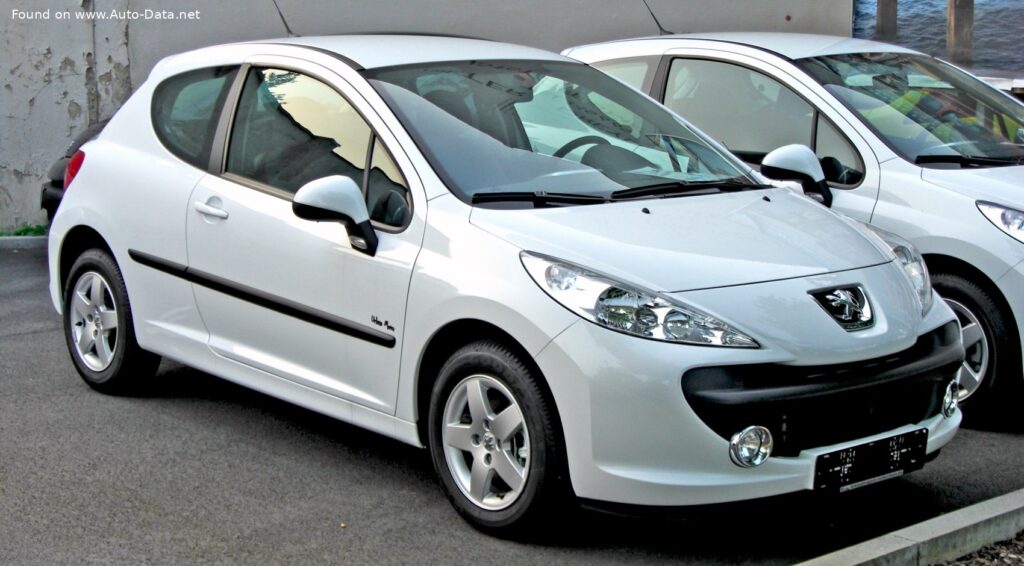
The Peugeot 207 RC 1.6 (174 Hp), produced between 2006 and 2009, represented the performance pinnacle within the Peugeot 207 supermini range. Positioned as a hot hatch, it followed the legacy of Peugeot’s celebrated performance models, notably the 205 GTi and 206 RC. While never officially sold in the United States, the 207 RC was a significant player in the competitive European B-segment hot hatch market, offering a blend of spirited performance, sophisticated engineering, and distinctive French styling. It aimed to challenge established rivals with its potent turbocharged engine and sport-tuned chassis, embodying Peugeot’s commitment to accessible performance vehicles.
Powertrain & Engine Architecture
At the heart of the Peugeot 207 RC was its 1.6-liter (1598 cm³) turbocharged inline-four engine, designated the 5FY EP6DTS. This powerplant was part of the “Prince” engine family, a collaborative effort between PSA Peugeot Citroën and BMW, renowned for its efficiency and power delivery. The engine generated 174 horsepower at 6000 rpm, achieving 108.9 hp per liter. Critically, it produced 177.01 lb-ft of torque available from 1600 to 3500 rpm, ensuring brisk acceleration and flexible in-gear performance.
The engine featured direct fuel injection, a twin-scroll turbocharger, and an intercooler, all contributing to efficient power generation and reduced turbo lag. A DOHC (Dual Overhead Camshaft) valvetrain with Variable Valve Timing (VVT) further optimized combustion and efficiency. The engine was exclusively paired with a 5-speed manual transmission, delivering power to the front wheels. This combination allowed the 207 RC to accelerate from 0 to 60 mph in 6.7 seconds, reaching a top speed of 136.7 mph.
Driving Characteristics
The 207 RC 1.6 offered a distinctly different driving experience compared to other variants in the 207 lineup. The standard 207 models, equipped with smaller displacement engines and lower power outputs, prioritized fuel economy and everyday usability. The 1.6L turbo engine in the RC provided a significant performance boost, delivering noticeably quicker acceleration and a more engaging driving experience. Compared to potential higher-performance versions (had they existed within the 207 range), the RC struck a balance between outright speed and everyday practicality. The 5-speed manual transmission was well-matched to the engine’s torque curve, providing precise gear changes and allowing the driver to effectively utilize the available power. The broad torque band meant less frequent gear shifting was required, enhancing drivability in various conditions. While not as raw or focused as some of its competitors, the 207 RC offered a refined and accessible hot hatch experience.
Equipment & Trim Levels
The Peugeot 207 RC was offered exclusively as a 3-door hatchback, emphasizing its sporty credentials. Standard features included unique RC-specific styling elements, such as a distinctive front bumper with larger air intakes, pronounced wheel arches, and a rear spoiler. Inside, the RC featured bolstered sport seats for improved lateral support, aluminum pedals, and unique instrument cluster graphics. While specific trim levels were limited, optional extras could include features like climate control, upgraded audio systems, and metallic paint finishes. The interior offered a practical balance, with a minimum trunk space of 9.53 cubic feet, expanding to 32.6 cubic feet with the rear seats folded.
Chassis & Braking
The 207 RC’s chassis was specifically tuned for performance. It featured an independent McPherson strut setup at the front with a coil spring and anti-roll bar, complemented by a semi-independent rear suspension with coil springs and an elastic beam. This configuration, combined with a lower ride height and stiffer damping, aimed to provide precise handling and reduced body roll. Braking performance was provided by ventilated discs at the front and disc brakes at the rear, supported by an Anti-lock Braking System (ABS) for enhanced safety and control. The steering system utilized a rack and pinion setup, offering direct feedback to the driver.
Market Reception & Comparison
The Peugeot 207 RC 1.6 (174 Hp) entered a competitive segment, facing rivals like the Renault Clio RS, Ford Fiesta ST, and Opel Corsa OPC/VXR. Critics generally praised the RC’s potent engine and refined driving experience. However, some found it less engaging than its predecessor, the 206 RC, and some competitors. Fuel economy was commendable for a hot hatch, with a combined rating of 32.7 US mpg. The 207 RC’s reliability was generally considered good, benefiting from the collaborative engineering with BMW. However, like many European performance cars, maintenance costs could be higher than those of more mainstream vehicles. The car’s compliance with Euro 4 emission standards was also a positive point, reflecting a balance between performance and environmental considerations.
Technical Specifications
| Category | Specification |
| Brand | Peugeot |
| Model | 207 |
| Generation | 207 |
| Type (Engine) | RC 1.6 (174 Hp) |
| Start of Production | 2006 |
| End of Production | 2009 |
| Powertrain Architecture | Internal Combustion engine |
| Body type | Hatchback |
| Seats | 5 |
| Doors | 3 |
| Fuel consumption (economy) – urban | 23.8 US mpg (9.9 l/100 km) |
| Fuel consumption (economy) – extra urban | 41.3 US mpg (5.7 l/100 km) |
| Fuel consumption (economy) – combined | 32.7 US mpg (7.2 l/100 km) |
| CO2 emissions | 171 g/km |
| Fuel Type | Petrol (Gasoline) |
| Acceleration 0 – 60 mph | 6.7 sec |
| Acceleration 0 – 100 km/h | 7.1 sec |
| Maximum speed | 136.7 mph (220 km/h) |
| Emission standard | Euro 4 |
| Weight-to-power ratio | 7.2 kg/Hp, 139.2 Hp/tonne |
| Weight-to-torque ratio | 5.2 kg/Nm, 192 Nm/tonne |
| Power | 174 Hp @ 6000 rpm |
| Power per liter | 108.9 Hp/l |
| Torque | 177.01 lb.-ft. @ 1600-3500 rpm (240 Nm) |
| Engine layout | Front, Transverse |
| Engine Model/Code | 5FY EP6DTS |
| Engine displacement | 1.6 liters (1598 cm³, 97.52 cu. in.) |
| Number of cylinders | 4 |
| Engine configuration | Inline |
| Cylinder Bore | 3.03 in. (77 mm) |
| Piston Stroke | 3.38 in. (85.8 mm) |
| Compression ratio | 10.5:1 |
| Number of valves per cylinder | 4 |
| Fuel injection system | Direct injection |
| Engine aspiration | Turbocharger, Intercooler |
| Valvetrain | DOHC-VVT |
| Engine oil capacity | 4.49 US qt (4.25 l) |
| Coolant | 5.6 US qt (5.3 l) |
| Kerb Weight | 2755.78 lbs. (1250 kg) |
| Max. weight | 3527.4 lbs. (1600 kg) |
| Trunk (boot) space – minimum | 9.53 cu. ft. (270 l) |
| Trunk (boot) space – maximum | 32.6 cu. ft. (923 l) |
| Fuel tank capacity | 13.21 US gal (50 l) |
| Length | 158.66 in. (4030 mm) |
| Width | 67.72 in. (1720 mm) |
| Height | 57.95 in. (1472 mm) |
| Wheelbase | 100 in. (2540 mm) |
| Drag coefficient (Cd) | 0.30 |
Legacy
The Peugeot 207 RC 1.6 (174 Hp) represents an important step in Peugeot’s hot hatch evolution. It showcased the brand’s ability to adapt to new engine technologies, moving towards turbocharged powerplants. While it didn’t achieve the same cult following as the 205 GTi or 206 RC, it offered a compelling package of performance, practicality, and refined driving dynamics. The 207 RC paved the way for the highly acclaimed 208 GTi, which recaptured much of the enthusiast adoration. Today, the 207 RC is remembered as a capable and engaging hot hatch that, while perhaps not reaching the iconic status of some of its predecessors, offered a distinctive French character in the early 21st-century European market. The “Prince” engine family, co-developed with BMW, proved to be a robust and reliable unit, and well-maintained examples of the 207 RC continue to offer an enjoyable driving experience for enthusiasts.
