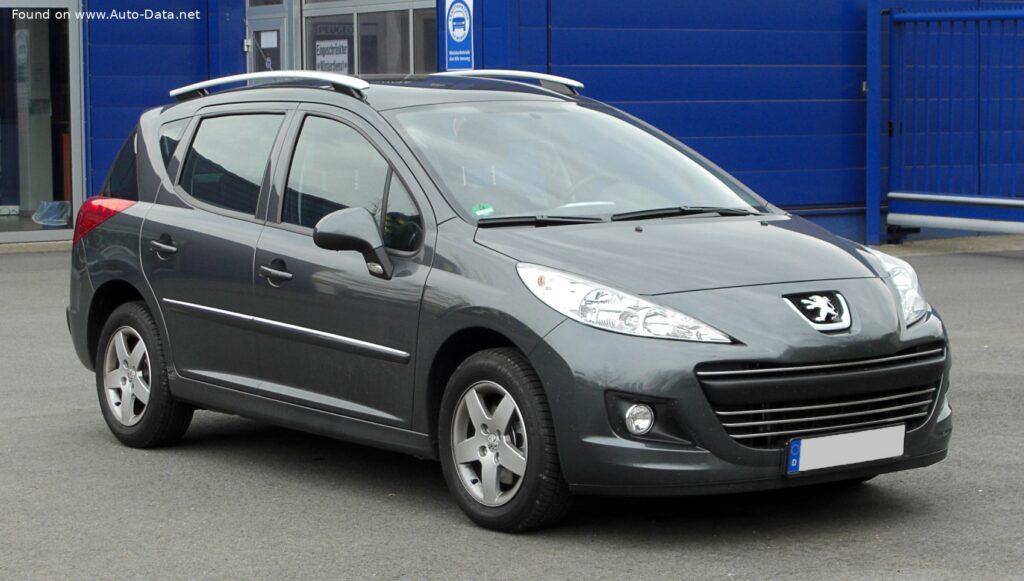
The Peugeot 207 SW (facelift 2009) represents a significant iteration of Peugeot’s popular B-segment offering, specifically tailored for the European market. As a station wagon (known as an estate in Europe), this variant of the 207 generation, produced from 2009 to 2013, emphasized practicality, fuel efficiency, and a compact footprint suitable for dense urban environments and varied road conditions across the continent. While never officially sold in the United States, the Peugeot 207 SW (facelift 2009) played a crucial role in Peugeot’s lineup, providing a versatile alternative to the standard hatchback, competing in a fiercely contested segment that valued both economy and utility.
The 1.6 HDi Engine in the 207 SW (facelift 2009)
The 207 series itself was a successor to the highly successful 206, carrying forward Peugeot’s design language and commitment to driving dynamics, albeit with a slightly larger and more mature presence. The 2009 facelift brought subtle but important updates, refining its aesthetics and often incorporating minor mechanical or technological enhancements to keep it competitive. This particular model, equipped with the 1.6 HDi (High-pressure Direct Injection) engine producing 109 horsepower, was a prime example of the European preference for efficient diesel powertrains, offering a compelling blend of performance and exceptional fuel economy for daily commuting and longer journeys. This configuration occupied a mid-range position within the 207 SW lineup, offering a balance between affordability and performance, sitting above the lower-powered petrol variants and below the more expensive and specialized trims.
Powertrain & Engine Architecture
Under the hood of the Peugeot 207 SW (facelift 2009) lay a refined 1.6-liter (1560 cm3 or 95.2 cu. in.) HDi diesel engine, a powerplant synonymous with efficiency and robust performance within the PSA Group (Peugeot S.A. and Citroën). This inline four-cylinder engine, designated by the code 9HZ DV6TED4, delivered 109 horsepower at a modest 4000 rpm, translating to a respectable power-per-liter figure of 69.9 HP/l. More critically for a diesel, it produced a substantial 177.01 lb.-ft. (240 Nm) of torque arriving early at just 1750 rpm. This low-end torque was a key characteristic, providing strong acceleration from a standstill and excellent in-gear flexibility, making it well-suited for both city driving and highway cruising.
The engine’s architecture featured a DOHC (Double Overhead Camshaft) valvetrain with four valves per cylinder, ensuring efficient breathing. Its advanced Diesel Commonrail fuel injection system, combined with a turbocharger and intercooler, was instrumental in achieving both its power output and its impressive fuel economy. The compression ratio of 17.6:1 further optimized the diesel combustion process. Paired exclusively with a smooth-shifting 5-speed manual transmission, the 207 SW 1.6 HDi was designed for driver engagement and maximum efficiency. Unlike some higher-performance 207 variants that offered automatic transmission options, the 1.6 HDi SW was exclusively available with a manual gearbox, prioritizing fuel economy and driver control.
Driving Characteristics
The 1.6 HDi engine in the 207 SW provided a distinctly different driving experience compared to the petrol-powered versions. While the petrol engines offered a more rev-happy character, the HDi prioritized low-end torque. This meant that the 207 SW 1.6 HDi felt strong and responsive at lower speeds, making it ideal for navigating urban traffic. The 5-speed manual transmission was well-matched to the engine’s characteristics, with gear ratios optimized for both fuel efficiency and usable power. Acceleration from 0 to 60 mph took approximately 9.8 seconds, which was respectable for a small diesel estate, but noticeably slower than the more powerful petrol variants. However, the HDi’s strength lay in its mid-range acceleration and its ability to maintain comfortable cruising speeds on the highway with minimal effort. Compared to the 1.4L petrol engine, the 1.6 HDi offered significantly more torque, resulting in a more relaxed and effortless driving experience, particularly when fully loaded or tackling inclines.
Equipment & Trim Levels
The Peugeot 207 SW (facelift 2009) 1.6 HDi was typically offered in several trim levels, each building upon the base specification. Standard features generally included air conditioning, power steering, electric front windows, a CD player with auxiliary input, and ABS brakes. Higher trim levels, such as ‘Sport’ or ‘Allure’, added features like alloy wheels, rear parking sensors, automatic headlights and rain sensors, cruise control, and upgraded interior trim. Interior upholstery was typically cloth, with options for more premium materials on higher-spec models. The dashboard layout was functional and ergonomic, with clear instrumentation and logically placed controls. Optional extras included a panoramic sunroof, a navigation system, and a premium audio system. The 207 SW aimed for a balance between affordability and comfort, offering a good level of equipment as standard while allowing customers to personalize their vehicle with optional extras.
Chassis & Braking
The Peugeot 207 SW (facelift 2009) utilized a McPherson strut front suspension and a semi-independent torsion beam rear suspension. This setup provided a good balance between ride comfort and handling. The front suspension offered precise steering and good body control, while the rear suspension helped to maintain stability and minimize body roll. The braking system consisted of ventilated disc brakes on the front wheels and disc brakes on the rear wheels. ABS (Anti-lock Braking System) was standard, providing enhanced braking performance and stability in emergency situations. The 1.6 HDi variant, due to its increased weight compared to the petrol models, often featured slightly uprated suspension components and brakes to ensure adequate performance and safety. The steering was electric power-assisted, offering light and precise control, particularly beneficial for urban driving. Stabilizer bars were fitted to both the front and rear axles to further reduce body roll during cornering.
Market Reception & Comparison
Critics generally praised the Peugeot 207 SW 1.6 HDi for its fuel efficiency, strong torque delivery, and comfortable ride. It was often seen as a practical and economical choice for families and individuals who needed a versatile vehicle for both urban and long-distance driving. Compared to the petrol-powered 207 SW variants, the 1.6 HDi offered significantly better fuel economy, making it a more cost-effective option for high-mileage drivers. However, it was slightly slower in terms of acceleration. Compared to its competitors, such as the Renault Clio Estate and Skoda Fabia Combi, the 207 SW offered a more stylish design and a more refined interior. However, some critics noted that the 207 SW’s interior space was slightly smaller than some of its rivals. The 1.6 HDi engine was generally considered to be reliable, although, like all diesel engines, it required regular maintenance and careful servicing to ensure optimal performance and longevity.
Technical Specifications
| Category | Specification |
| Brand | Peugeot |
| Model | 207 SW (facelift 2009) |
| Type (Engine) | 1.6 HDi (109 Hp) |
| Start of Production | 2009 |
| End of Production | 2013 |
| Powertrain Architecture | Internal Combustion Engine, Front Wheel Drive |
| Body type | Station wagon (estate) |
| Seats | 5 |
| Doors | 5 |
| Fuel consumption (economy) – urban | 5.8 l/100 km (40.6 US mpg) |
| Fuel consumption (economy) – extra urban | 3.8 l/100 km (61.9 US mpg) |
| Fuel consumption (economy) – combined | 4.5 l/100 km (52.3 US mpg) |
| CO2 emissions | 120 g/km |
| Fuel Type | Diesel |
| Acceleration 0 – 60 mph | 9.8 sec |
| Acceleration 0 – 100 km/h | 10.3 sec |
| Maximum speed | 119.92 mph (193 km/h) |
| Emission standard | Euro 4 |
| Weight-to-power ratio | 11.6 kg/Hp (86 Hp/tonne) |
| Weight-to-torque ratio | 5.3 kg/Nm (189.3 Nm/tonne) |
| Engine Specs | |
| Power | 109 Hp @ 4000 rpm |
| Power per liter | 69.9 Hp/l |
| Torque | 177.01 lb.-ft. (240 Nm) @ 1750 rpm |
| Engine layout | Front, Transverse |
| Engine Model/Code | 9HZ DV6TED4 |
| Engine displacement | 1560 cm3 (95.2 cu. in.) |
| Number of cylinders | 4 |
| Engine configuration | Inline |
| Cylinder Bore | 2.95 in. (75 mm) |
| Piston Stroke | 3.48 in. (88.3 mm) |
| Compression ratio | 17.6:1 |
| Number of valves per cylinder | 4 |
| Fuel injection system | Diesel Commonrail |
| Engine aspiration | Turbocharger, Intercooler |
| Valvetrain | DOHC |
Legacy
The Peugeot 207 SW 1.6 HDi has proven to be a relatively reliable vehicle in the used car market. The 9HZ DV6TED4 engine, while requiring regular maintenance, is known for its durability and longevity. Common issues include diesel particulate filter (DPF) clogging, particularly on vehicles that primarily cover short distances, and potential problems with the turbocharger. However, these issues are generally well-documented and can be addressed with proper servicing. Today, the 207 SW 1.6 HDi represents an affordable and economical option for those seeking a practical and fuel-efficient estate car. Its combination of versatility, low running costs, and comfortable ride continues to appeal to a wide range of buyers. While newer models offer more advanced technology and safety features, the 207 SW remains a testament to Peugeot’s ability to create well-rounded and dependable vehicles that stand the test of time.