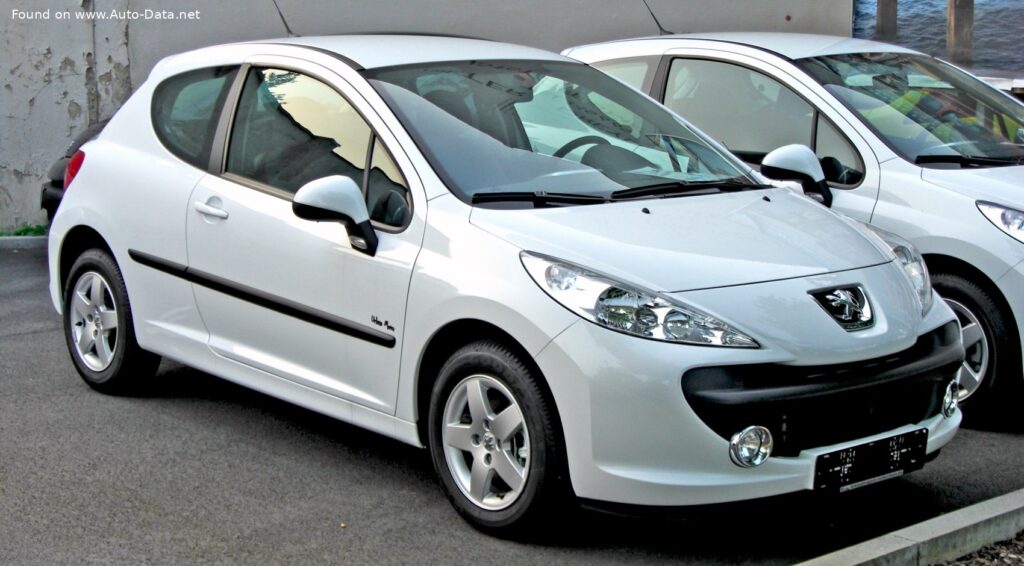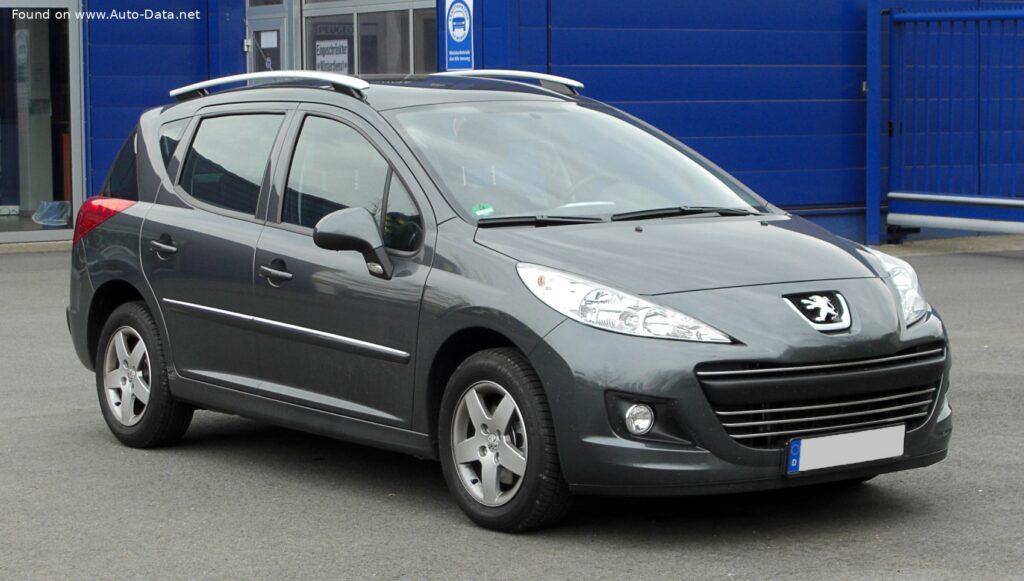
The Peugeot 207 SW (facelift 2009) 1.6 HDi (92 Hp) represents a significant offering in the highly competitive European compact segment, specifically targeting the practical-minded consumer. Introduced as part of the 207’s mid-cycle refresh in 2009, this station wagon variant, known as an “estate” in Europe, built upon the success of the popular 207 hatchback by offering enhanced cargo capacity and versatility without significantly increasing its footprint. Produced from 2009 to 2013, this particular iteration featured Peugeot’s widely utilized and efficient 1.6-liter HDi (High-Pressure Direct Injection) diesel engine, delivering 92 horsepower.
In its primary European market, the 207 SW was positioned as an accessible and economical family car, ideal for navigating both congested city streets and longer highway journeys. Its powertrain architecture, based on an internal combustion engine driving the front wheels, combined with a manual transmission, emphasized fuel efficiency and ease of maintenance—key attributes for its target demographic. The facelift brought subtle but effective styling updates and minor interior refinements, keeping the 207 SW fresh against a backdrop of evolving competition. This model exemplifies Peugeot’s long-standing commitment to producing practical, stylish, and efficient vehicles for the masses, particularly excelling in the compact car category where diesel engines often hold a dominant position due to their superior fuel economy.
Powertrain & Engine Architecture
At the heart of the Peugeot 207 SW (facelift 2009) 1.6 HDi (92 Hp) lies a robust and well-regarded 1.6-liter (1560 cm3 or 95.2 cu. in.) inline four-cylinder diesel engine. Codenamed 9HP DV6DTED, this powerplant is a testament to Peugeot’s expertise in diesel technology, featuring a common rail fuel injection system, a turbocharger, and an intercooler. These technologies work in concert to optimize combustion efficiency and power delivery, making it a highly practical choice for everyday driving.
Engine Details
The 9HP DV6DTED engine utilizes a second-generation common rail direct injection system, operating at pressures up to 1600 bar. This high-pressure injection ensures fine atomization of the fuel, leading to more complete combustion and reduced emissions. The turbocharger, a variable geometry turbo (VGT), provides boost across a wider engine speed range, enhancing both low-end torque and high-end power. The intercooler cools the compressed air from the turbocharger, further increasing air density and improving combustion efficiency. The engine employs a Single Overhead Camshaft (SOHC) valvetrain with two valves per cylinder (intake and exhaust). The engine’s block is constructed from cast iron, providing durability, while the cylinder head is made of aluminum alloy to reduce weight.
Transmission
Power is transmitted to the front wheels via a smooth-shifting 5-speed manual transmission. This transmission is a conventional design, known for its reliability and relatively low maintenance requirements. The gear ratios are optimized for fuel efficiency and everyday drivability, rather than outright performance. First gear is relatively short for easy starting from a standstill, while fifth gear is tall to maximize fuel economy during highway cruising. The clutch is a single-plate dry clutch, providing a predictable and engaging driving experience.
Driving Characteristics
The Peugeot 207 SW 1.6 HDi (92 Hp) offers a driving experience geared towards practicality and efficiency. While not a sporty vehicle, the engine’s substantial low-end torque (230 Nm or 169.64 lb.-ft. at 1750 rpm) provides adequate acceleration for everyday driving situations. Overtaking maneuvers require some planning, but are achievable with a downshift. The 5-speed manual transmission is precise and easy to use, allowing drivers to maintain optimal engine speed for the conditions.
Compared to higher-output versions of the 207, such as those equipped with gasoline engines, the 1.6 HDi feels less responsive at higher engine speeds. However, the diesel engine’s superior torque delivery makes it more effortless to drive in urban environments and when carrying a load. Compared to a manual transmission equipped 207, the automatic transmission (not available on this specific trim) would have sacrificed some fuel economy and responsiveness for added convenience. The 207 SW’s suspension is tuned for comfort, providing a relatively smooth ride over uneven surfaces. Handling is predictable and safe, but not particularly engaging. The steering is light and easy to use, making it well-suited for city driving.
Equipment & Trim Levels
The 207 SW 1.6 HDi (92 Hp) typically came equipped with a reasonable level of standard equipment, reflecting its position as a mainstream family car. Standard features generally included power steering, central locking, electric front windows, an audio system with CD player, and ABS (Anti-lock Braking System). Safety features such as driver and passenger airbags were also standard.
Interior upholstery was typically cloth, with a durable and practical finish. The dashboard layout was functional and easy to use, with clearly labeled controls. Optional extras available for this trim level included air conditioning, alloy wheels, a trip computer, and a rear parking sensor. Higher trim levels offered additional features such as automatic headlights, rain-sensing wipers, and a more sophisticated audio system. The 207 SW was available in a range of exterior colors, allowing buyers to personalize their vehicle.
Chassis & Braking
The 207 SW utilized an independent McPherson strut front suspension, providing a comfortable ride and predictable handling. The rear suspension was a semi-independent torsion beam setup, which is a cost-effective and space-efficient solution for compact cars. This configuration provides adequate ride quality for everyday driving, although it is not as sophisticated as a fully independent rear suspension.
Braking was handled by ventilated discs at the front and disc brakes at the rear. ABS (Anti-lock Braking System) was standard, enhancing braking performance and stability in emergency situations. The steering system was a rack and pinion type with electric power assistance, providing light and responsive steering feel. The 207 SW rode on 195/55 R16 tires, mounted on 16-inch steel or alloy wheels, offering a good balance of comfort and grip.
Market Reception & Comparison
Critics generally viewed the Peugeot 207 SW 1.6 HDi (92 Hp) favorably, praising its fuel efficiency, practicality, and comfortable ride. The 1.6 HDi engine was widely recognized as a strong performer, offering a good balance of power and economy. However, some critics noted that the engine could feel strained at higher speeds, and that the interior trim quality was not as refined as some of its competitors.
Compared to other trims in the 207 lineup, the 1.6 HDi offered superior fuel economy and lower running costs, making it an attractive option for budget-conscious buyers. However, the gasoline-powered versions of the 207 offered more responsive performance. In terms of reliability, the 1.6 HDi engine proved to be generally reliable, although regular maintenance is essential to ensure long-term durability. Compared to rivals such as the Renault Clio Estate and Skoda Fabia Combi, the 207 SW offered a competitive package, with a distinctive French design and a reputation for comfortable ride quality.
Technical Specifications
| Category | Specification |
| General Information | |
| Brand | Peugeot |
| Model | 207 |
| Generation | 207 SW (facelift 2009) |
| Type (Engine) | 1.6 HDi (92 Hp) |
| Start of Production | 2009 year |
| End of Production | 2013 year |
| Powertrain Architecture | Internal Combustion engine |
| Body type | Station wagon (estate) |
| Seats | 5 |
| Doors | 5 |
| Performance Specs | |
| Fuel consumption (economy) – urban | 5.5 l/100 km (42.8 US mpg) |
| Fuel consumption (economy) – extra urban | 3.7 l/100 km (63.6 US mpg) |
| Fuel consumption (economy) – combined | 4.4 l/100 km (53.5 US mpg) |
| CO2 emissions | 114 g/km |
| Fuel Type | Diesel |
| Acceleration 0 – 60 mph | 11.7 sec |
| Acceleration 0 – 100 km/h | 12.3 sec |
| Maximum speed | 113.09 mph (182 km/h) |
| Emission standard | Euro 5 |
| Weight-to-power ratio | 13.6 kg/Hp, 73.8 Hp/tonne |
| Weight-to-torque ratio | 5.4 kg/Nm, 184.4 Nm/tonne |
| Engine Specs | |
| Power | 92 Hp @ 4000 rpm |
| Power per liter | 59 Hp/l |
| Torque | 230 Nm (169.64 lb.-ft.) @ 1750 rpm |
| Engine layout | Front, Transverse |
| Engine Model/Code | 9HP DV6DTED |
| Engine displacement | 1560 cm3 (95.2 cu. in.) |
| Number of cylinders | 4 |
| Engine configuration | Inline |
| Cylinder Bore | 75 mm (2.95 in.) |
| Piston Stroke | 88.3 mm (3.48 in.) |
| Compression ratio | 18:1 |
| Number of valves per cylinder | 2 |
| Fuel injection system | Diesel Commonrail |
| Engine aspiration | Turbocharger, Intercooler |
| Valvetrain | SOHC |
| Engine oil capacity | 3.75 l (3.96 US qt) |
| Coolant | 5.6 l (5.92 US qt) |
| Engine systems | Particulate filter |
| Space, Volume and Weights | |
| Kerb Weight | 1247 kg (2749.16 lbs) |
| Max. weight | 1770 kg (3902.18 lbs) |
| Max load | 523 kg (1153.02 lbs) |
| Trunk (boot) space – minimum | 337 l (11.9 cu. ft.) |
| Trunk (boot) space – maximum | 1258 l (44.43 cu. ft.) |
| Fuel tank capacity | 50 l (13.21 US gal) |
| Permitted trailer load with brakes (12%) | 1150 kg (2535.32 lbs) |
| Permitted trailer load without brakes | 600 kg (1322.77 lbs) |
| Dimensions | |
| Length | 4164 mm (163.94 in.) |
| Width | 1748 mm (68.82 in.) |
| Width with mirrors folded | 1818 mm (71.57 in.) |
| Width including mirrors | 1972 mm (77.64 in.) |
| Height | 1527 mm (60.12 in.) |
| Wheelbase | 2540 mm (100 in.) |
| Front track | 1467 mm (57.76 in.) |
| Rear (Back) track | 1461 mm (57.52 in.) |
| Minimum turning circle (turning diameter) | 10.6 m (34.78 ft) |
| Drivetrain, Brakes and Suspension Specs | |
| Drivetrain Architecture | The Internal combustion engine (ICE) drives the front wheels of the vehicle. |
| Drive wheel | Front wheel drive |
| Number of gears and type of gearbox | 5 gears, manual transmission |
| Front suspension | Independent type McPherson |
| Rear suspension | Semi-independent, coil spring |
| Front brakes | Ventilated discs |
| Rear brakes | Disc |
| Assisting systems | ABS (Anti-lock braking system) |
| Steering type | Steering rack and pinion |
| Power steering | Electric Steering |
| Tires size | 195/55 R16 |
| Wheel rims size | 16 |
Legacy
The Peugeot 207 SW 1.6 HDi (92 Hp) has proven to be a durable and reliable vehicle in the used car market. The 9HP DV6DTED engine, while requiring regular maintenance (particularly regarding the diesel particulate filter), is generally known for its longevity. The simplicity of the mechanical components and the availability of spare parts contribute to its relatively low cost of ownership.
Today, the 207 SW remains a popular choice for buyers seeking an affordable and practical station wagon. Its fuel efficiency and spacious interior continue to appeal to families and individuals who prioritize functionality over performance. While newer models offer more advanced features and improved safety technology, the 207 SW represents a solid and dependable option for those seeking a cost-effective and versatile vehicle.