
Technical Specifications
| Brand | Peugeot |
| Model | 208 |
| Generation | 208 I (Phase I, 2012) |
| Type (Engine) | GTI 1.6 THP (200 Hp) |
| Start of production | 2013 |
| End of production | 2015 |
| Powertrain Architecture | Internal Combustion engine |
| Body type | Hatchback |
| Seats | 5 |
| Doors | 3 |
| Fuel consumption (urban) | 8.2 l/100 km (28.7 US mpg, 34.4 UK mpg, 12.2 km/l) |
| Fuel consumption (extra urban) | 4.7 l/100 km (50 US mpg, 60.1 UK mpg, 21.3 km/l) |
| Fuel consumption (combined) | 5.9 l/100 km (39.9 US mpg, 47.9 UK mpg, 16.9 km/l) |
| CO2 emissions | 139 g/km |
| Fuel Type | Petrol (Gasoline) |
| Acceleration 0 – 100 km/h | 6.8 sec |
| Acceleration 0 – 62 mph | 6.8 sec |
| Acceleration 0 – 60 mph | 6.5 sec |
| Maximum speed | 230 km/h (142.92 mph) |
| Emission standard | Euro 5 |
| Weight-to-power ratio | 5.8 kg/Hp, 172.4 Hp/tonne |
| Weight-to-torque ratio | 4.2 kg/Nm, 237.1 Nm/tonne |
| Power | 200 Hp @ 6800 rpm |
| Power per litre | 125.2 Hp/l |
| Torque | 275 Nm @ 1700 rpm (202.83 lb.-ft. @ 1700 rpm) |
| Engine layout | Front, Transverse |
| Engine Model/Code | 5FU EP6CDTX |
| Engine displacement | 1598 cm3 (97.52 cu. in.) |
| Number of cylinders | 4 |
| Engine configuration | Inline |
| Number of valves per cylinder | 4 |
| Fuel injection system | Direct injection |
| Engine aspiration | Turbocharger, Intercooler |
| Engine oil capacity | 4.25 l (4.49 US qt | 3.74 UK qt) |
| Coolant capacity | 6 l (6.34 US qt | 5.28 UK qt) |
| Kerb Weight | 1160 kg (2557.36 lbs.) |
| Max. weight | 1650 kg (3637.63 lbs.) |
| Max load | 490 kg (1080.27 lbs.) |
| Trunk (boot) space – minimum | 285 l (10.06 cu. ft.) |
| Trunk (boot) space – maximum | 1152 l (40.68 cu. ft.) |
| Fuel tank capacity | 50 l (13.21 US gal | 11 UK gal) |
| Length | 3962 mm (155.98 in.) |
| Width | 1829 mm (72.01 in.) |
| Height | 1460 mm (57.48 in.) |
| Wheelbase | 2538 mm (99.92 in.) |
| Front track | 1475-1470 mm (58.07 – 57.87 in.) |
| Rear (Back) track | 1471-1467 mm (57.91 – 57.76 in.) |
| Ride height (ground clearance) | 123-129 mm (4.84 – 5.08 in.) |
| Minimum turning circle (turning diameter) | 10.4 m (34.12 ft.) |
| Drivetrain Architecture | The Internal combustion engine (ICE) drives the front wheels of the vehicle. |
| Drive wheel | Front wheel drive |
| Number of gears and type of gearbox | 6 gears, manual transmission |
| Front suspension | Independent, type McPherson with coil spring and anti-roll bar |
| Rear suspension | Semi-independent, coil spring |
| Front brakes | Ventilated discs |
| Rear brakes | Disc |
| Assisting systems | ABS (Anti-lock braking system) |
| Steering type | Steering rack and pinion |
| Tires size | 205/45 R17 88V |
| Wheel rims size | 17 |
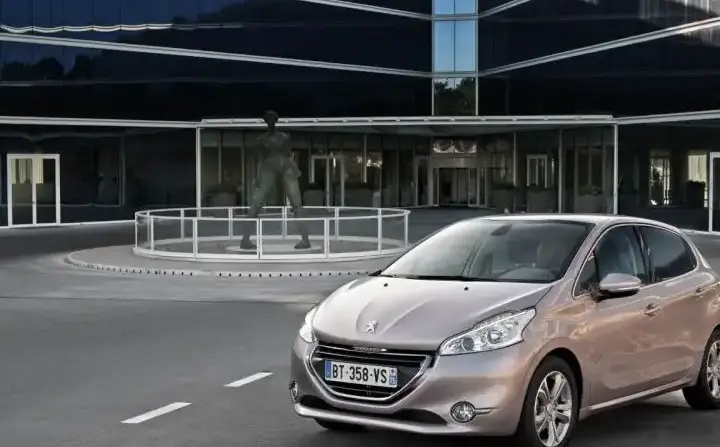
The Peugeot 208 GTI 1.6 THP, launched in 2013, was a crucial part of Peugeot’s strategy to rebuild its brand image and attract driving enthusiasts. Based on the 208 platform (T7) which first appeared in 2012, the GTI was the performance leader of the range. It was exclusively offered as a three-door hatchback, reinforcing its sporty character. The 208 GTI aimed to recapture the essence of Peugeot’s iconic GTI models of the past, most notably the 205 GTI, while integrating contemporary technology and safety features. Production ran until 2015, when it was replaced by minor revisions to the 208 lineup.
Powertrain & Engine Architecture
The core of the 208 GTI is the EP6CDTX engine, a 1.6-liter turbocharged four-cylinder gasoline engine. This engine, belonging to Peugeot’s Prince engine family, is defined by its direct fuel injection and variable valve timing. The engine code 5FU denotes a specific tuning for the GTI model. It generates 200 horsepower at 6800 rpm and 275 Nm (202.83 lb-ft) of torque at 1700 rpm. This output was achieved through a combination of a twin-scroll turbocharger, optimized engine mapping, and a revised exhaust system. The engine is mounted transversely at the front of the vehicle. The 208 GTI was exclusively available with a six-speed manual transmission, selected for its driver engagement and responsiveness. The gearbox features closely-spaced ratios designed to maximize acceleration and deliver a sporty driving experience.
Driving Characteristics
The 208 GTI provides a significantly more engaging driving experience than the standard 208 models. The 1.6 THP engine delivers strong acceleration, achieving 0-62 mph (0-100 km/h) in 6.8 seconds. The turbocharger provides a broad torque curve, offering ample power throughout the rev range. The six-speed manual transmission is precise and offers a satisfying shift feel. The chassis is well-tuned, with a firm but not overly harsh suspension setup. The steering is responsive and provides good feedback to the driver. Compared to other 208 variants, the GTI benefits from a more aggressive suspension setup, larger brakes, and a limited-slip differential (LSD) on some models, further enhancing its handling. The LSD helps to minimize understeer and improve traction during cornering.
Equipment & Trim Levels
The 208 GTI came well-equipped as standard. Key features included sport seats with red stitching, a leather-wrapped steering wheel, aluminum pedals, and a unique instrument cluster design. Exterior styling included a rear spoiler, a chrome exhaust tailpipe, and 17-inch alloy wheels. Optional extras included a panoramic glass roof, a navigation system, and parking sensors. The interior trim focused on a sporty aesthetic, with a predominantly black color scheme accented by red details. The GTI also featured Peugeot’s i-Cockpit design, characterized by a smaller steering wheel and a raised instrument panel.
Chassis & Braking
The 208 GTI utilizes a McPherson strut front suspension and a semi-independent torsion beam rear suspension. The suspension components were specifically tuned for the GTI to provide a more dynamic driving experience. The front suspension incorporates a thicker anti-roll bar to reduce body roll. The braking system features ventilated discs at the front and solid discs at the rear. The GTI also benefits from larger brake calipers and upgraded brake pads compared to the standard 208 models. ABS (Anti-lock Braking System) is standard, providing enhanced braking performance and stability.
Market Reception & Comparison
The Peugeot 208 GTI was generally well-received by automotive journalists. It was praised for its engaging driving dynamics, responsive engine, and sporty styling. Some critics, however, pointed out that the interior quality could be improved. Compared to other trims in the 208 range, the GTI offered significantly higher performance and a more focused driving experience. Fuel economy was respectable for a hot hatch, with a combined fuel consumption of 5.9 l/100 km (39.9 US mpg). The GTI’s main competitors included the Renault Clio RS and Volkswagen Polo GTI. The Clio RS offered a more raw and aggressive driving experience, while the Polo GTI provided a more refined and comfortable ride.
Legacy
The Peugeot 208 GTI 1.6 THP remains a popular choice among enthusiasts in the used car market. The EP6CDTX engine is generally considered reliable, provided regular maintenance is performed. Common issues include occasional oil leaks and potential turbocharger problems. The 208 GTI’s combination of performance, handling, and affordability has made it a desirable hot hatch. It represents an important chapter in Peugeot’s GTI history and continues to be appreciated by drivers who value a fun and engaging driving experience.
